Chicago Physicists Caught Millions of Electrons Moving Together in Slow Motion Inside a Magnet
In Fe5GeTe2, a magnetic material only seven years old, electrons crawl collectively while staying quantum coherent up to 100 kelvin — behavior nobody predicted and which may be switchable with a laser.

Electrons in a metal are supposed to be fast. That is essentially the definition of a metal. A team at the University of Chicago's Pritzker School of Molecular Engineering has found a material in which they are not -- and, more strangely, in which slowing down does not cost them their quantum coherence.
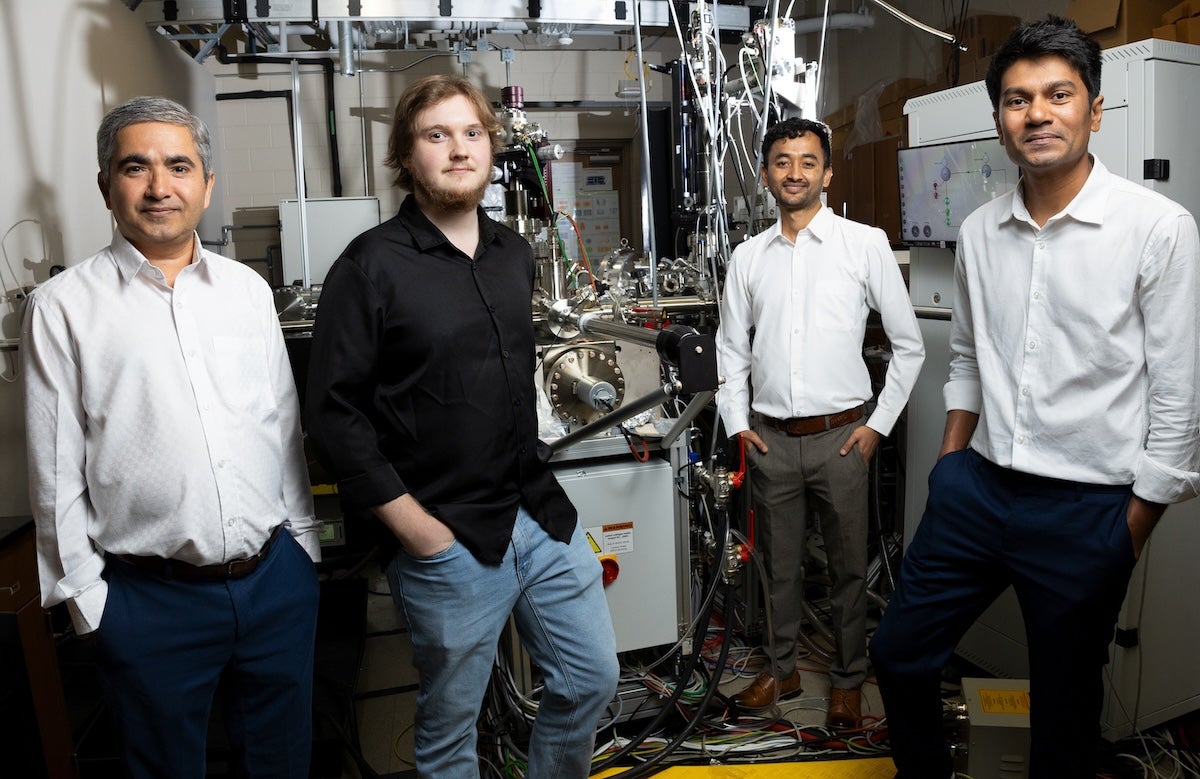
The material is Fe5GeTe2, an iron-germanium-tellurium compound first synthesized about seven years ago. It belongs to the family of van der Waals magnets: crystals built from atomically thin magnetic sheets stacked loosely enough that a single layer can be peeled off, the way graphene is peeled from graphite. The group, led by assistant professor Shuolong Yang with postdoctoral scholars Gabriele Berruto and Qiang Gao, reports the result in Science Advances.
They looked at it with angle-resolved photoemission spectroscopy, or ARPES, which works by firing light at a crystal surface, knocking electrons loose, and measuring the angle and energy of every one that comes off. Reconstructed, those measurements give a direct picture of how electron energy depends on momentum -- the material's band structure. The Chicago setup used an ultraviolet laser focused down to a spot ten micrometers across, small enough to interrogate a single clean patch of a sample rather than averaging over defects.
What appeared in the data was a flat band. Flatness in this context means energy barely changes as momentum changes, and since the slope of that curve is what sets how fast an electron travels, a flat band is a band of very slow electrons. Flat bands are prized because when electrons stop outrunning each other, their mutual repulsion stops being a small correction and starts running the show; that is the regime where superconductivity, magnetism, and exotic correlated states come from. The material also shows charge ordering, with electrons locking into frozen periodic patterns instead of flowing freely.
The surprise was coherence. Collective slow motion usually implies the electrons are getting scrambled by disorder and interactions, and quantum phase information washes out fast. Here it did not. "We're measuring the interaction of thousands or millions of electrons, and they are all moving together in a coherent way," Yang said. The behavior survives up to roughly 100 kelvin -- about 173 degrees Celsius below zero, still deeply cryogenic, but substantially warmer than comparable systems manage. Yang called it "a fundamental discovery that deviates from theoretical predictions."
The device angle follows from the material being magnetic as well as correlated. Distinct magnetic and charge-ordered phases give you distinct states to encode a bit in, and the group is now demonstrating optical switching between those phases using microfocused lasers -- flipping the state with light rather than current, which is where the energy savings would come from. That remains a laboratory result at 100 kelvin, and the honest gap between it and a memory chip is the roughly 200 degrees between there and a warm room.