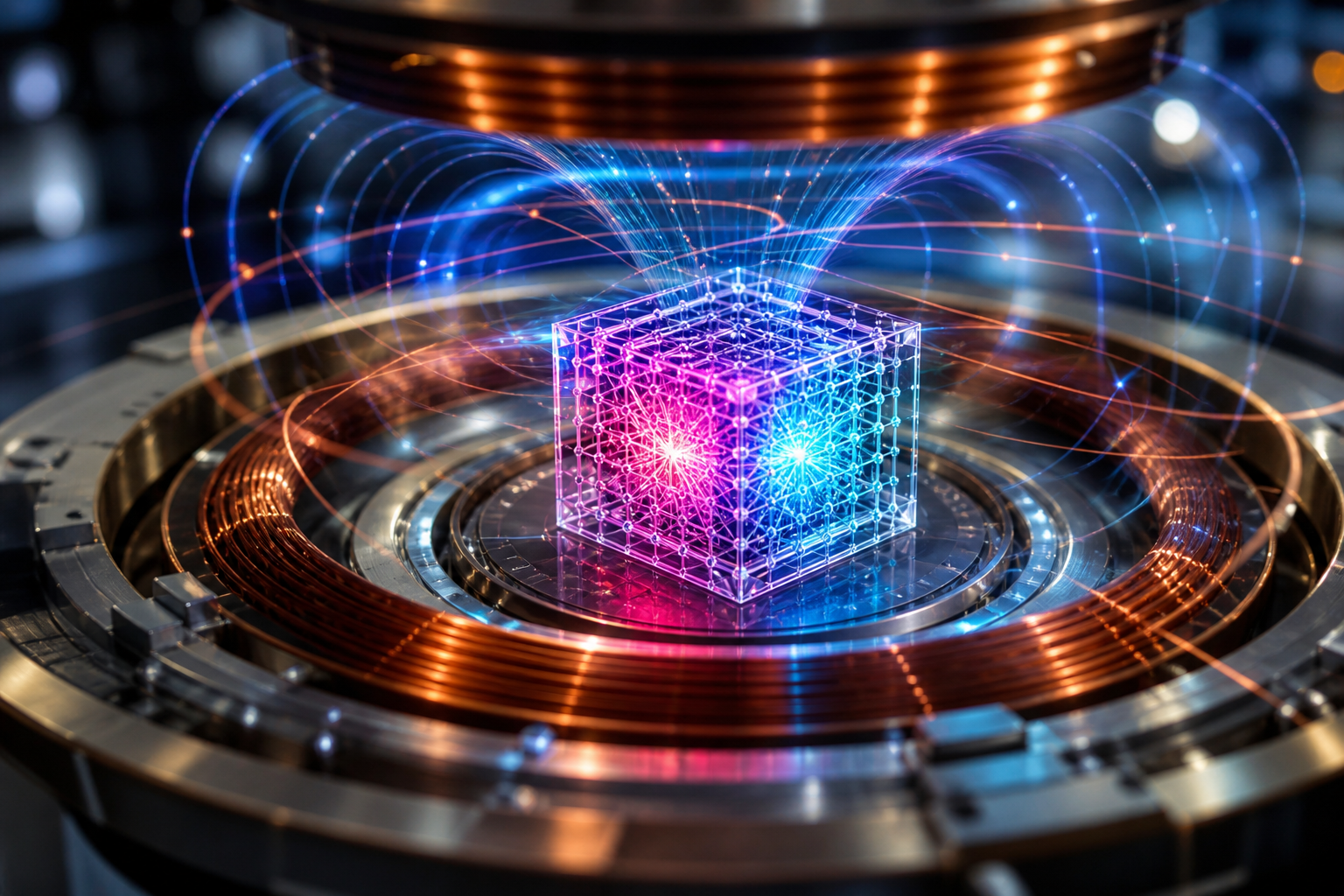
Scientists Create Exotic Matter That Shouldn't Exist Using Time-Controlled Magnetic Fields
Quantum physics breakthrough shows that carefully timing magnetic field changes can unlock entirely new forms of matter with potentially revolutionary applications for quantum computing.

Researchers have successfully created exotic quantum states of matter that don't exist under normal conditions by manipulating magnetic fields over time in precisely controlled patterns. The breakthrough, achieved by Cal Poly Physics Department Lecturer Ian Powell and student researcher Louis Buchalter, demonstrates that the future of quantum technology may depend not just on the materials used, but on how those materials are manipulated through time. Their findings suggest that time-dependent control could be the key to organizing new forms of quantum matter with unprecedented stability and resistance to errors.
The research, published in Physical Review B in a paper titled 'Flux-Switching Floquet Engineering,' shows that when magnetic fields are changed in controlled, time-dependent ways, they can generate quantum states that have no equivalent in static materials. Powell explained that this represents an advance in understanding how time-dependent control can create and organize new forms of quantum matter. The central insight is that useful quantum properties can depend not just on what a material is, but on how it is driven through time.
The team demonstrated that by periodically changing magnetic fields, scientists can produce what they call 'driven quantum phases' that have no static counterpart in nature. This approach offers a new method for designing quantum systems with properties that are more stable and less vulnerable to 'noise' or imperfections—one of the major challenges facing quantum computing technology. These disruptions often lead to errors in quantum calculations or system performance, making stability a critical factor for practical quantum applications.
Beyond creating new quantum states, the research also identified mathematical organizing principles that mirror patterns typically found in higher-dimensional quantum systems. This suggests that relatively simple systems driven by changing conditions could provide new ways to explore more complex quantum physics phenomena. The findings could have direct applications for quantum computing and quantum simulation, potentially contributing to better quantum technologies in the longer term.
While the immediate applications are primarily in research settings such as ultracold-atom experiments, Powell noted that any eventual impact on industries like pharmaceuticals, finance, manufacturing, or aerospace would likely be indirect, through contributing to the longer-term development of improved quantum technologies. The next steps toward industry use would require experimental validation and further work connecting these theoretical ideas to realistic quantum-device platforms that could be deployed in practical applications.