Cal Poly Duo Show Switching Magnetic Flux Can Drive Matter Into Exotic Quantum Phases That Don't Exist Statically
Ian Powell and undergraduate-turned-coauthor Louis Buchalter introduce "flux-switching Floquet engineering" in Physical Review B — a comparatively forgiving recipe for error-resistant topological qubits.
SAN LUIS OBISPO, Calif. — Two physicists at California Polytechnic State University have shown that switching a magnetic field between discrete values, rather than turning it smoothly up or down, can drive ordinary matter into exotic quantum phases that simply do not exist in any static material. The work, published in Physical Review B, lays out a new paradigm — "flux-switching Floquet engineering" — that the authors say could yield error-resistant quantum computing platforms and a route to materials that mimic higher-dimensional physics inside an ordinary lab.
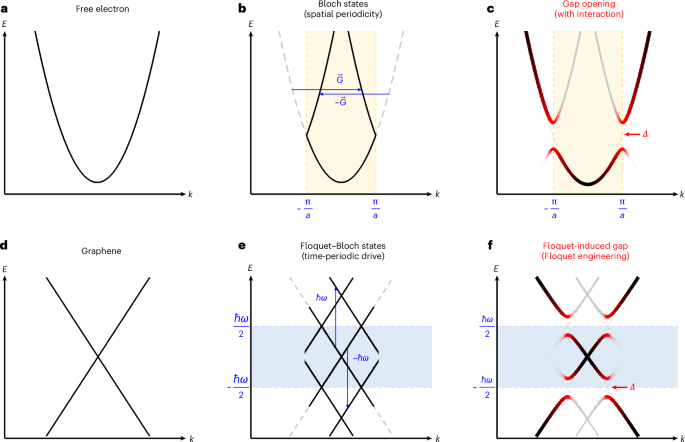
The paper, titled "Flux-Switching Floquet Engineering," was authored by Cal Poly physics lecturer Ian Powell and his former undergraduate student Louis Buchalter, who earned a bachelor's degree in physics from the university in 2025. It builds on a half-century-old workhorse of condensed-matter theory called the Harper-Hofstadter model, which describes electrons hopping on a two-dimensional square lattice in the presence of a perpendicular magnetic field. When the magnetic flux through each unit cell takes a rational value, the electrons settle into a famous fractal structure of energy bands — the Hofstadter butterfly. Powell and Buchalter asked a different question: what happens if the flux is forced to switch back and forth in time between two such rational values?
The answer, the authors found, is that the lattice's quasi-energy spectrum fragments into a far richer collection of magnetic subbands, with a topological phase diagram more elaborate than anything seen in the static Hofstadter model. "Periodically changing a magnetic field can produce driven quantum phases with no static counterpart," Powell wrote. The new phases inherit the protective topology that makes Floquet topological insulators so attractive to quantum-computing engineers — the wavefunctions are robust against local disorder — but they also display a new kind of self-similarity tied to the switching cycle itself, which the authors describe as a fingerprint of effectively higher-dimensional behavior.
The paper's most provocative claim is that flux-switching matter could materially reduce the error rate of certain proposed topological qubits. Today's prototype quantum computers, including those at Google, IBM and Microsoft, struggle with decoherence: stray noise scrambles the quantum information they encode. Topological phases, in which information is stored non-locally in the geometry of the system, are widely regarded as the most plausible long-term solution, but they are notoriously hard to engineer. Powell argues that flux switching is comparatively forgiving of imperfections — turning the magnetic flux on and off at the right cadence is, by his estimate, several orders of magnitude easier than maintaining the exotic spin-orbit textures required by the leading static proposals.
The team has not yet built such a system in a real material. Their result is a numerical and analytical demonstration that the phases exist, are stable, and have computable signatures. But Powell said the experimental ingredients — cold atoms in optical lattices, or arrays of superconducting qubits — are already available in laboratories at JILA in Boulder, the Max Planck Institute in Munich, and Princeton, all of which his group is now in conversation with.
Independent reviewers said the work is technically rigorous and timely. "The interesting thing here is the simplicity," said Mohammad Hafezi of the University of Maryland, who has worked on Floquet engineering for over a decade and was not involved in the Cal Poly paper. "They are saying you don't need elaborate driving protocols. A two-state square wave in the flux is enough." The longer-term promise — quantum simulation of physics in four or more dimensions, on a tabletop — is harder to assess. But the paper has already drawn attention from defense and energy agencies funding the next round of U.S. quantum-information research, and Powell, who is in early-career status, said his lab has begun a follow-on collaboration with a national laboratory he declined to name pending publication.