Ninety Americans Are Among the Missing in Nepal. The Recovered Death Toll Passed 680 on Friday
A collapsing Himalayan glacier dumped more than 100 million cubic meters of ice and rock into the Trishuli valley. Three days later, Nepali police are still counting.
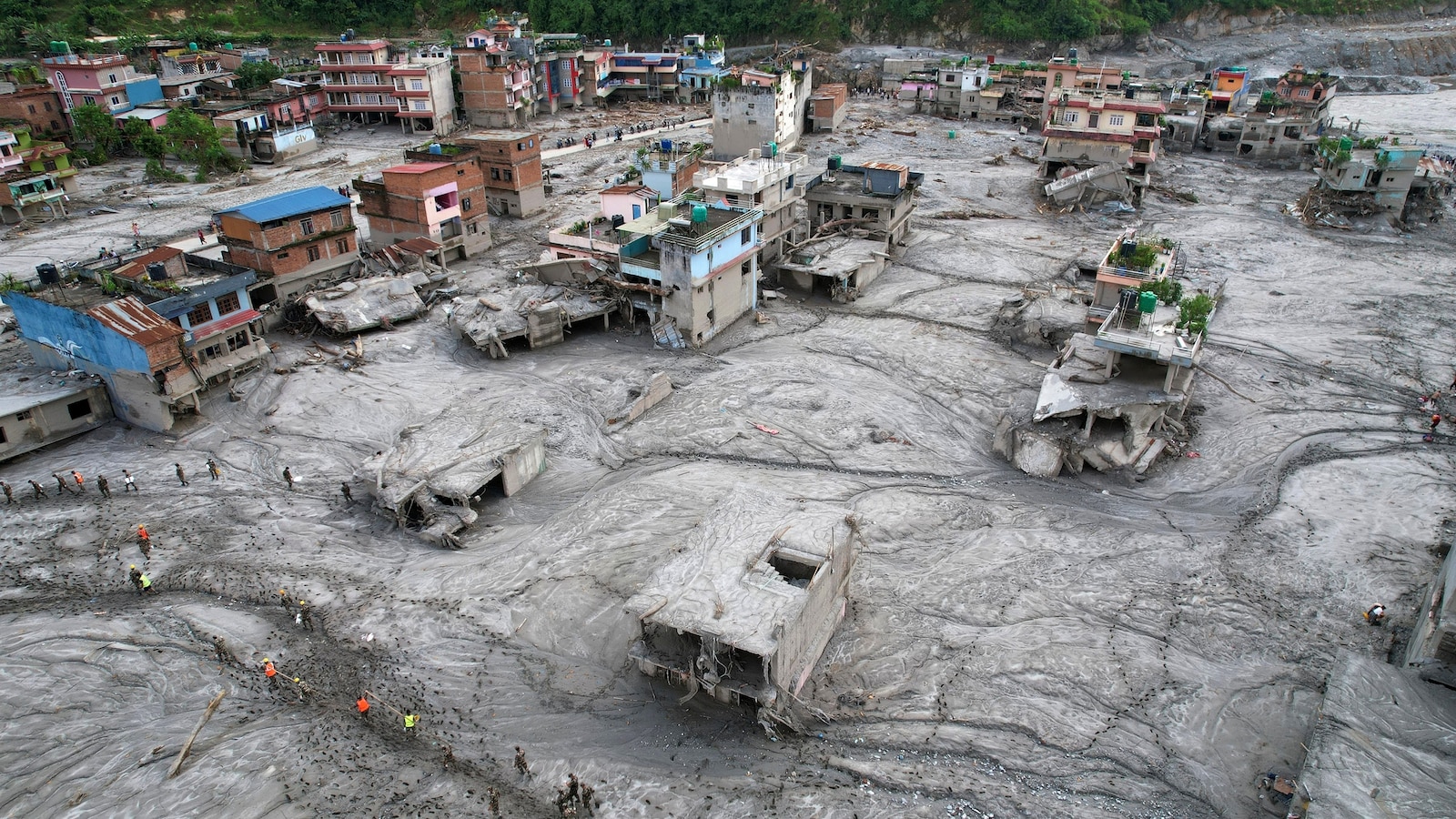
Ninety American citizens were unaccounted for in Nepal as of Friday, a State Department spokesperson said, three days after a collapsing Himalayan glacier sent a wall of ice, rock and water down the Trishuli River valley and erased villages along the Nepal-Tibet border.
The recovered death toll reached 682 on Friday — 675 in Nepal and seven across the border in Tibet. Nepali authorities listed 2,498 people as missing. Chinese state media put the number missing on the Tibetan side at 554. Taken together, more than 3,000 people remain unaccounted for in a disaster that was, until Wednesday morning, a normal end to the monsoon season.
The trigger was a landslide roughly 12 miles northeast of the Rasuwagadhi border crossing, at about 8:40 a.m. local time on Wednesday. The U.S. Geological Survey estimated that more than 100 million cubic meters of ice, rock and debris were displaced. A geophysicist reviewing satellite imagery said the slide sheared away a large glacier, or a substantial part of one, from a cliff face roughly 16,000 feet up, and that the debris fell some 6,000 feet before it reached the river. From there it had a clear run downhill.
The destruction extends at least 62 miles downriver from the border, through the districts of Rasuwa, Nuwakot, Chitwan and Nawalparasi. Nepali authorities said 7,514 people had been rescued, including 227 foreign nationals, and that 219 injured people had been treated or discharged. Five Americans have been evacuated. The State Department has pledged $3.6 million in humanitarian assistance and said in a statement that "there is no higher priority for us than the safety of American citizens."
Asked about the disaster this week, President Donald Trump said, "That's a terrible thing. No, we are sending aid."
The identification problem is now the hard part. Bodies have been pulled from silt and debris miles from where the people were last seen, and Nepali officials have said that remains which cannot be identified will be held by the government after DNA and other evidence is preserved. That process, in a country where forensic capacity is thin and the affected districts are reachable mainly by helicopter, will take months.
The scale of the American presence reflects the calendar. Late August is the front edge of Nepal's autumn trekking season, when the Langtang and Manaslu circuits fill with foreign hikers, and the Rasuwagadhi corridor is one of the main overland routes between Kathmandu and Tibet. Beijing's Ministry of Foreign Affairs said 100 Chinese nationals were among those missing inside Nepal.
Glacial collapses of this kind are not new to the Himalaya — a similar failure killed roughly 200 people in India's Chamoli district in 2021 — but the volume displaced on Wednesday is far larger, and it landed on a valley that had been developed for hydropower and cross-border trade. Search teams were still working the riverbanks on Saturday.