NC State Engineers Transmit Radio Waves From a Laser-Made 'Lightsaber' Antenna of Ionized Air
A laser-ionized column of air carried a 30 MHz VHF signal with no physical feed. The team says the antenna can be tuned and steered, though receiving signals is not yet demonstrated.

Engineers at North Carolina State University have used a laser to turn a thin column of air into a working radio antenna, and say the glowing beam resembles a lightsaber.
The team transmitted radio waves at 30 megahertz, in the very high frequency band, from a plasma filament created by firing a laser through the air. The work, titled "Laser-Induced-Plasma-Filament Antenna Transmitting 30 MHz VHF," appeared in the IEEE Journal of Microwaves (DOI 10.1109/jmw.2026.3722433). The authors are Prya Darshni, Paul Franzon and Arthur Dogariu, with contributions from Texas A&M University and Princeton University.
Plasma, a gas whose atoms have been stripped of electrons, conducts electricity. A laser with the right power and beam diameter can ionize air along a narrow path, producing a filament that behaves like a conductor. The researchers used that filament in place of a metal rod.
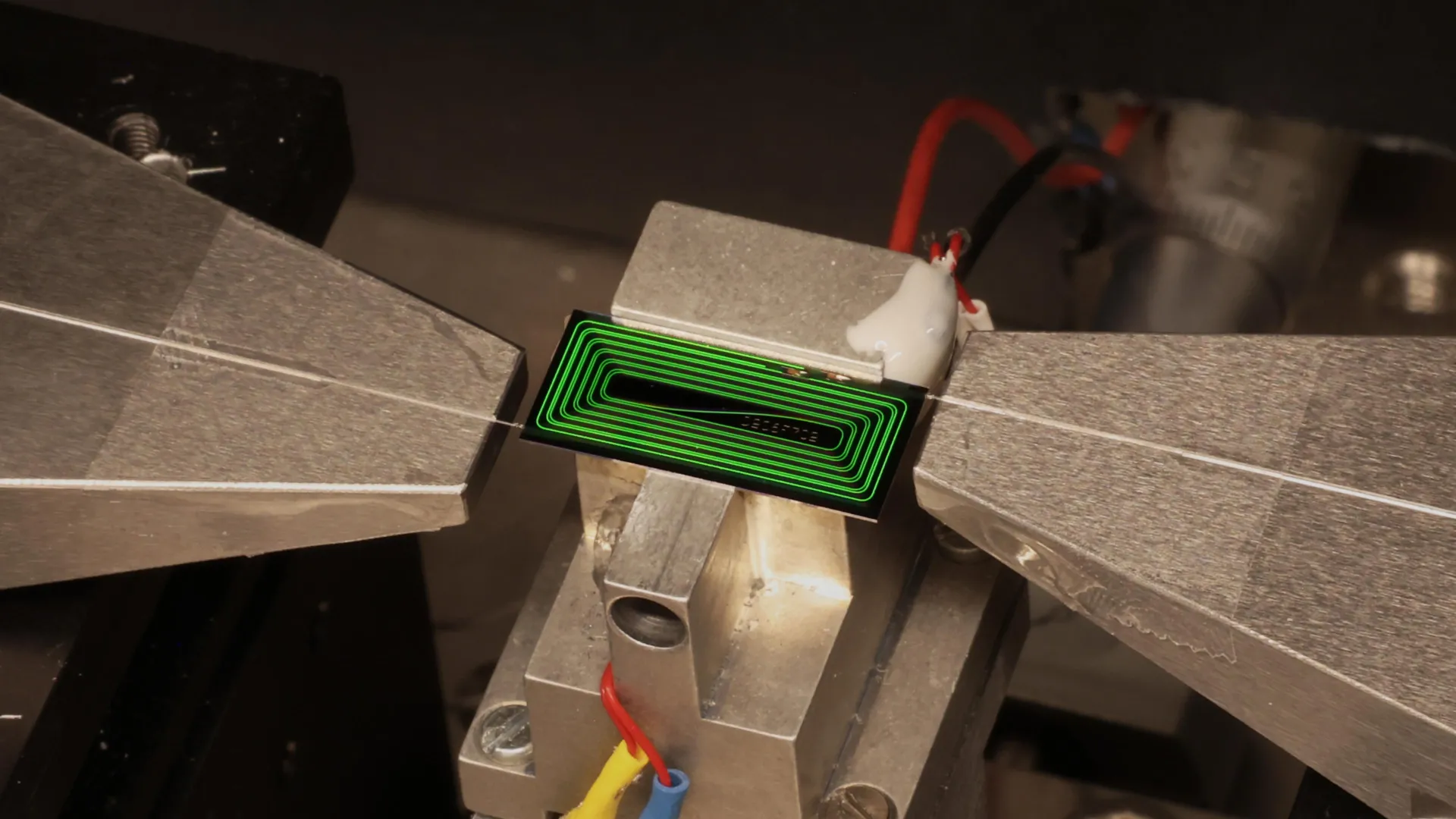
The antenna is fed without any wire touching it. A metal ring capacitor surrounds the laser path and generates an electromagnetic field that couples to the plasma. The radio-frequency signal flows through the ring and drives the filament, so there is no mechanical connection between the antenna and the radio equipment.
The design offers two advantages that metal antennas lack. The antenna's length depends on the laser settings, so it can be adjusted to work across a wide range of frequencies. And it can be pointed by changing the direction of the laser, which allows beam steering with no moving metal parts.
"The plasma beam antenna looks like a lightsaber and is tunable, meaning we should be able to transmit across a broad range of frequencies," Darshni said. Franzon said the approach enables customized antenna design without complex mechanical deployment mechanisms.
Very high frequency radio covers 30 to 300 megahertz and carries broadcast radio, aviation communication and many satellite links, so the demonstration sits at the bottom of a heavily used band. Ordinary antennas for those wavelengths are long, which makes them awkward to carry into space.
The researchers see uses on satellites and spacecraft in low Earth orbit, where frequency scanning and low payload weight are valuable. A conventional antenna that unfolds in orbit adds mass and moving parts, while a laser-based one would not.
There are limits. The experiment demonstrated transmission only, and the ability to receive signals has not been shown, though the team says it sees no theoretical barrier. The demonstration was at a single frequency in the VHF band, and the power needed to keep the plasma lit has to be weighed against the savings in hardware.