Breakthrough Crystal Acts Like Metal and Glass Simultaneously, Could Enable Smart Contact Lenses
Scientists map optical properties of molybdenum oxychloride, revealing strongest light-bending effect ever measured in natural material.
Researchers have achieved a major breakthrough in optical materials science by creating the first detailed experimental map of molybdenum oxychloride (MoOCl2), a remarkable crystal that can simultaneously behave like both a reflective metal and transparent glass. The layered crystal exhibits the strongest light-bending effect ever measured in a natural material, with potential applications ranging from smart contact lenses to ultrathin augmented reality glasses. The findings represent a significant step toward miniaturizing optical components that currently require bulky lenses and hardware.
The research team from XPANCEO, working with scientists from the National University of Singapore and the University of Chemistry and Technology in Prague, published their findings in Nano Letters. Their study reveals that MoOCl2 acts as an optical "chameleon" whose properties change dramatically depending on orientation. When positioned one way, the crystal reflects light like a metal surface, but rotating it by 90 degrees makes it transparent like glass. This unusual characteristic stems from its extreme optical anisotropy, where properties vary dramatically depending on direction.
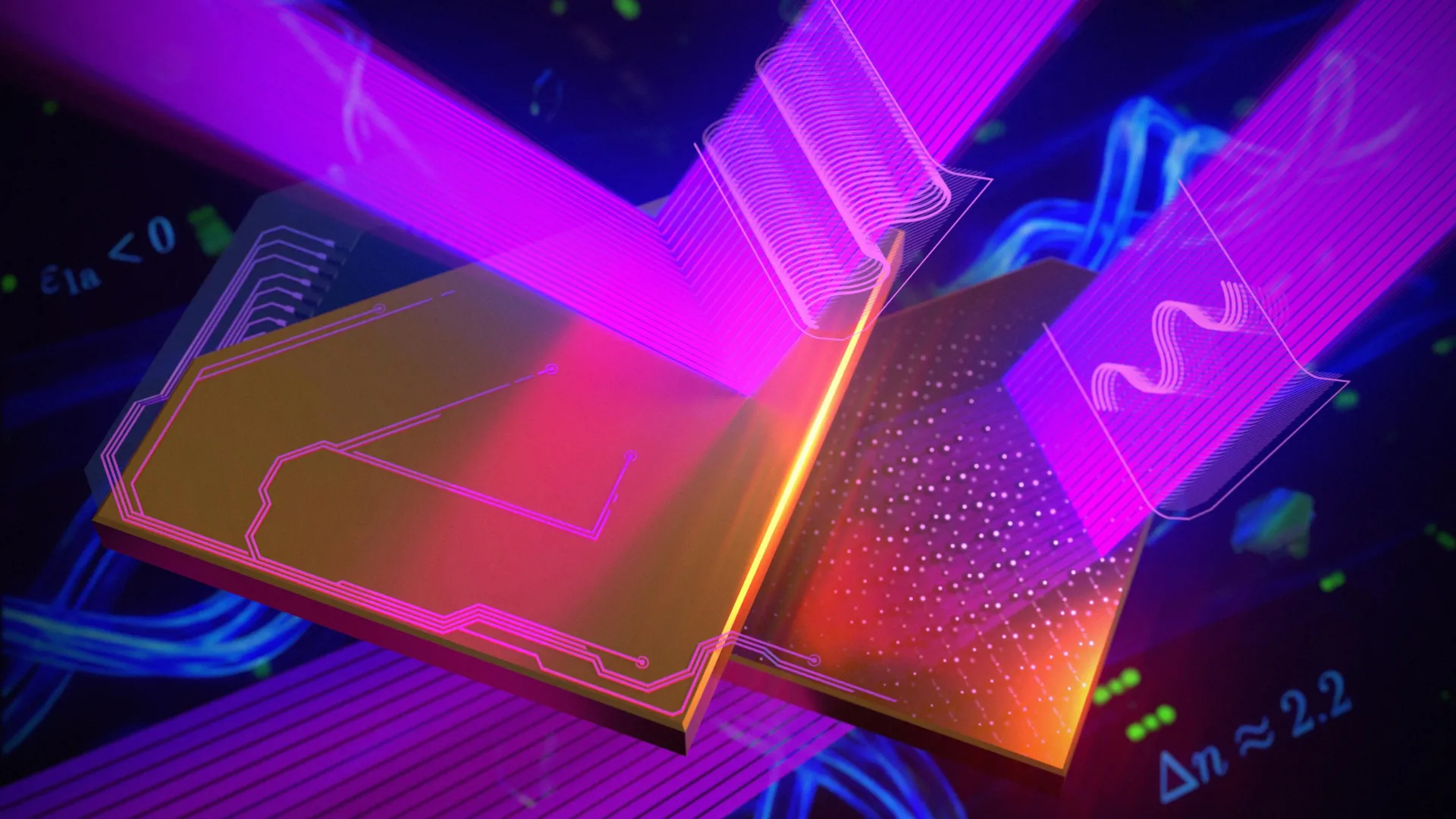
The crystal demonstrates an in-plane birefringence value of approximately 2.2, allowing it to split and bend light with exceptional efficiency while being thousands of times thinner than a human hair. For companies like XPANCEO developing next-generation wearable technologies, this could enable sophisticated light control needed for AR displays using materials far thinner than current optical components. The researchers also identified a rare epsilon-near-zero point at 512 nanometers in green light, where part of the material's optical response falls almost to zero.
At the epsilon-near-zero point, light effectively slows down while the electric field inside the crystal becomes stronger, significantly enhancing interactions between light and matter. This combination could prove especially valuable for integrated photonic chips, potentially enabling faster data processing while using much less power. The enhanced light-matter interactions may also open new possibilities for quantum computing applications and advanced sensing technologies.
Physicists have been studying MoOCl2 for several years because of its unusual electronic structure as a "bad metal" containing one-dimensional chains of molybdenum atoms. These chains allow electrons to move more easily in one direction than another, creating the material's exceptionally strong anisotropy. Previous studies published in Science and Nature Communications had already observed tightly confined light waves called hyperbolic plasmon polaritons traveling through the material, but this new research provides the first comprehensive mapping of its practical optical properties for future technological applications.