Strange Crystal Discovered That Acts Like Metal and Glass Simultaneously
Molybdenum oxychloride exhibits strongest light-bending effect ever measured in natural material, potentially enabling invisible wearable technologies.
Researchers have identified a remarkable crystal that could revolutionize the development of nearly invisible technologies like smart contact lenses and ultrathin augmented reality glasses. Molybdenum oxychloride (MoOCl2) exhibits unprecedented optical properties, including the strongest light-bending effect ever measured in a natural material, while being thousands of times thinner than a human hair.
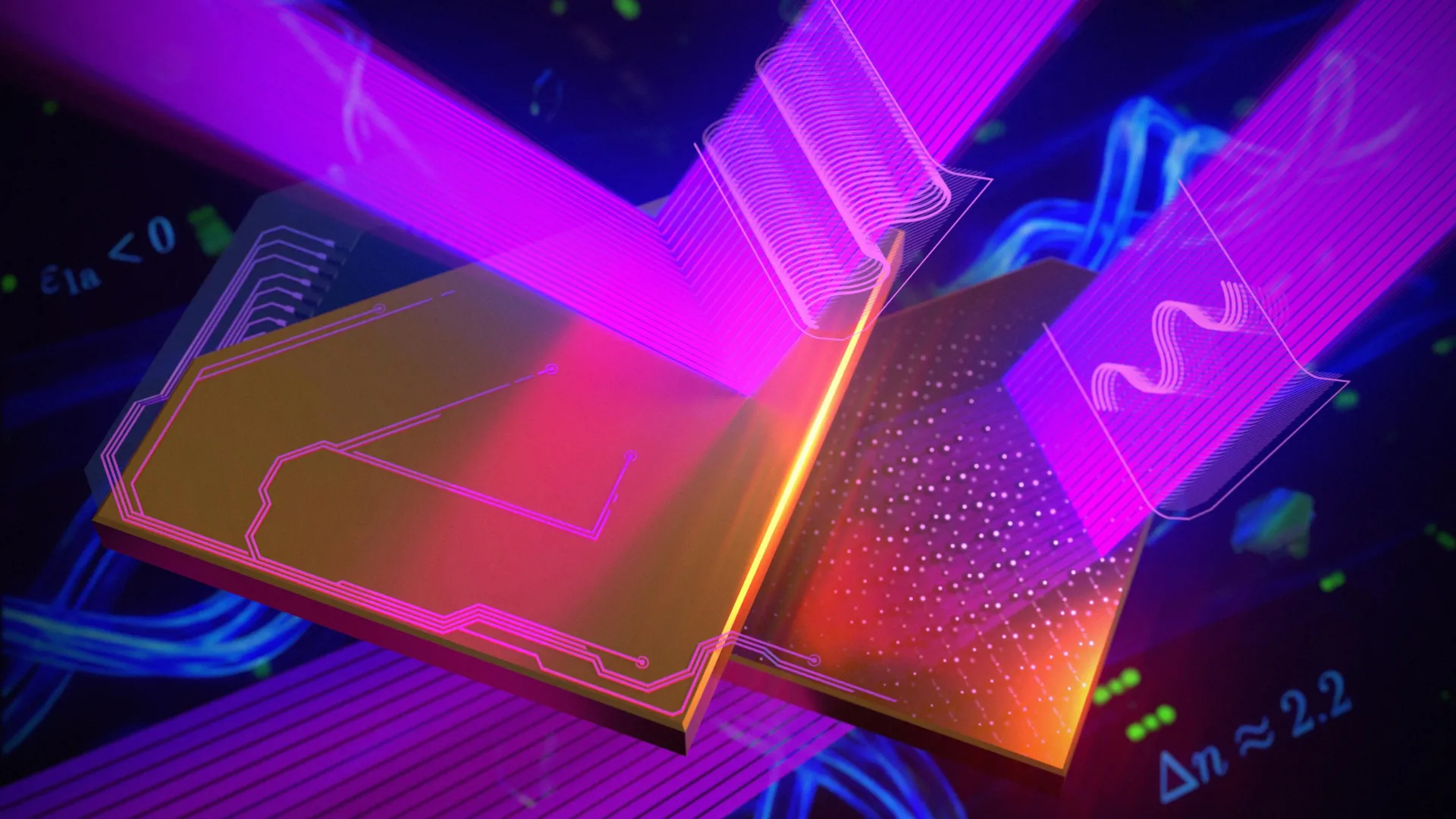
The crystal functions as an optical "chameleon," dramatically changing its behavior depending on orientation. When positioned one way, it reflects light like a metal surface. Rotate it 90 degrees, and it becomes transparent like glass. This extraordinary characteristic stems from its extreme optical anisotropy, meaning its properties vary drastically depending on direction. The material also demonstrates an in-plane birefringence value of approximately 2.2, enabling it to split and bend light with exceptional efficiency.
A team from XPANCEO, collaborating with scientists from the National University of Singapore and the University of Chemistry and Technology in Prague, conducted the first comprehensive experimental mapping of the crystal's optical behavior. Their findings, published in Nano Letters, reveal capabilities that could enable sophisticated light control using materials dramatically smaller than current optical components.
The researchers also discovered a rare epsilon-near-zero point at 512 nanometers (green light), where part of the material's optical response falls almost to zero. At this point, light effectively slows down while the electric field inside the crystal becomes stronger, significantly enhancing interactions between light and matter. This effect could prove especially valuable for integrated photonic chips, potentially enabling faster data processing with much lower power consumption.
Molybdenum oxychloride's unique properties arise from its unusual electronic structure as a "bad metal" containing one-dimensional chains of molybdenum atoms. These chains allow electrons to move more easily in one direction than another, creating the material's exceptionally strong anisotropy. The discovery could accelerate development of next-generation optical devices that manipulate light at the atomic scale, bringing science fiction concepts like truly invisible wearable technology closer to reality.