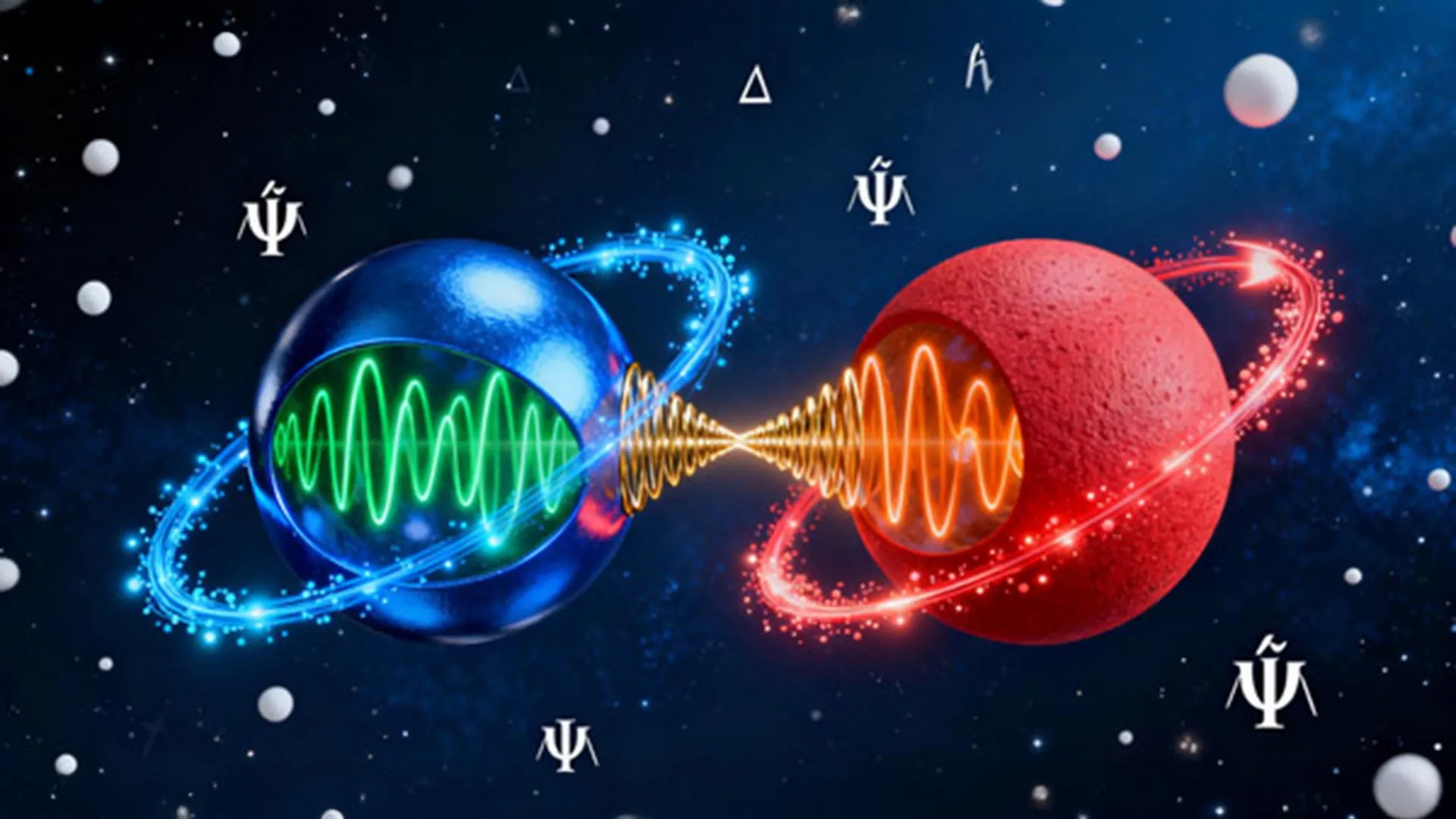
Two Plastic Beads in Water Broke Newton's Third Law — and 10,000 of Them Kept Moving for an Hour
Tokyo physicists put differently sized colloidal spheres in an electric field. The big ones pulled on the small ones harder than the small ones pulled back, and the whole suspension refused to settle.

Newton's third law says that when one object pulls on another, the second pulls back just as hard. It is one of the safest statements in physics — for objects in isolation. Put two particles in a fluid and drive that fluid with an external field, and the guarantee quietly disappears, because the force one particle feels is now mediated by flow rather than transmitted directly. Researchers at Tokyo University of Science have built a system that exploits exactly that loophole, and reported it in Physical Review Letters on August 6.
The setup is unglamorous. Polystyrene colloidal spheres — two sizes, with radii of 1 and 1.5 micrometers — suspended in water between two electrodes coated in indium tin oxide. Switch on an alternating electric field and each particle generates an electrohydrodynamic flow in the water around it, a circulating current that drags neighboring particles inward. The critical detail is that the strength of that flow scales with the particle's size.
So a 1.5-micrometer sphere pulls on a 1-micrometer sphere harder than the small one pulls back. The attraction is unbalanced — nonreciprocal, in the field's term — and an unbalanced pair of forces on a bound pair does not cancel. It produces net thrust. The mismatched pairs become self-propelled, swimming through the water on nothing but the asymmetry of their own mutual attraction. No motor, no chemical fuel, no internal machinery: the propulsion comes from the size difference.
What those swimmers then do collectively is the more striking part. In a suspension of particles that were all the same size, the physics stayed symmetric and the outcome was the textbook one — particles attracted each other and settled into a static crystalline aggregate. In the mixed suspension, with more than 10,000 particles, nothing settled. The self-propelled pairs gathered into clusters that repeatedly broke apart and reassembled, and the system sustained that churn for over an hour without ever reaching equilibrium.
"Particles that attract each other generally continue to gather over time," said Professor Yutaka Sumino, who led the work with Assistant Professor Kiwamu Yoshii in the Department of Applied Physics at Tokyo University of Science. "However, colloidal particles under an electric field exhibit unexpected behavior: They attract each other but do not form huge clumps." The team included Shoma Hara, a second-year master's student, along with Keisuke Kittaka, Hiroaki Ishikawa and Masazumi Okada.
That refusal to clump is what makes the result useful rather than merely curious. Living matter has the same signature — cell tissues, bacterial colonies and cytoskeletal networks all hold themselves in states that are structured but never static, which is what lets them reorganize on demand. Reproducing it here required no biology and no complexity, just two bead sizes and a voltage.
The applications the authors point to follow from the control knobs. Because the behavior depends on the size ratio and on the applied field, both are adjustable from outside the sample: change the field and the collective state changes with it. That is the basic requirement for programmable materials that reconfigure on command, and for swarms of microrobots that assemble and disperse under external direction without any of them carrying a controller.
Newton's third law is not actually violated here, and the authors do not claim it is. Momentum is conserved once the water is counted as part of the system. But for anyone tracking only the particles — which is what a materials scientist designing a microscopic swarm actually cares about — action and reaction have come unstuck, and the machinery built on that asymmetry works.