North Korea Fired Two Short-Range Ballistic Missiles From Wonsan on Sunday, Three Hours Apart, One Flying 280 Miles and the Other More Than 370. It Came Days After Pyongyang Rejected a U.N. Resolution on Its Nuclear Program and Weeks After Trump Scaled Back a Drill With Seoul to Woo Kim.
Kim Yo Jong called a six-nation 'Pacific Vanguard' naval exercise a 'frantic military move' and said there will be 'never ever change in the course of intensifying the nuclear war deterrence.' U.S. Pacific Command said the launches pose no immediate threat.
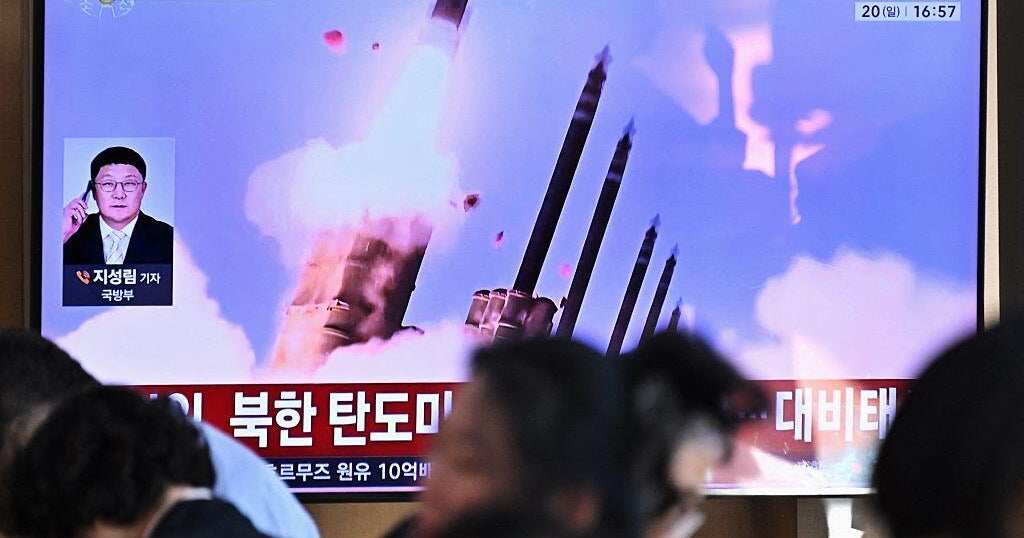
North Korea launched two short-range ballistic missiles into the sea off its east coast on Sunday, South Korea's military said, the latest in a run of weapons tests that has continued even as President Trump has tried to coax Kim Jong Un back to the table by trimming joint exercises with Seoul.
The two missiles were fired about three hours apart from the Wonsan area on the North's eastern coast. The first flew roughly 280 miles and the second more than 370 miles, both landing in the waters between the Korean Peninsula and Japan, according to South Korea's Joint Chiefs of Staff. "South Korean and U.S. authorities are conducting a detailed analysis to determine its exact specifications," the Joint Chiefs said of the second missile. Japan's Defense Ministry said it detected a suspected North Korean missile earlier in the day and that it did not land in Japanese territorial waters.
U.S. Pacific Command said it was aware of the launches and is "consulting closely with our allies and partners." "Based on current assessments, these events do not pose an immediate threat to U.S. personnel or territory, or to our allies," the command said in a post on X. "The United States remains committed to the defense of the U.S. homeland and our allies in the region." South Korea's presidential office urged the North to halt ballistic missile launches, which are banned under U.N. Security Council resolutions, and the South's military said it maintains readiness to repel any provocation under its alliance with Washington.
The launches came days after Pyongyang reasserted its status as a nuclear-armed state and rejected a United Nations resolution demanding it halt its nuclear activities. They also followed a pattern that has held all summer: Trump scaled back a joint U.S.-South Korean military exercise last month in what was widely read as an overture to Kim, and North Korea answered by firing anyway. Kim Yo Jong, the leader's sister and a senior official, dismissed the gesture at the time, saying a shorter drill did not change its "provocative, aggressive nature." The North's military then launched about 10 short-range ballistic missiles toward the sea, following through on an earlier threat to respond to the exercise.
On Friday, Kim Yo Jong turned to another target, the U.S.-led "Pacific Vanguard" maritime exercise that brought together the United States, South Korea, Japan, Australia, New Zealand and Canada. She called it a "frantic military move" by the Americans meant to prolong their hegemony in the Asia-Pacific, and said "regular U.S.-led war rehearsals" are the main source of tension on the peninsula. "Our will to defend our sovereignty will be expressed in clearer action and there will be never ever change in the course of intensifying the nuclear war deterrence," she said.
Earlier this month, North Korea held what it described as a joint live-fire drill involving missiles, artillery and drones, one day after the United States, South Korea and Japan wrapped up a five-day trilateral exercise the North called a provocation. Pyongyang said its drill fired different types of weapons simultaneously, which analysts read as practice for saturating South Korean and American air defenses with mixed salvos.
The pattern leaves Washington with an awkward ledger. Trump has offered concessions on exercises to revive the personal diplomacy of his first term, and Pyongyang has pocketed them while continuing to test, refusing to talk and hardening its language on the nuclear arsenal. Sunday's two launches were modest by North Korean standards, but they were a reminder that the North's answer to an olive branch has, so far, been a missile.
Originally reported by CBS News.