Webb Telescope Peers Into a 'Moon Factory' Around a Distant Giant Planet
For the first time, astronomers measured the chemistry of a moon-forming disc circling the exoplanet CT Cha b, finding it rich in carbon-bearing molecules like benzene and acetylene.
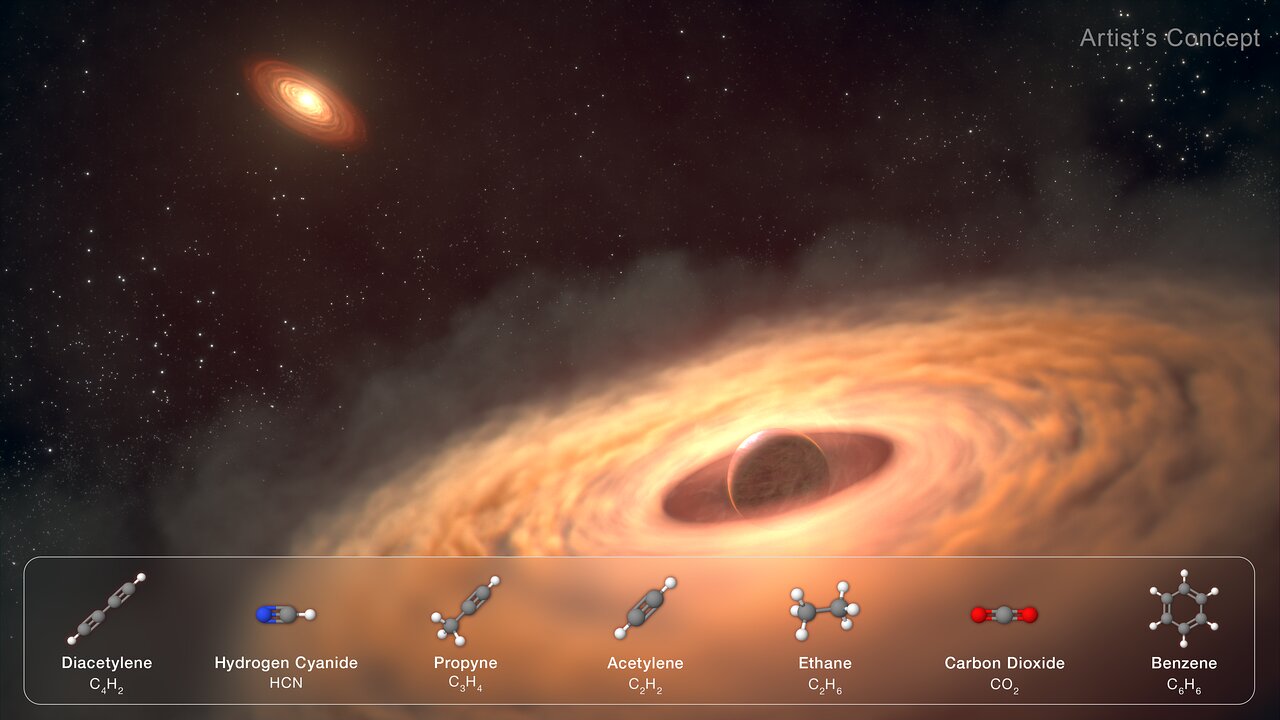
Astronomers using the James Webb Space Telescope have captured the first direct measurements of the chemistry inside a disc of material swirling around a giant planet far beyond our solar system — a possible "construction yard" where moons may one day take shape.
The disc surrounds an exoplanet called CT Cha b, located about 625 light-years from Earth. Such circumplanetary discs are thought to be the birthplaces of moons, much as the larger discs around young stars give rise to planets. But until now, scientists had never been able to probe the detailed makeup of one. Webb's exquisite sensitivity in the infrared changed that, letting researchers read the molecular fingerprints embedded in the disc's faint glow.
What they found was a strikingly carbon-rich environment. The team identified seven carbon-bearing molecules within the disc, including acetylene and benzene, along with diacetylene, hydrogen cyanide, propyne, ethane and carbon dioxide. Together, those compounds represent the raw chemical inventory from which moons — and the building blocks of more complex chemistry — could assemble.
The system is extraordinarily young. The central star, CT Cha, is only about two million years old and is still actively pulling in surrounding material, a snapshot of planet and moon formation caught in the act. Crucially, the researchers determined that the planet's moon-forming disc is distinct from the broad disc encircling the star itself. The two structures are separated by some 74 billion kilometers, confirming that Webb was peering at material bound to the planet rather than to its host star.
No moons have actually been spotted in the data — the disc is a potential nursery, not a confirmed one. But the observation offers a rare window into the conditions under which natural satellites are born. Studying CT Cha b's disc could help explain how the major moons of our own solar system's gas giants, such as the large satellites orbiting Jupiter, came together billions of years ago.
Detecting such a faint structure so close to the glare of its parent planet is itself a technical feat. The disc's spectral signature is buried in light from the planet and the nearby young star, and separating it required the kind of infrared precision that earlier observatories could not deliver. That capability is what allowed the team to not merely glimpse the disc but to inventory the specific molecules within it.
The result underscores how Webb is steadily transforming the study of how worlds and their companions form. By resolving the chemistry of an individual planet's surroundings light-years away, astronomers can begin to test theories of moon formation against real systems rather than models alone — and to ask whether the ingredients for moons, and perhaps for the chemistry that precedes life, are common around newborn planets across the galaxy.