Webb Peers Through the Dust of the 'Cigar Galaxy' and Counts 16.5 Million Stars
In 65 hours of infrared observations, NASA's James Webb Space Telescope resolved the frenetic starburst galaxy Messier 82 in unprecedented detail, exposing a warped disk and millions of individual suns.
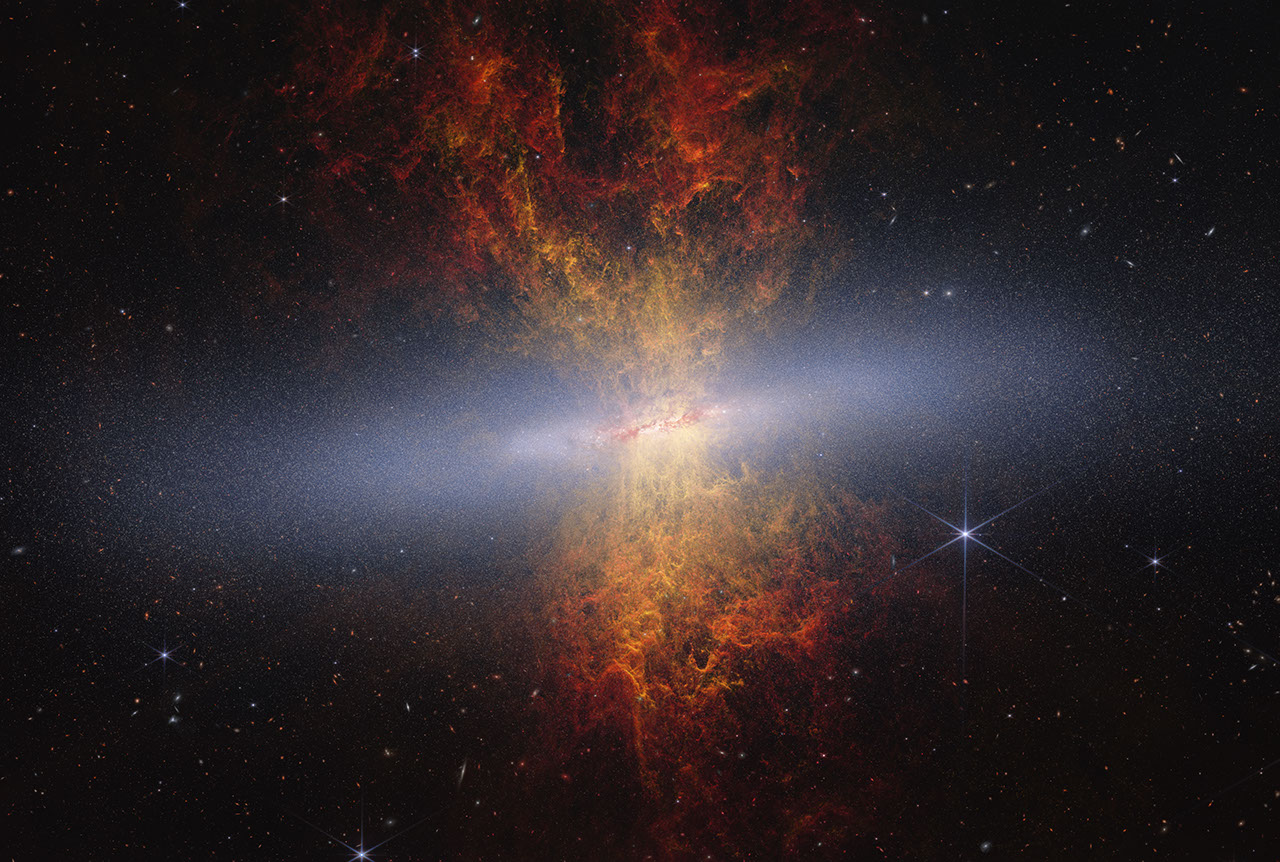
NASA's James Webb Space Telescope has turned its infrared eye on one of the most frenetic galaxies in the nearby universe, resolving the edge-on starburst galaxy Messier 82 — better known as the Cigar Galaxy — in extraordinary new detail. Peering through the thick veils of dust that have long obscured the galaxy's interior, Webb pinpointed roughly 16.5 million individual stars, a feat no previous observatory has managed.
Located about 12 million light-years from Earth, M82 is a scientific curiosity. Seen edge-on and blazing with rapid star formation, it churns out new stars at a furious pace, making it one of astronomers' favorite laboratories for studying how galaxies build themselves. But that same intense activity generates enormous clouds of dust that block visible light, hiding much of the action from telescopes like Hubble. Infrared light, which slips through dust far more easily, offered a way in.
The new imaging campaign was ambitious: a total of 65 hours of observation time with Webb's Near-Infrared Camera, or NIRCam. That long exposure, combined with the telescope's sensitivity, allowed astronomers to see features never before glimpsed, including the galaxy's distended, warped disk structure and its millions of resolved individual stars. Where earlier images showed a smooth, glowing haze, Webb reveals a teeming metropolis of suns.
Studying M82's stellar population at this resolution lets scientists trace the galaxy's evolutionary history and probe the physics of extreme star formation — processes that are usually buried beneath dust in more distant systems. By cataloging where stars of different ages and masses sit within the galaxy, researchers can reconstruct how the starburst ignited and how it is reshaping M82 from the inside out, insights that bear on how galaxies across the cosmos grow and change.
The observations also serve as a striking demonstration of Webb's core strength. While Hubble has imaged M82 many times in visible light, only Webb's infrared vision could pierce the dust to expose the galaxy's hidden architecture, and mission scientists paired the two views to highlight just how much detail the newer telescope adds. Since beginning science operations, Webb has repeatedly transformed familiar objects into fresh discoveries, and the Cigar Galaxy is the latest reminder that even well-studied corners of the sky still hold surprises waiting in the dark.
Starburst galaxies like M82 are prized by astronomers because they compress into a small region the same violent star-forming processes that shaped galaxies throughout cosmic history. The furious birth of massive, short-lived stars drives powerful galactic winds that blast gas and dust thousands of light-years out of the disk, and earlier Webb observations traced those outflows as glowing tendrils streaming from the galaxy's core. The new stellar census complements that picture, giving researchers a way to connect M82's newly revealed population of individual stars to the dramatic winds its starburst unleashes.