Webb Maps Bizarre Weather on a Hot Jupiter: Sandy Mornings, Clear Evenings
On the scorching exoplanet WASP-94A b, the James Webb Space Telescope found thick clouds of vaporized rock at dawn that vanish by sunset — a finding that may upend a decade of exoplanet measurements.

Astronomers using the James Webb Space Telescope have charted the daily weather on a distant alien world for the first time, and the forecast is strange: thick clouds of vaporized rock blanket the planet's morning skies, only to evaporate into clear air by evening.
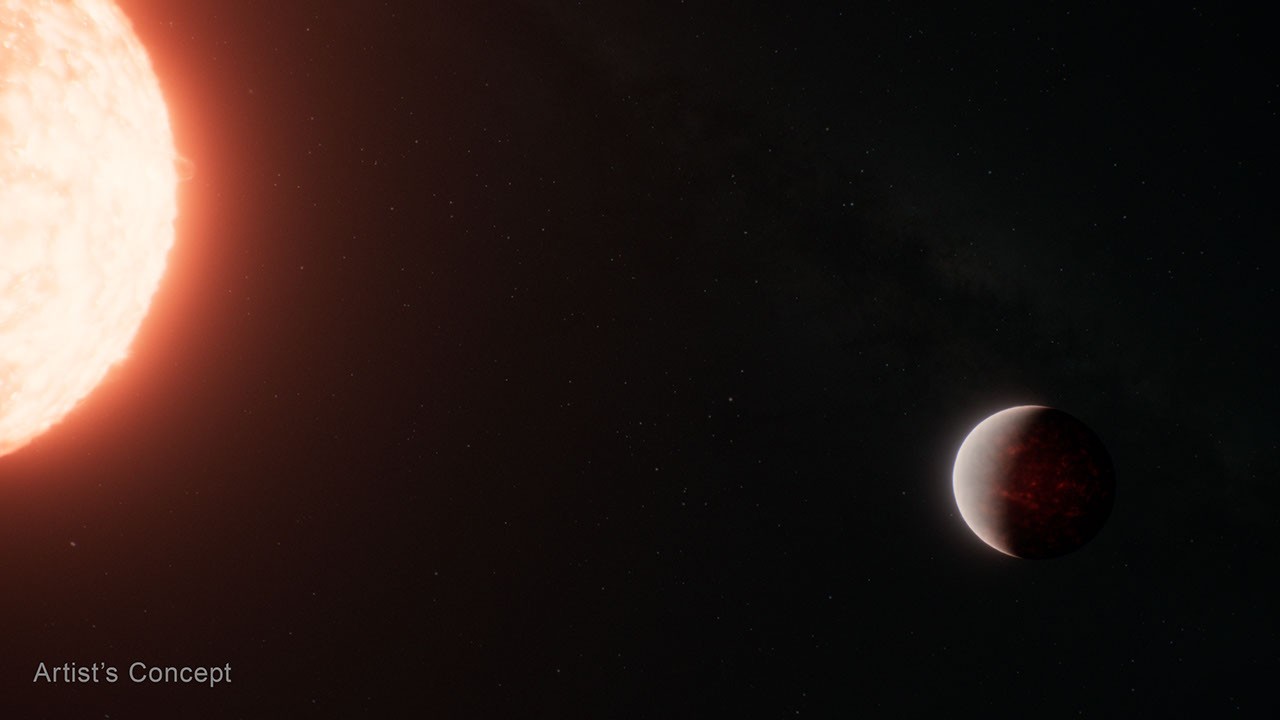
The planet, WASP-94A b, is a "hot Jupiter" — a gas giant orbiting its star every four days at a distance of nearly 700 light-years from Earth. Because it is tidally locked, one hemisphere is bathed in permanent, scorching daylight while the other faces eternal night. Average temperatures top 1,500 Kelvin, and the evening edge of the planet runs roughly 450 Kelvin hotter than the morning edge, creating dramatic contrasts between different parts of the same world.
Webb's observations revealed that the planet's permanent morning side is shrouded in dense clouds made of magnesium silicate — essentially the vaporized form of the rocky mineral found in sand — along with traces of iron and magnesium sulfide. By the time the trailing evening side rotated into view, those clouds had completely dissipated, leaving clear skies. "It was really surprising how different the two halves of the same planet are," said Sagnick Mukherjee, a postdoctoral fellow at Arizona State University and lead author of the study, published May 21 in the journal Science.
Scientists think powerful winds are responsible. Equatorial super-rotation may carry rocky vapor over the cold night side, where it condenses into clouds that then sweep onto the morning hemisphere; alternatively, the clouds may behave like morning fog, burning off as the day heats up. Either way, the asymmetry between the two limbs is far larger than astronomers expected.
The discovery carries a warning for the broader field. Most measurements of exoplanet atmospheres average light from the entire planet, blending the cloudy and clear hemispheres together. If the kind of lopsided weather seen on WASP-94A b is common among hot Jupiters, the team cautions, then many published estimates of these planets' compositions could be skewed — in some cases by as much as a hundredfold — forcing researchers to develop sharper methods to account for a world's two very different faces.
The observations were possible because Webb can dissect the faint light filtering through a planet's atmosphere as it crosses the face of its star, teasing apart the chemical fingerprints of the morning and evening limbs separately. That technique, beyond the reach of earlier telescopes, is turning exoplanet science from a discipline that simply detects distant worlds into one that can describe their climates in increasing detail. As astronomers compile weather reports for more hot Jupiters, they hope to learn whether WASP-94A b's split personality is an oddity or a clue to circulation patterns that govern gas giants throughout the galaxy.