Southern California Faults at Highest Stress in 1,000 Years, Study Warns
Researchers modeling the San Andreas and San Jacinto systems found Cajon Pass acting as an 'earthquake gate' that could let a rupture jump both faults at once near Los Angeles.
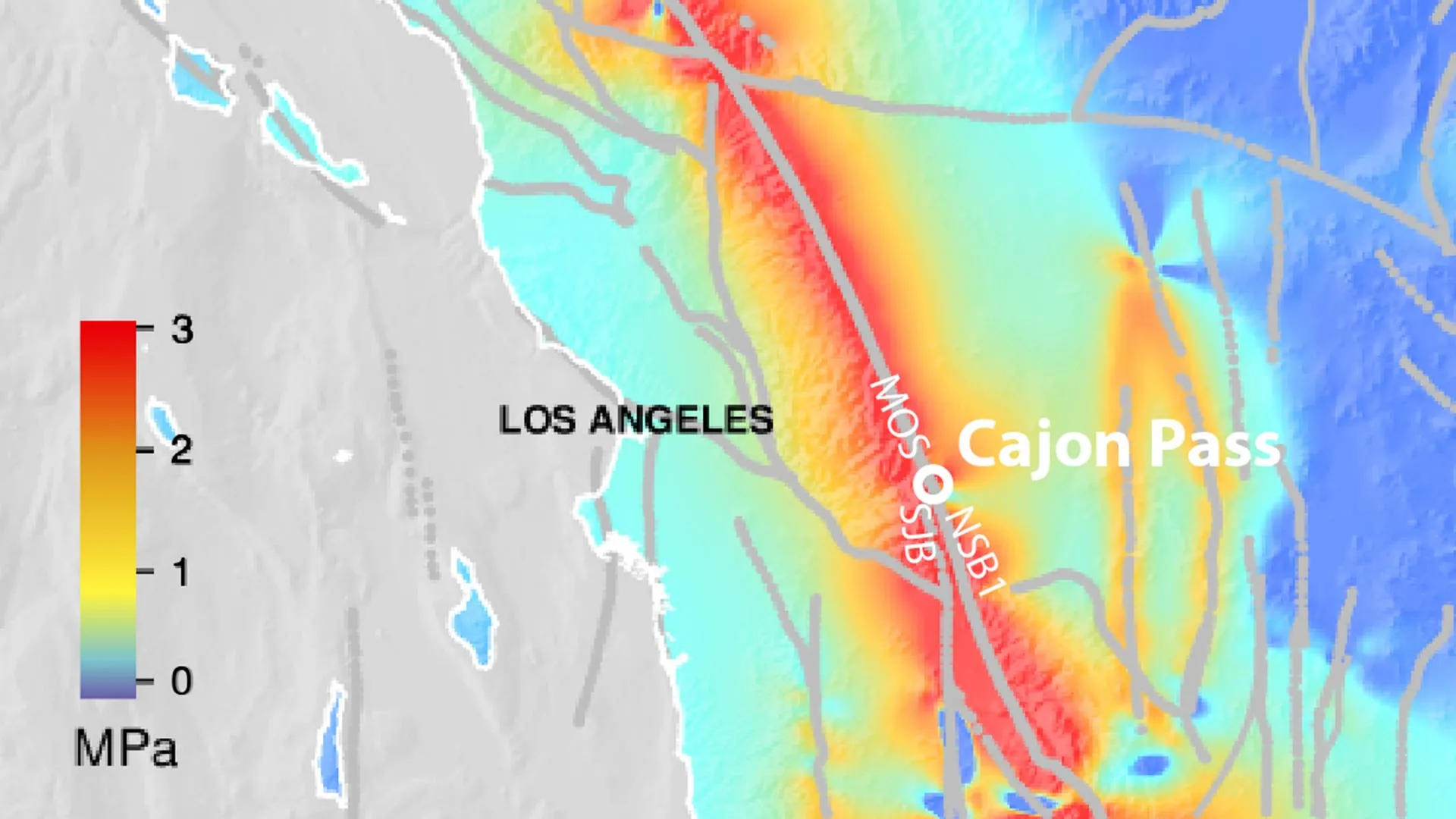
The faults beneath Southern California have wound up to their highest stress levels in roughly a thousand years, according to a new study that warns the region's two great fault systems may be primed to rupture together in a single, devastating earthquake near Los Angeles.
At the center of the analysis is Cajon Pass, the rugged mountain corridor northeast of San Bernardino where the San Andreas and San Jacinto faults nearly meet. The researchers describe the pass as an "earthquake gate" — a junction that can determine whether a rupture stays confined to one fault or leaps across to its neighbor, dramatically enlarging the resulting quake.
Using a millennium-long computer simulation of how stress accumulates and releases along the faults, the team found alarming readings. The San Jacinto–San Bernardino section now carries about 3.6 megapascals of stress, exceeding any value in the 1,000-year model, while the Mojave South section of the San Andreas stands at 2.8 megapascals.
"Not only is it concerning that the stresses are reaching historic highs," said Dr. Liliane Burkhard of the University of Bern, who led the study, "but also that the relative stress conditions between the two fault systems are approaching the range we associate with major ruptures crossing both faults simultaneously." The international team included scientists from the University of Hawaiʻi at Mānoa, the U.S. Geological Survey and the Scripps Institution of Oceanography.
A rupture that jumps the Cajon Pass gate and tears through both systems would be far larger than one confined to a single fault, and it would strike directly beneath some of the most densely populated and economically vital terrain in the country. The researchers note that such an event would severely affect Los Angeles, San Bernardino, Riverside and the Coachella Valley, along with the freeways, aqueducts and power lines that thread through the region.
The southern San Andreas in particular has long unsettled seismologists because it has not produced a great earthquake in roughly three centuries — far longer than the intervals seen in the geologic record. The last major rupture along the Mojave section is thought to date to around 1857, when the Fort Tejon quake tore some 225 miles of fault, while the segment near the Salton Sea has been quiet even longer, leaving an enormous reservoir of pent-up strain.
The findings, published in the Journal of Geophysical Research: Solid Earth, do not predict when an earthquake will occur — that remains beyond the reach of current science. But by quantifying just how loaded the faults have become, the work sharpens a warning that California's emergency planners have repeated for decades: the question of a catastrophic Southern California quake is one of when, not if.
Originally reported by ScienceDaily.