Scientists Finally Complete Schrödinger's 100-Year-Old Theory of How We See Color
A Los Alamos team used geometry to prove that hue, saturation and lightness are baked into the mathematics of color itself — not learned from culture or experience.
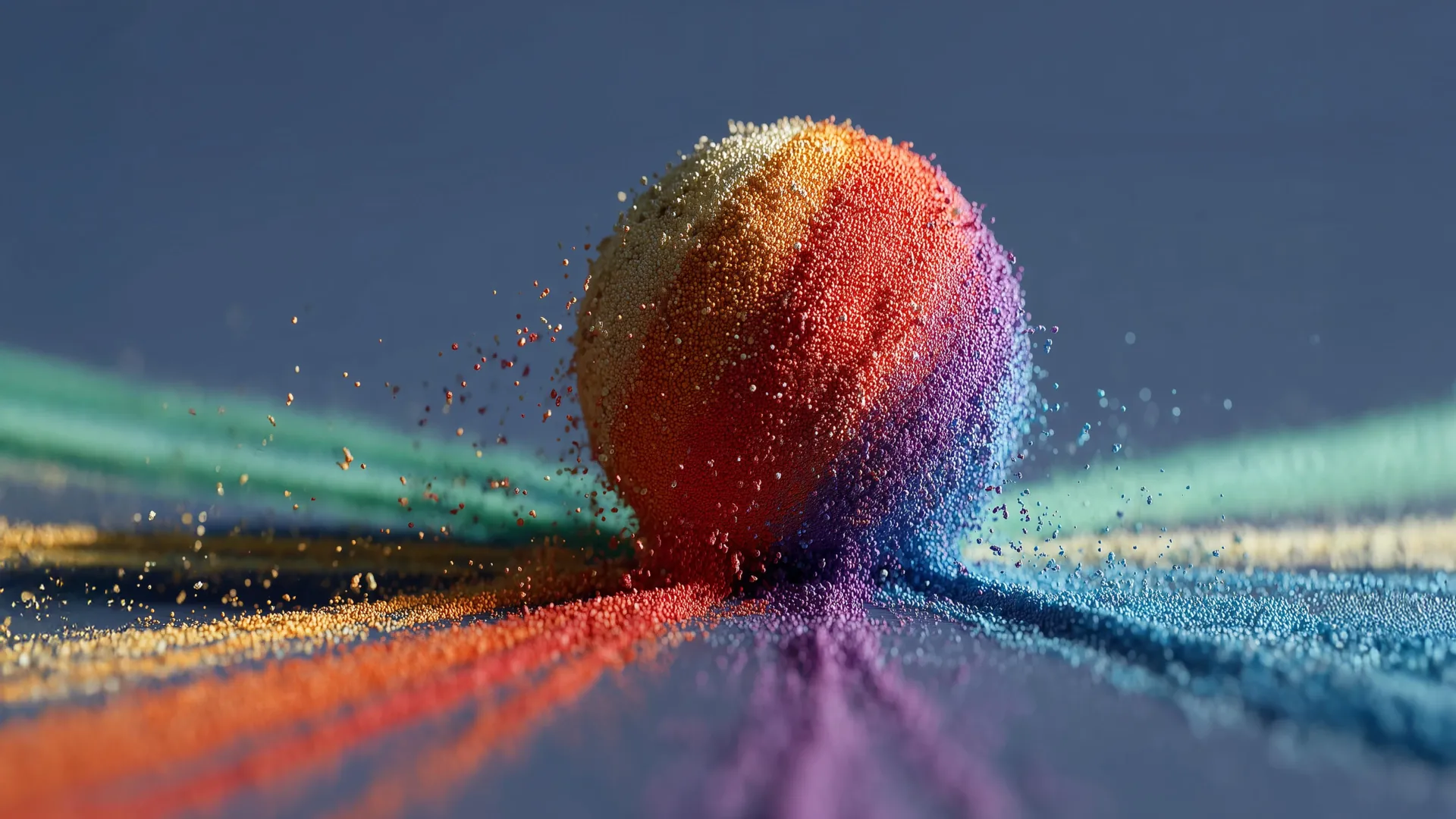
Nearly a century after Erwin Schrödinger turned his attention from quantum mechanics to the riddle of human color vision, scientists say they have finally supplied the missing piece of his theory — and in doing so settled a long-running debate about where the qualities we perceive in color actually come from.
In the 1920s, Schrödinger developed mathematical definitions for hue, saturation and lightness built on a Riemannian model of color perception, a geometric framework that treats colors as points in a curved mathematical space. The model was elegant but incomplete, and for decades it resisted a fully rigorous formulation. The new work shows that the familiar attributes of color are not external labels we impose but intrinsic properties woven into the structure of color space itself.
The breakthrough came from an unexpected direction. A team led by Roxana Bujack, a scientist at Los Alamos National Laboratory, was developing algorithms for scientific visualization — the discipline of turning data into images researchers can actually interpret — when they uncovered weaknesses in the mathematical scaffolding behind the century-old theory. Using geometry, they built a precise definition of color perception grounded in hue, saturation and lightness, formalizing Schrödinger's model in a way that had eluded researchers since his era.
"What we conclude is that these color qualities don't emerge from additional external constructs such as cultural or learned experiences but reflect the intrinsic properties of the color metric itself," Bujack said. In other words, the reason a color reads as more or less saturated, brighter or darker, is determined by the geometry of how similar colors are to one another — not by language, upbringing or training. The result, presented at a visualization science conference, realizes what the team describes as Schrödinger's dream of a closed model able to define hue, saturation and lightness using only the geometric property of highest color similarity.
The implications reach well beyond a historical footnote. A mathematically airtight account of color perception matters for any field that depends on rendering data faithfully to the human eye, from medical imaging and satellite analysis to the design of displays and the color maps scientists use to communicate results. Misleading color schemes can distort how viewers read a chart or a scan; a rigorous theory offers a principled way to build maps that match how people genuinely perceive difference and intensity.
It is also a reminder of how long foundational questions can linger at the intersection of physics, mathematics and biology. Schrödinger, best known for the wave equation that bears his name and the famous thought experiment about a cat, treated color vision as a serious problem in mathematical physics. A hundred years later, researchers chasing better pictures of their own data have closed the loop he opened — confirming that the rainbow of human experience is, at its core, a matter of geometry.