A 'Death Jar' in Laos Holds the Bones of 37 People, Cracking a Century-Old Mystery
For the first time, archaeologists found undisturbed human remains sealed inside one of the giant stone vessels of the Plain of Jars, confirming the enigmatic megaliths were used for burial.
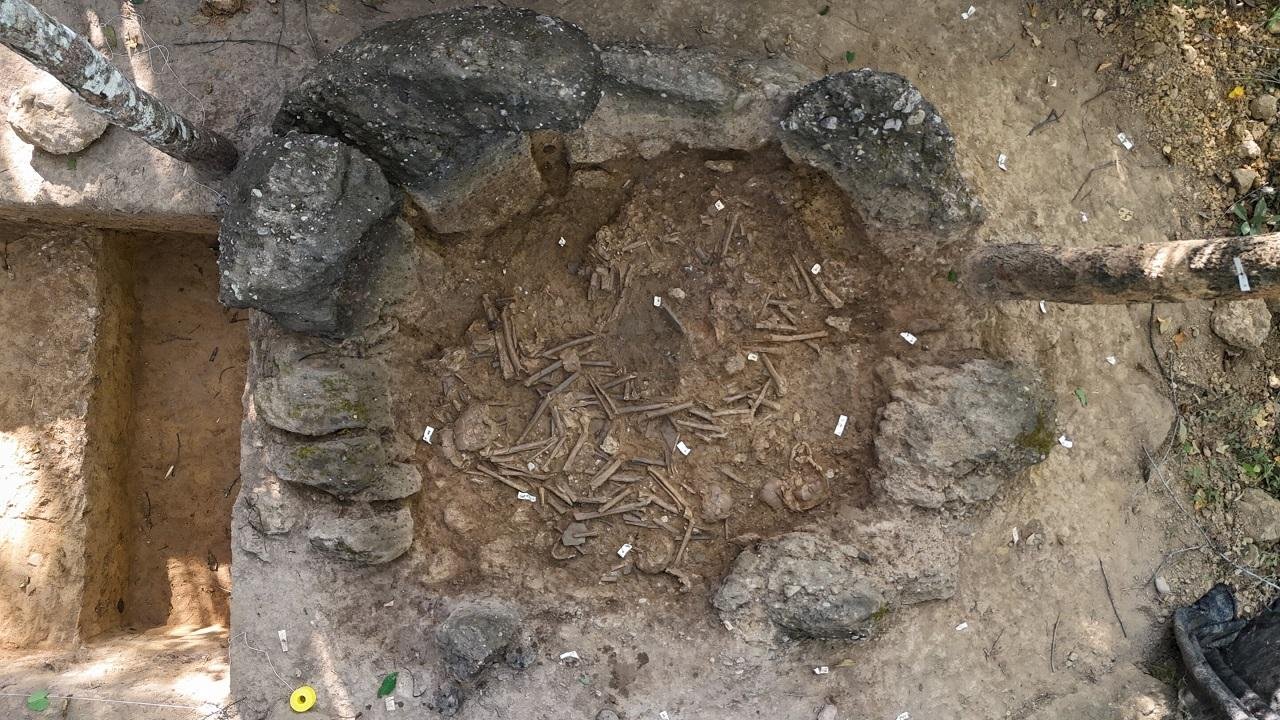
Archaeologists working in the highlands of northern Laos have found the disarticulated remains of at least 37 people packed inside a single giant stone vessel, the first time human bones have been recovered undisturbed from within one of the enigmatic megaliths of the Plain of Jars — and the strongest evidence yet that the mysterious structures were built for the dead.
The find, reported in the journal Antiquity, comes from Jar Site 75, about 70 kilometers northeast of the town of Phonsavan in Xiangkhouang Province. The vessel, dubbed Jar 1, stands roughly 1.3 meters tall and measures more than two meters across. Inside, researchers from a team of Australian and Lao archaeologists uncovered tightly bundled human remains — adults and children alike — radiocarbon dated to between 890 and 1160 CE.
The Plain of Jars has puzzled scholars since the early 20th century. Thousands of carved stone jars, some weighing several tons, are scattered across the Laotian landscape, their purpose long debated. Earlier excavations had turned up human remains buried in the ground around the jars, hinting at a mortuary role, but no one had found bodies preserved inside a vessel itself. The new discovery changes that, supplying the missing link between the megaliths and the people who built them.
Analysis of the bones and teeth suggested the jar was not used in a single event but reused across multiple generations as part of a secondary burial tradition — a practice in which bodies are first allowed to decompose or are otherwise treated elsewhere, and the cleaned bones are later gathered and deposited in a final resting place. Rather than complete, articulated skeletons, the jar held clusters of long bones and skull fragments deliberately grouped together, a hallmark of such rituals.
The vessel also yielded glass beads traced to India and Mesopotamia, a striking detail that places this remote upland community within sprawling ancient trade networks stretching across Asia and into the Near East. The beads suggest the people who used the jars were connected, however indirectly, to commerce that spanned thousands of kilometers.
Researchers cautioned that the precise function of the jars may have varied from place to place across the vast complex, which was inscribed as a UNESCO World Heritage Site in 2019. Excavation in the region remains painstaking and dangerous: Laos is among the most heavily bombed countries in history, and unexploded ordnance from the Vietnam War era still litters many sites, limiting where archaeologists can safely dig. Even so, the bone-filled jar offers a rare, vivid window into a burial culture that flourished here a millennium ago, and edges scientists closer to solving one of Southeast Asia's most durable archaeological riddles.