Physicists Reverse the Flow of Energy in Turbulence, Upending an 80-Year-Old Law
A University of Pittsburgh team showed the direction of turbulent energy transfer can be flipped, challenging Kolmogorov's 1941 theory and opening the door to steering ocean currents and microfluidic devices.

For more than 80 years, physicists have lived by a rule about turbulence so well established that it reads almost like a law of nature: in the swirling chaos of a fluid, energy flows in one direction. A new study has shown that the rule can be broken — and that the direction of energy flow in turbulence can actually be reversed.
The work, published in the journal Science Advances, challenges a framework laid down in 1941 by the Soviet mathematician Andrey Kolmogorov, whose theory of the "energy cascade" has anchored the study of turbulent flows ever since. In three-dimensional flows like those in a river or the open ocean, Kolmogorov's picture holds that energy injected at large scales — big eddies and currents — cascades down to ever-smaller whirls until it dissipates as heat. The direction, from large to small, was assumed to be essentially fixed.
Not so, says a team led by Lei Fang, an assistant professor in the University of Pittsburgh's Swanson School of Engineering, working with the doctoral student Xinyu Si and physicists Filippo De Lillo and Guido Boffetta of the University of Turin in Italy. The researchers found that under the right conditions, energy can be made to flow the other way — from small scales up to large ones — opening the possibility of actively controlling how fluids mix and move.
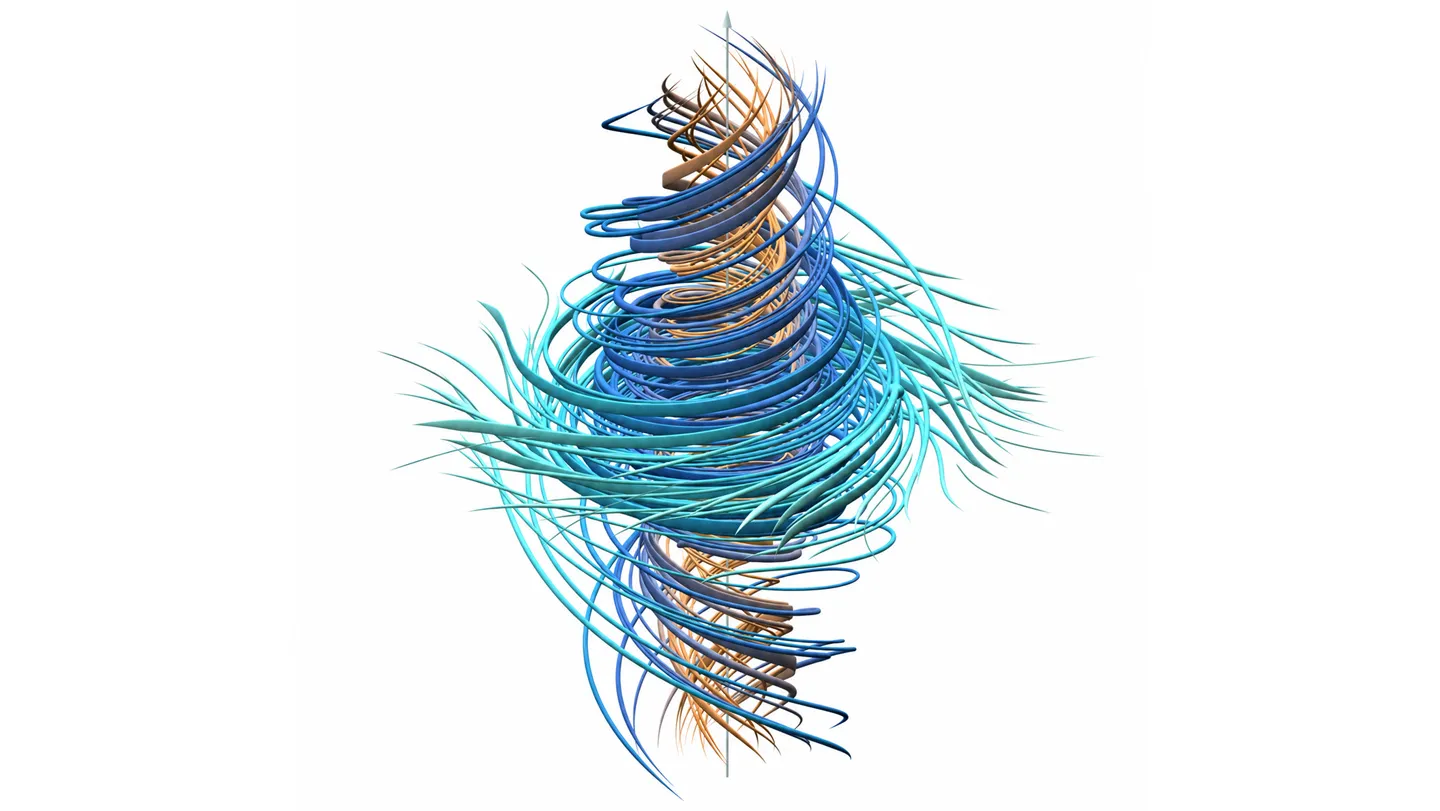
The key was geometry. Fang built a mathematical framework based on tensors, the objects physicists use to describe how forces and motion interact within a system. His analysis showed that the alignment of these tensors governs the direction of energy transfer: change the alignment, and you change which way the energy flows. To test the idea, the team ran laboratory experiments using electromagnetic forces to stir thin layers of water in a controlled two-dimensional flow, and watched the predicted reversal play out, matching their computer simulations.
The implications reach well beyond the laboratory. The ability to steer turbulent energy could improve the way engineers manage the dispersal of pollutants in coastal waters, design microfluidic devices that mix tiny volumes of fluid for medical diagnostics, and refine the climate and ocean models that depend on accurately capturing how energy moves through turbulent systems. In each case, turbulence has long been treated as something to endure rather than direct.
That a principle so foundational could be overturned speaks to how stubbornly turbulence has resisted understanding — the great physicist Richard Feynman famously called it the most important unsolved problem in classical physics. The new findings do not solve turbulence, but they reveal a hidden lever in its machinery, and with it a tantalizing prospect: that one of nature's most untamable phenomena might, in part, be tamed.