MIT Shows One Green Fuel Can Power Both Kinds of Spacecraft Thruster
A single Air Force-developed propellant ran both a chemical engine and electric electrospray thrusters in the lab — a dual-mode design that could send briefcase-sized CubeSats to Mars.
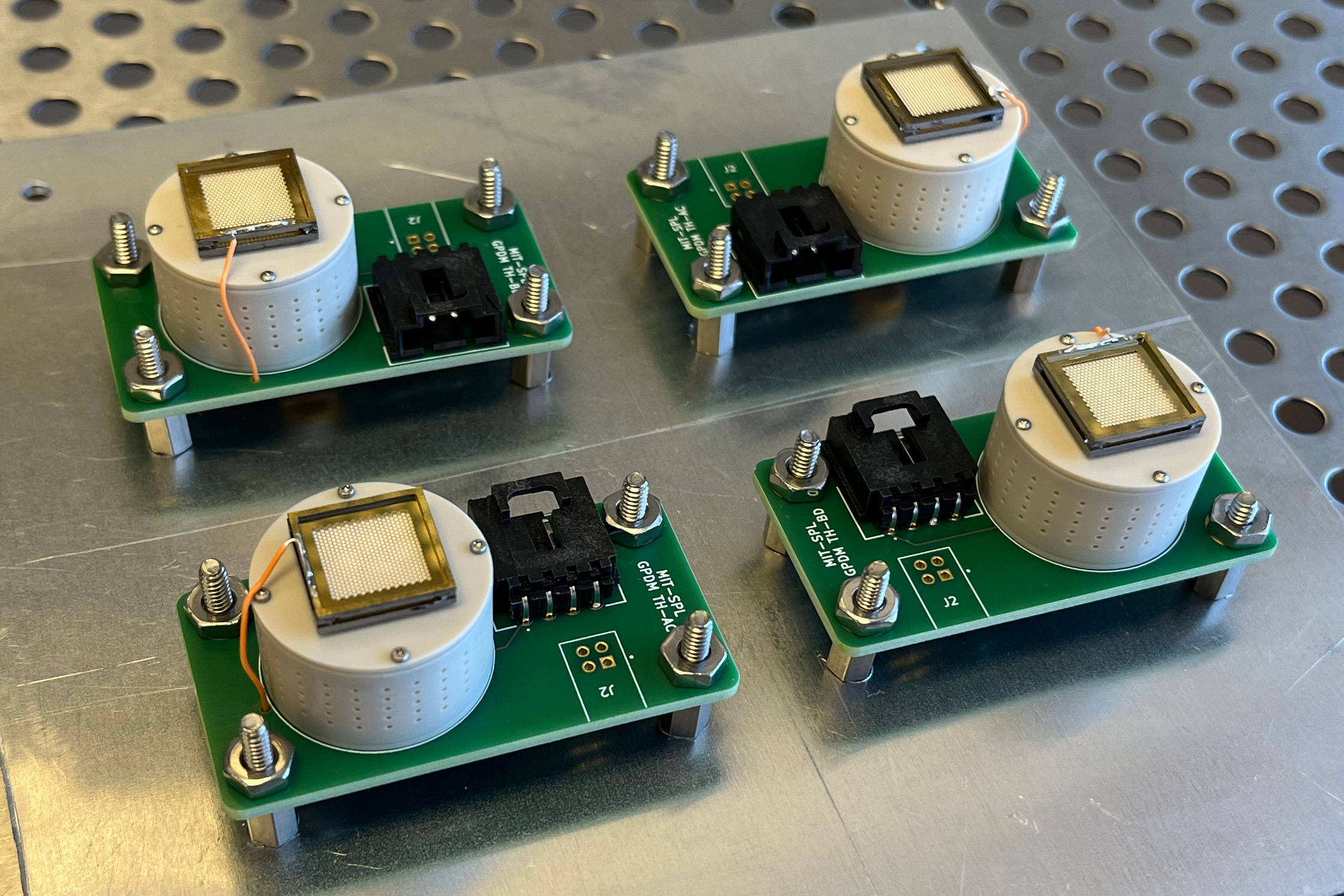
MIT researchers have demonstrated that a single fuel can power two fundamentally different kinds of spacecraft engine — a chemical thruster for quick bursts of speed and electric thrusters for slow, ultra-efficient long-haul travel — opening the door to tiny satellites that could journey as far as Mars on their own. The work, reported in the Journal of Propulsion and Power, could collapse two propulsion systems into one compact package light enough to fit aboard a CubeSat.
The key is an ionic liquid called ASCENT, short for Advanced SpaceCraft Energetic Non-Toxic propellant, originally developed by the U.S. Air Force as a "green" replacement for the toxic hydrazine that has long fueled chemical rockets. The MIT team showed that the same propellant can also drive miniature electric engines known as electrospray thrusters, which work by electrically extracting and accelerating charged droplets to generate gentle but extraordinarily fuel-efficient thrust.
"If you can have chemical and electrical propulsion in one small package, it's the best of both worlds," said Amelia Bruno, the study's lead author and a former postdoc in MIT's Department of Aeronautics and Astronautics. The dual-mode approach pairs the punch of chemical propulsion — useful for escaping a planet's gravity or dodging space debris — with the marathon efficiency of electric thrusters, which can run for months to push a spacecraft across vast distances on very little fuel.
The implications are biggest for the smallest spacecraft. CubeSats, often no larger than a briefcase, have proliferated because they are cheap to build and launch, but their limited propulsion has largely confined them to low Earth orbit. A single shared fuel tank feeding both engine types could change that calculus dramatically. "We could send CubeSats to Mars, or the asteroid belt, where they could make the journey slowly, using electrospray thrusters," said co-author Paulo Lozano, the Miguel Aleman Velasco Professor of Aeronautics and Astronautics at MIT. Former graduate student Matthew Corrado also contributed to the experiments.
The concept is about to leave the laboratory. The team is working with NASA on the Green Propulsion Dual Mode mission, a CubeSat scheduled for launch in November 2026 that will carry one chemical thruster and four electrospray thrusters, all drawing from a single propellant tank. It will be the first in-orbit test of a two-in-one propulsion system for small spacecraft.
If the demonstration succeeds, it could rewrite what small, low-cost satellites are capable of — turning briefcase-sized probes from passengers stuck in Earth orbit into explorers capable of striking out across the solar system.
Originally reported by MIT News.