After 87 Years, Physicists Capture the 'Ghost' Migdal Effect — a New Window on Dark Matter
A Chinese team reported in Nature the first direct observation of a 1939 prediction: an electron flung from a recoiling atom, a trick that could finally reveal lightweight dark matter.

For nearly nine decades it was one of physics' most stubborn ghosts: a subtle quantum process predicted on paper but never caught in the act. Now a team of Chinese scientists has reported the first direct observation of the Migdal effect, a breakthrough that could open a new path toward detecting the invisible dark matter thought to make up roughly 85% of the universe's matter.
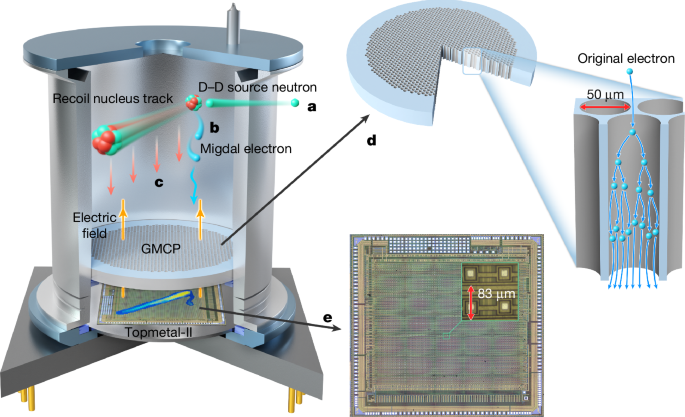
The effect was predicted in 1939 by the Soviet physicist Arkady Migdal. He theorized that when an atomic nucleus suddenly gains energy and recoils — for instance, after a collision with a neutral particle such as a neutron — the abrupt shift in the atom's internal electric field can fling one of its orbiting electrons free. The process is real but vanishingly rare, and for 87 years it remained beyond the reach of experiment, drowned out by background noise from cosmic rays and natural radiation.
To finally see it, the team — led by researchers at the University of Chinese Academy of Sciences and reported in the journal Nature — built what amounts to an 'atomic camera': a high-precision gas detector fitted with a custom microchip capable of tracking individual atoms and the electrons they release. By bombarding gas molecules with neutrons and sifting through more than 800,000 candidate events, the scientists isolated six clean signals bearing the effect's telltale signature — two particle tracks springing from the same point.
The discovery reached a statistical significance of five standard deviations, the gold standard for claiming a detection in particle physics. The result closes a long-standing gap between theory and observation, but its real promise lies in what it could enable next. The Migdal effect can effectively 'up-convert' otherwise imperceptible low-energy nuclear recoils into detectable electronic signals, dramatically improving sensitivity to the lightweight dark matter particles that have eluded conventional detectors.
'With the Migdal effect, once an electron is ejected, our detector can, in theory, capture 100% of its energy,' one of the researchers noted, explaining how the phenomenon could sharpen the hunt for particles previously considered out of reach. Dark matter has never been observed directly; it is inferred only from its gravitational pull on stars and galaxies. By turning a once-theoretical quirk of atomic physics into a practical detection tool, the experiment hands physicists a fresh instrument in one of science's most consequential searches.
Dark matter is one of the central mysteries of modern science. It emits no light and has never been detected directly, yet its gravitational influence is needed to explain how galaxies spin and how the universe's largest structures hold together. Experiments around the world have spent decades hunting for the faint recoil of an atomic nucleus struck by a passing dark matter particle, but the lightest candidates produce signals too weak for conventional detectors to register. By proving the Migdal effect is real and measurable, the new experiment hands those searches a powerful amplifier — and a fresh reason for optimism in a quest that has so far yielded only tantalizing hints.