Lab-Grown Brain-and-Spinal-Cord Tissue Reveals Why Nerves Stop Healing — and How a Drug Might Switch Repair Back On
Cambridge scientists grew a miniature human nervous-system circuit that twitched real muscle, then discovered that neurons lose their power to regrow around mid-pregnancy. An existing hormone drug dramatically restored that ability.

Scientists in Cambridge have built a miniature, living model of the human nervous system in a dish — and in the process uncovered why nerve damage that doctors have long called "irreversible" might one day be reversed.
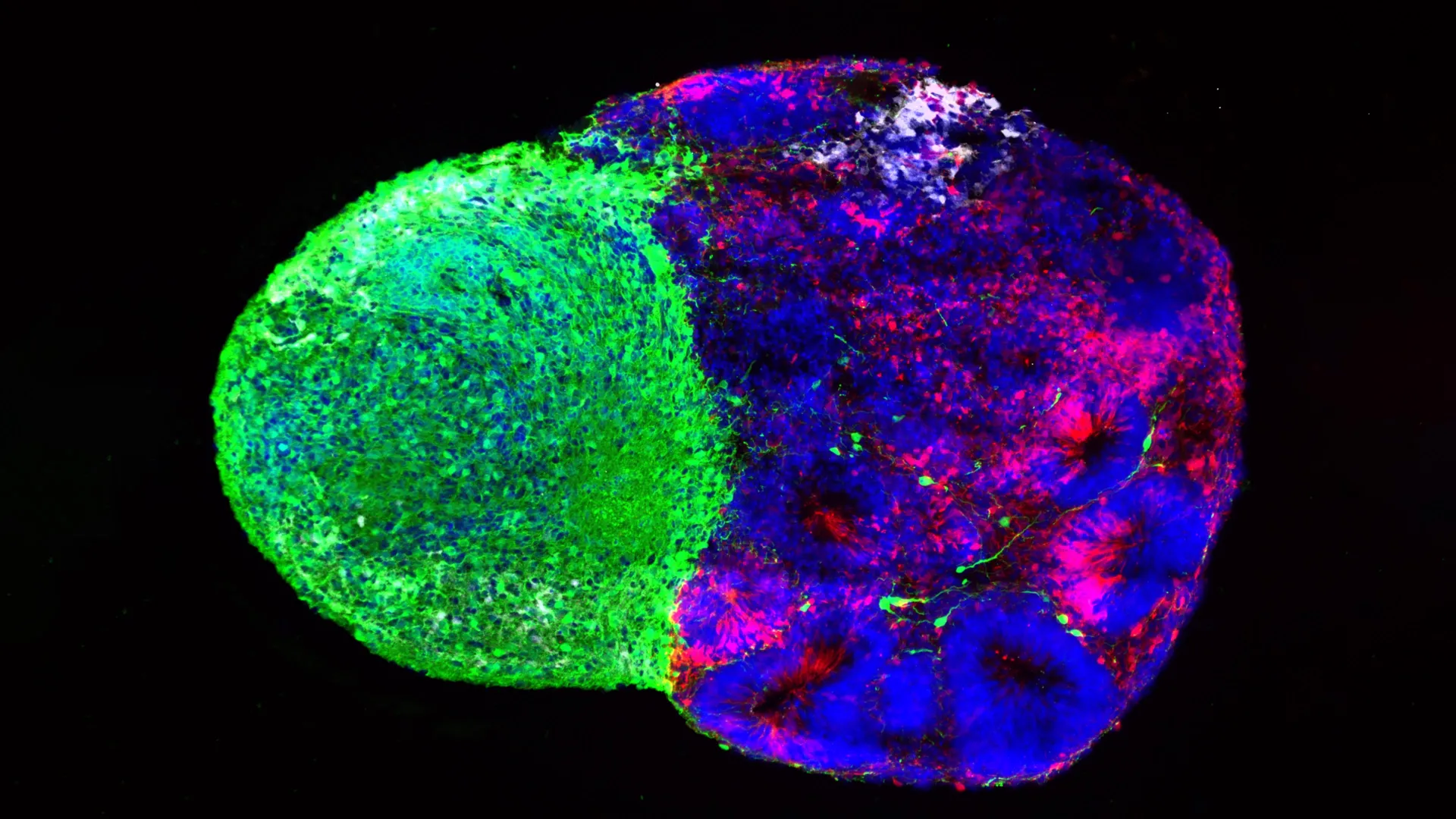
The researchers, at the University of Cambridge, created tiny lab-grown structures that mimic how movement commands travel from the brain to the spinal cord in a developing human. Starting from stem cells, they grew separate clusters of brain and spinal-cord tissue and placed them side by side. Remarkably, nerve fibers sprouting from the brain tissue grew across the gap and wired themselves into the spinal-cord cluster, forming a working circuit. The connection was no mere anatomical curiosity: when stimulated, it could drive tiny clusters of muscle to contract, recreating in miniature the brain-to-muscle relay that lets a person move.
With a functioning model in hand, the team probed one of neuroscience's most stubborn puzzles: why the human nervous system loses its ability to heal. They found a sharp developmental cutoff. Up until roughly day 150 of development — corresponding to the middle trimester of pregnancy — axons severed in the model readily regrew. After that point, their capacity to regenerate collapsed.
"Neurons taken from less mature organoids regrew long fibers after injury, but those from more mature organoids showed a sharp drop in their ability to regrow," said George Gibbons, the study's first author. The finding offers a striking explanation for why an adult with a spinal-cord injury rarely recovers lost function: somewhere in early development, the molecular machinery for regrowth is quietly switched off.
The most hopeful discovery came next. The researchers identified a network of genes that governs this loss of regenerative power — and found that the switch is not necessarily permanent. By treating the mature neurons with an existing hormone drug, the team dramatically boosted the regrowth of nerve fibers, coaxing cells that had stopped healing to extend new connections once again. In other words, the brakes on regeneration can, at least in the lab, be released.
The implications for medicine are significant. Spinal-cord injuries, along with many forms of nerve damage, are devastating precisely because the adult nervous system will not rebuild itself. A model that reproduces a working human brain-spinal circuit gives scientists a powerful new platform to test therapies without relying on animal models that imperfectly reflect human biology. And the fact that a drug already in use could reawaken the repair process hints at a faster path from laboratory bench to patient. Much work remains before any treatment reaches people, but the study reframes a problem once considered hopeless as a biological switch that might be flipped.