How One Cell Builds a Brain of 170 Billion: Cells Use Their Family Tree as a Map
In the journal Neuron, Cold Spring Harbor scientists propose that brain cells find their place by tracking their own lineage — a positioning system that could also inform AI design.
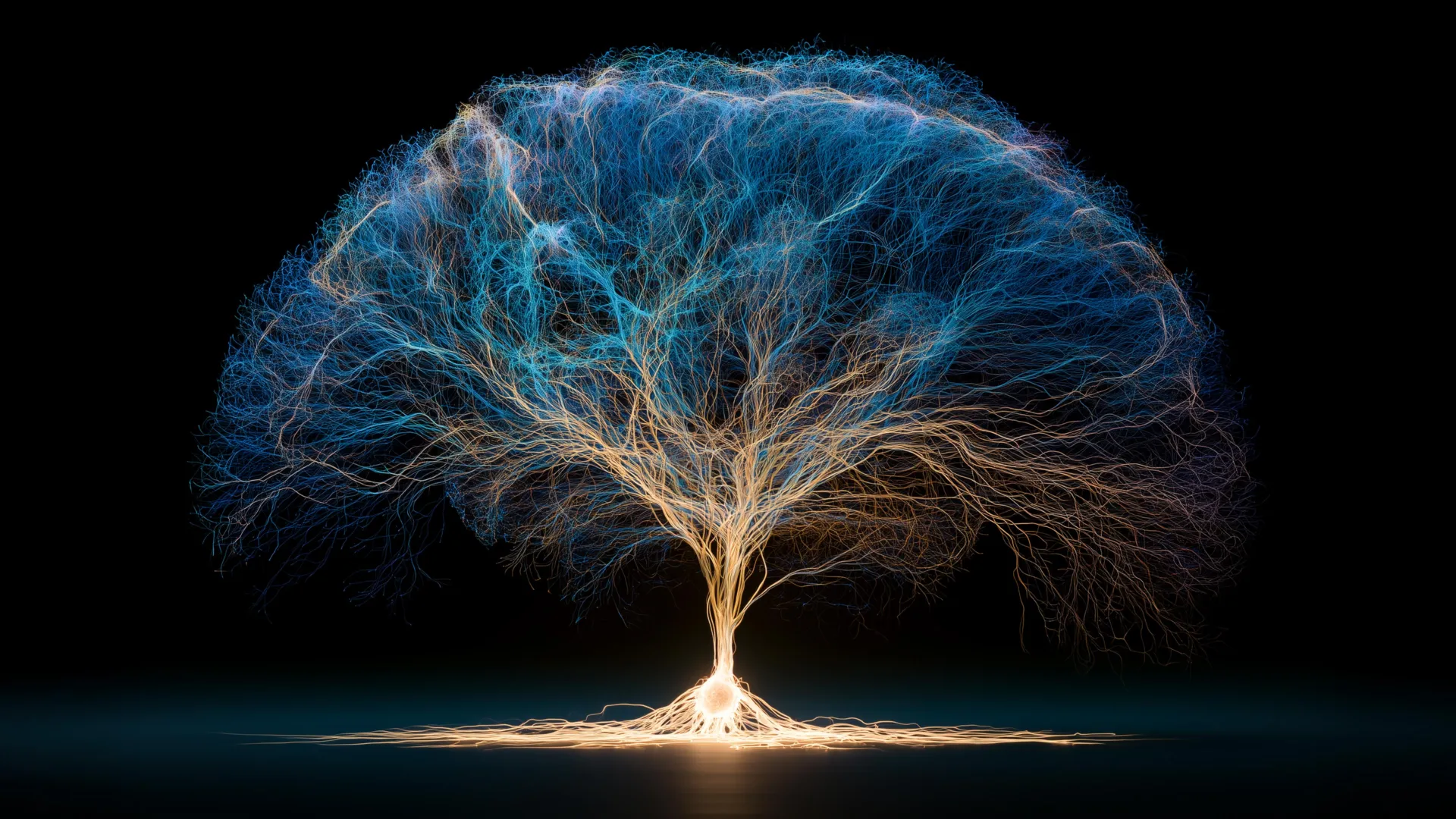
One of biology's deepest mysteries is how a single fertilized cell can give rise to a human brain of roughly 170 billion cells, each landing in precisely the right place to wire up a working mind. A new study from Cold Spring Harbor Laboratory offers a strikingly simple answer: brain cells may navigate by tracking their own family tree, using their cellular ancestry as a built-in positioning system.
The research, published in the journal Neuron, was led by postdoctoral researcher Stan Kerstjens and Professor Anthony Zador at Cold Spring Harbor, with collaborators at Harvard University and ETH Zürich. Their central idea is that cells descended from the same parent cell tend to stay near one another as the brain grows. That tendency, repeated across countless generations of dividing cells, allows large-scale structure to emerge without every cell having to read a detailed chemical map of where it belongs.
For decades, scientists have largely explained brain organization through diffusing chemical signals — molecular gradients that tell a cell where it is and what to become. The Cold Spring Harbor team argues that lineage provides a complementary, and remarkably economical, source of positional information. "The only thing a cell 'sees' is itself and its neighbors," Kerstjens said. "But its fate depends on where it sits." Ancestry, in effect, encodes location.
To build and test the theory, the researchers combined mathematical modeling with analyses of gene-expression patterns in developing mouse brains, examining cells both individually and in groups. They then validated their predictions in the brains of zebrafish, a favorite model organism for studying development, finding that the lineage-based scheme matched the organization they observed.
The implications reach beyond neuroscience. If cells routinely use ancestry to self-organize, the same principle may apply to other developing tissues and even to tumors, where cell lineage shapes how growths spread. The authors also suggest their framework could inform artificial intelligence, offering a blueprint for how complex, structured systems can assemble themselves from simple local rules. Ultimately, the work speaks to one of the most fundamental questions in science: how the ordered complexity of a brain — and the intelligence it produces — emerges from a single cell.