Electrons in Ultra-Clean Graphene Flow Like a Frictionless Liquid, Defying a 170-Year-Old Law of Physics
Physicists in India and Japan watched electrons abandon their particle-like behavior and move as a near-perfect 'Dirac fluid,' breaking the Wiedemann-Franz law by more than 200 times.

Physicists have watched electrons inside graphene do something that textbooks long held to be impossible in ordinary materials: stop behaving like individual particles and begin flowing together as a nearly frictionless liquid. The discovery, reported by researchers at the Indian Institute of Science in Bengaluru and the National Institute for Materials Science in Japan, offers one of the clearest demonstrations yet of an exotic state of matter known as a "Dirac fluid."
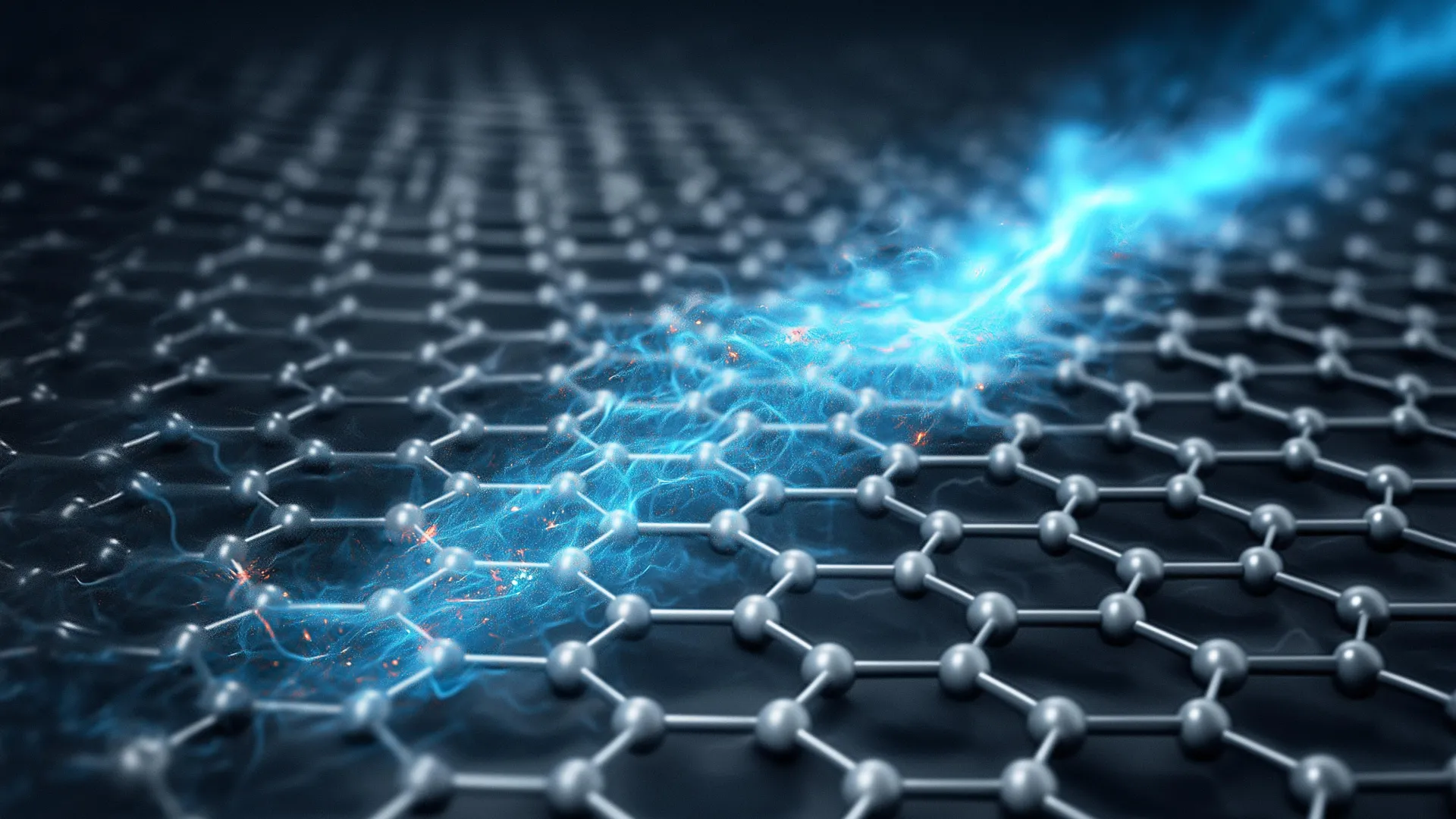
In samples of exceptionally clean graphene — a sheet of carbon just a single atom thick — the team cooled the material and tuned it close to the so-called Dirac point, where graphene sits on the knife's edge between metal and insulator. There, the electrons stopped scattering off one another as discrete charges and instead moved collectively, like molecules in a flowing liquid. The behavior closely resembles the quark-gluon plasma that physicists create in particle accelerators by smashing atomic nuclei together at near light speed.
Most strikingly, the flowing electrons violated the Wiedemann-Franz law, a relationship dating to the 1850s that ties a material's ability to conduct heat to its ability to conduct electricity. In the Dirac fluid, heat and charge decoupled, with the two conductivities diverging by more than 200 times at low temperatures. The electrons also exhibited a menagerie of strange phenomena, including negative resistance, swirling "electron whirlpools," and a counterintuitive effect known as superballistic flow, in which squeezing the electrons through a narrow channel actually makes them conduct more easily.
"It is amazing that there is so much to do on just a single layer of graphene even after 20 years of discovery," said Arindam Ghosh, the physicist who led the work, reflecting on how the celebrated material continues to surprise researchers two decades after it was first isolated. The first author of the study, Aniket Majumdar, and colleagues published their findings in the journal Nature Physics.
The implications reach beyond fundamental curiosity. Because the Dirac fluid responds collectively and with extremely low viscosity, it could form the basis of a new generation of quantum sensors capable of amplifying vanishingly weak electrical signals and detecting faint magnetic fields. Such devices would be valuable in ultra-low-noise applications, from advanced scientific instruments to precision medical diagnostics. More broadly, the result deepens a growing realization among physicists that electrons in the right materials can mimic the hydrodynamics of fluids, opening a frontier where the rules of plumbing and the rules of quantum mechanics begin to blur together.