Giant Planets Spin Faster Than Heavier Brown Dwarfs, Keck Survey Finds, Rewriting Formation Clues
A large survey of alien-world rotation rates shows mass alone does not set how fast a world spins, pointing to magnetic fields and formation as the deciding factors.
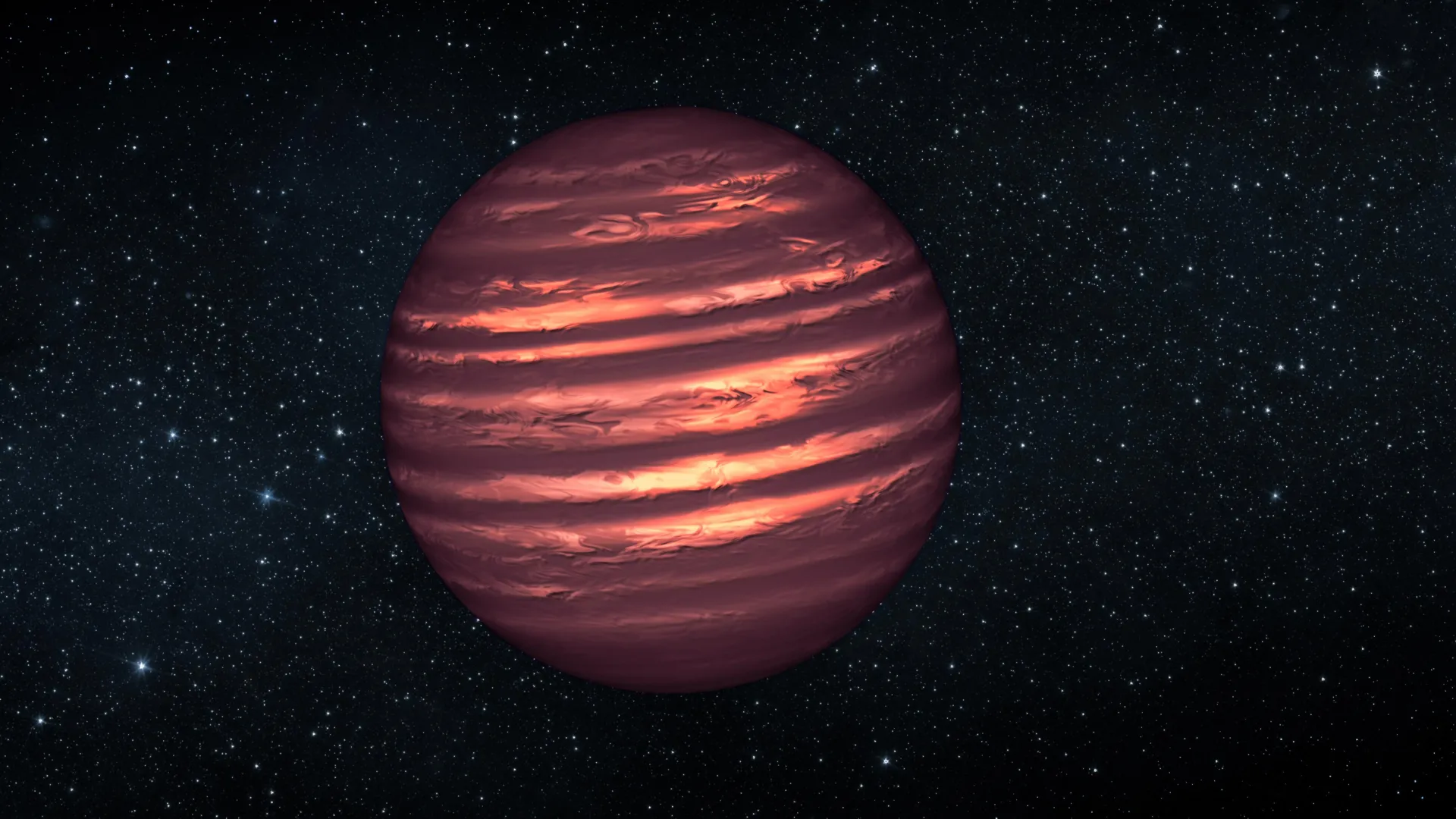
Astronomers have measured how fast dozens of distant worlds spin and uncovered a surprising pattern: giant planets can rotate faster than far more massive brown dwarfs, a result that complicates simple assumptions about the link between an object's mass and its spin — and offers a fresh clue to how planets are born.
Using the W. M. Keck Observatory in Hawaii, researchers conducted one of the largest surveys yet of the rotation rates of giant exoplanets and brown dwarfs orbiting other stars. Brown dwarfs are often called "failed stars" because they are more massive than planets but never gathered enough material to ignite sustained nuclear fusion. Intuitively, heavier objects might be expected to spin faster, having accreted more matter and angular momentum. The new measurements show the opposite can be true.
The survey found that some giant planets whirl more quickly than brown dwarfs that vastly outweigh them, suggesting that mass alone does not dictate how fast a world ends up turning. Instead, the team concluded, the processes by which these objects form — and the magnetic fields that thread through them — appear to play a decisive role in setting their final spin rates.
Magnetic braking offers a likely explanation. As a young planet or brown dwarf forms, its magnetic field can interact with surrounding gas and the disk of material from which it accretes, transferring away angular momentum and slowing its rotation. Differences in the strength and behavior of those magnetic fields, and in how each object assembled, could leave a giant planet spinning faster than a heftier neighbor. The findings hint that the spin of a world records something about its birth.
The study confirms a long-held theoretical prediction that the relationship between mass and rotation is more tangled than a straightforward scaling, and it gives observers a new window into the formative years of planets and their stellar-mass cousins. Spin, the researchers argue, is not just a curiosity but a fossil signature of formation, preserved long after the disks of gas and dust that built these worlds have dissipated.
Measuring the rotation of objects light-years away is a formidable task, requiring instruments sensitive enough to detect the subtle Doppler broadening of light as one side of a world spins toward Earth and the other away. By assembling spin measurements across a population of giants and brown dwarfs, astronomers can begin to test formation models statistically rather than one object at a time — and, in this case, to overturn an assumption that seemed almost too obvious to question.
Originally reported by ScienceDaily.