Every Honey Bee Flies Its Own Private Highway, Drone-Tracking Study Finds
German researchers followed individual bees with a high-speed drone and discovered each insect repeats its foraging route within centimeters, steering by landmarks like a lone tree.
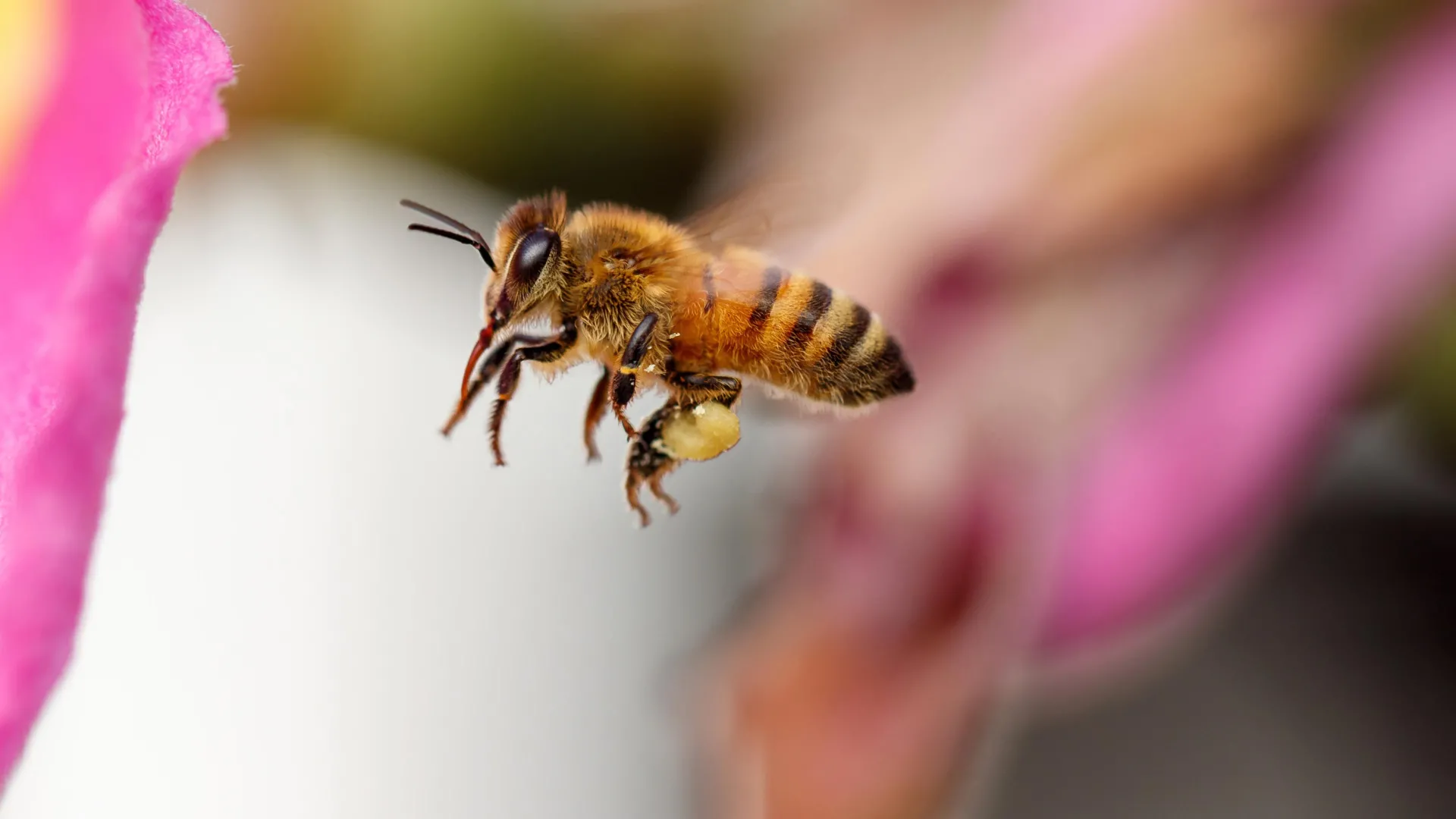
Honey bees, it turns out, are creatures of remarkable habit. A new study has found that individual bees fly their own personal commuting routes between hive and flower, repeating them so faithfully that some pass within centimeters of where they flew the time before.
Researchers at the University of Freiburg in Germany tracked foraging honey bees across a natural agricultural landscape using a high-speed, drone-based system, capturing the insects' three-dimensional flight paths in unprecedented detail. The results, published in the journal Current Biology, reveal that each bee charts a highly precise and individualized course rather than wandering freely toward food.
The precision was startling. Following bees over a distance of about 120 meters, the team found that some repeated their routes so exactly that they flew only centimeters from their earlier trajectories. Landmarks in the landscape, the scientists discovered, were the key. Near a large tree close to the hive, bees passed within roughly half a meter of their usual path, while over uniform terrain such as cornfields — where distinctive features are scarce — their routes wandered more.
To pull off the feat, the researchers used a tracking method called Fast Lock-On, or FLO, developed in the laboratory of Andrew Straw, which allows a multicopter drone to follow a single tiny insect through open country. Earlier efforts to study bee navigation had been limited to controlled settings or radar tracking that could not capture such fine-grained, individual detail across a real landscape.
The findings sharpen scientists' understanding of how insects with brains smaller than a grain of rice accomplish sophisticated feats of navigation, relying on memory and visual landmarks to retrace complex journeys. That a bee treats the world as a network of personal flight corridors, anchored to trees and other features, suggests its spatial memory is far more refined than previously appreciated.
The discovery adds a striking new dimension to the long-studied question of how bees share information. Foragers famously perform a "waggle dance" to tell hivemates the direction and distance of food, but the new tracking shows that once a bee commits to a route, it returns to that path again and again with almost surveyor-like fidelity rather than improvising each trip.
The work also carries practical weight for conservation. As farmland becomes more uniform — vast fields of a single crop stripped of hedgerows, trees and other markers — pollinators may lose the visual cues they depend on to forage efficiently. Preserving landscape features that help bees find their way, the researchers suggest, could be an overlooked factor in protecting the insects that pollinate much of the world's food supply.
Originally reported by ScienceDaily.