Archaeologists Unseal 18 Ancient Tombs on Egypt's Coast, Their Dead Fitted With Gold Tongues
The Ptolemaic- and Roman-era graves at Marina el-Alamein had lain sealed for nearly two millennia, yielding a granite sarcophagus with its lid intact and two dozen golden 'tongues' placed in the mouths of the deceased.
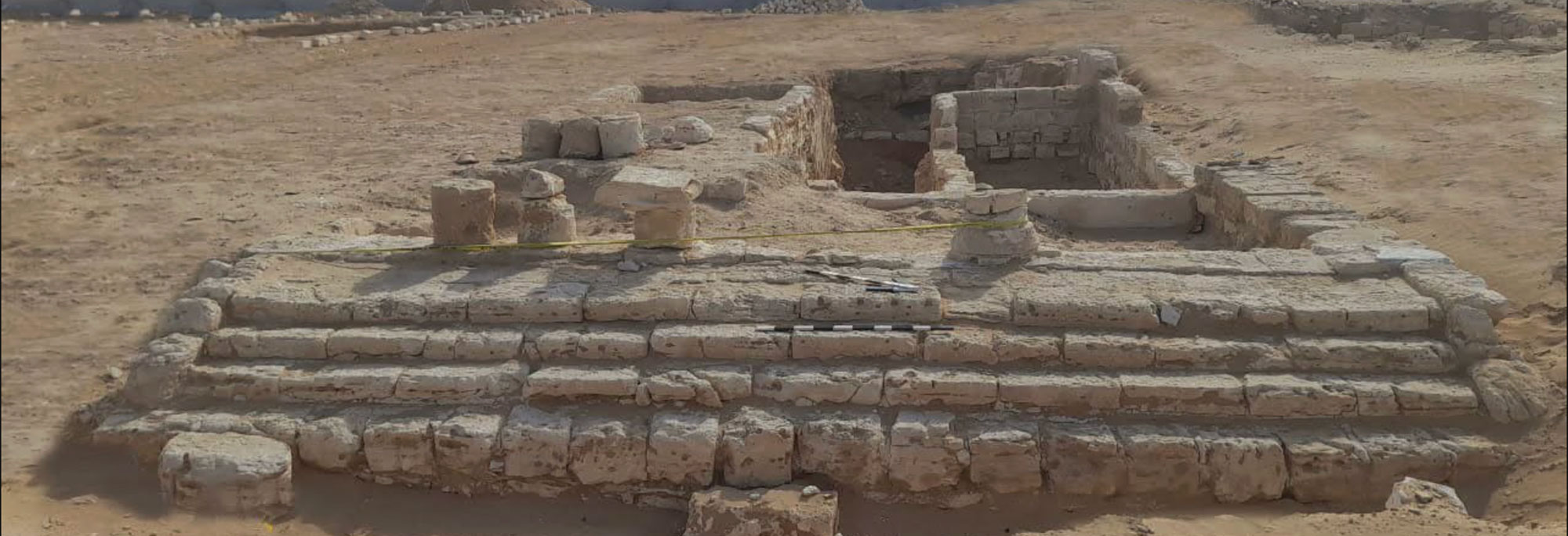
An Egyptian archaeological mission has uncovered 18 ancient tombs along the country's northwestern Mediterranean coast, some of them sealed for nearly two thousand years, the Ministry of Tourism and Antiquities announced. The graves, dating to the Ptolemaic and Roman periods, were found at Marina el-Alamein, the site of a once-thriving ancient port town.
The tombs were spread across two depths. Seven lay close to the surface, while the other 11 had been cut deep underground. Several of the burial chambers were discovered with their original stone blocking slabs still in place — a rare find that means the graves had never been disturbed or looted. Among the most striking discoveries was a granite sarcophagus roughly 2.5 meters, or about eight feet, long, its heavy lid still intact after nearly two millennia.
Inside several of the tombs, archaeologists recovered 24 gold pieces that had been placed in the mouths of the deceased — so-called "golden tongues." The practice reflected ancient funerary beliefs; the gold was thought to allow the dead to speak in the afterlife, particularly before Osiris, the god of the underworld, during the judgment of the soul. Such golden tongues have turned up at several Egyptian sites in recent years, but finding two dozen in a single excavation is notable.
The team also uncovered an offering altar whose base was carved to resemble a false door. "The false door is one of the oldest and most recognizable elements of ancient Egyptian funerary architecture," the ministry said, explaining that it "symbolizes the interface between the worlds of the living and the dead, through which the deceased could spiritually receive offerings presented by the living." The living would leave food and drink before such doors, believing the dead could pass through to receive them.
Marina el-Alamein, on the coast west of Alexandria, was a prosperous Greco-Roman settlement and trading hub, and its cemeteries have gradually revealed the blended Egyptian, Greek and Roman burial customs of the era. The new discoveries bring the total number of excavated tombs at the site to 44 since it was first identified in 1986, deepening scholars' understanding of a cosmopolitan community that flourished at the crossroads of the ancient Mediterranean.
Egyptian officials have increasingly showcased such finds as part of a broader push to revive tourism, a pillar of the national economy. A steady drumbeat of discoveries — from golden-tongued mummies to sealed sarcophagi — has kept the country's ancient past in the global spotlight, even as archaeologists caution that much of Marina el-Alamein's necropolis still lies buried beneath the coastal sands, awaiting future excavation.