China's JUNO Detector Delivers Most Precise Neutrino Measurement Yet
The Jiangmen Underground Neutrino Observatory's first results, published in Nature, sharpen two key oscillation parameters by a factor of 1.6 — a major step toward solving the neutrino mass puzzle.
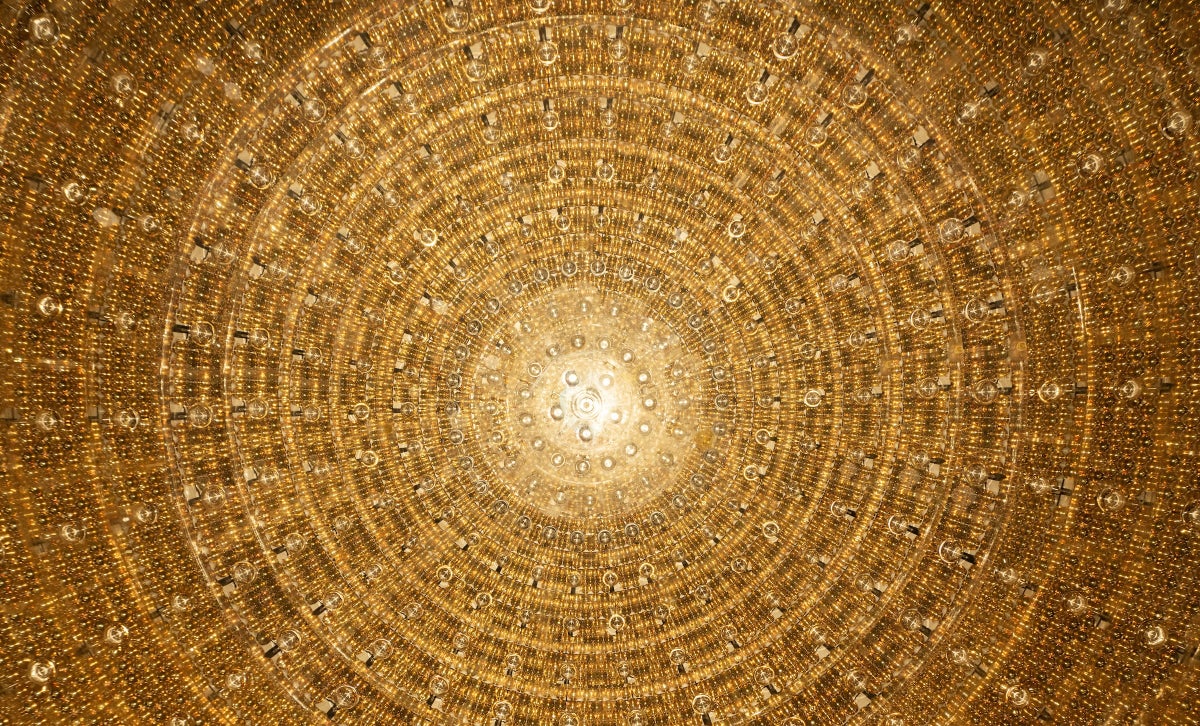
The Jiangmen Underground Neutrino Observatory, a vast detector buried beneath the hills of southern China, has delivered its first major physics result — and it is already the most precise measurement of its kind ever made. In a paper published in Nature on June 10, the JUNO Collaboration reported that it had pinned down two of the fundamental parameters governing how neutrinos change identity as they travel, sharpening the numbers by a factor of 1.6 over the best previous measurements assembled across decades of experiments.
Neutrinos are among the strangest particles in nature: nearly massless, electrically neutral, and so reluctant to interact that trillions pass harmlessly through every person each second. As they fly, they oscillate between three "flavors" — electron, muon and tau — a quantum behavior that can only happen if neutrinos have mass, a fact that the Standard Model of particle physics did not originally predict. Six parameters describe these oscillations; JUNO has now measured two of them with unrivaled precision.
The achievement rests on a remarkable instrument. JUNO sits 700 meters underground in Guangdong province, shielded from cosmic rays, and holds 20,000 tonnes of a specialized liquid inside a spherical detector that researchers liken to a 13-story-tall fishbowl. It primarily catches electron antineutrinos streaming from the nearby Yangjiang and Taishan nuclear power plants, whose reactors serve as a steady, well-understood source of the elusive particles.
The new results draw on just 59 days of high-quality data collected between August 26 and November 2, 2025 — a striking return for such a short initial run, and a sign of the detector's sensitivity. By reducing the uncertainties in the two oscillation parameters, JUNO tightens the constraints physicists use to test their theories and to hunt for cracks in the Standard Model.
The ultimate prize lies just ahead. JUNO's central mission is to determine the neutrino "mass ordering" — which of the three neutrino types is heaviest and which is lightest — a question that bears on everything from the behavior of exploding stars to why the universe contains matter at all. The first measurements lay the groundwork, demonstrating that the detector performs as designed and that the long-sought answer may be within reach.
For a field that has spent decades chasing one of nature's faintest signals, JUNO's debut marks the start of a new generation of experiments — and brings the neutrino mass mystery, as the researchers put it, sharply into focus.
Originally reported by Scientific American.