Your Brain Decides to Be Social Seconds Before You Move, Zebrafish Study Reveals
Recording activity across an entire vertebrate brain, scientists watched a wave of coordinated signaling sweep through the mind several seconds before a fish chose to approach another — and the stronger the signal, the more social the animal.
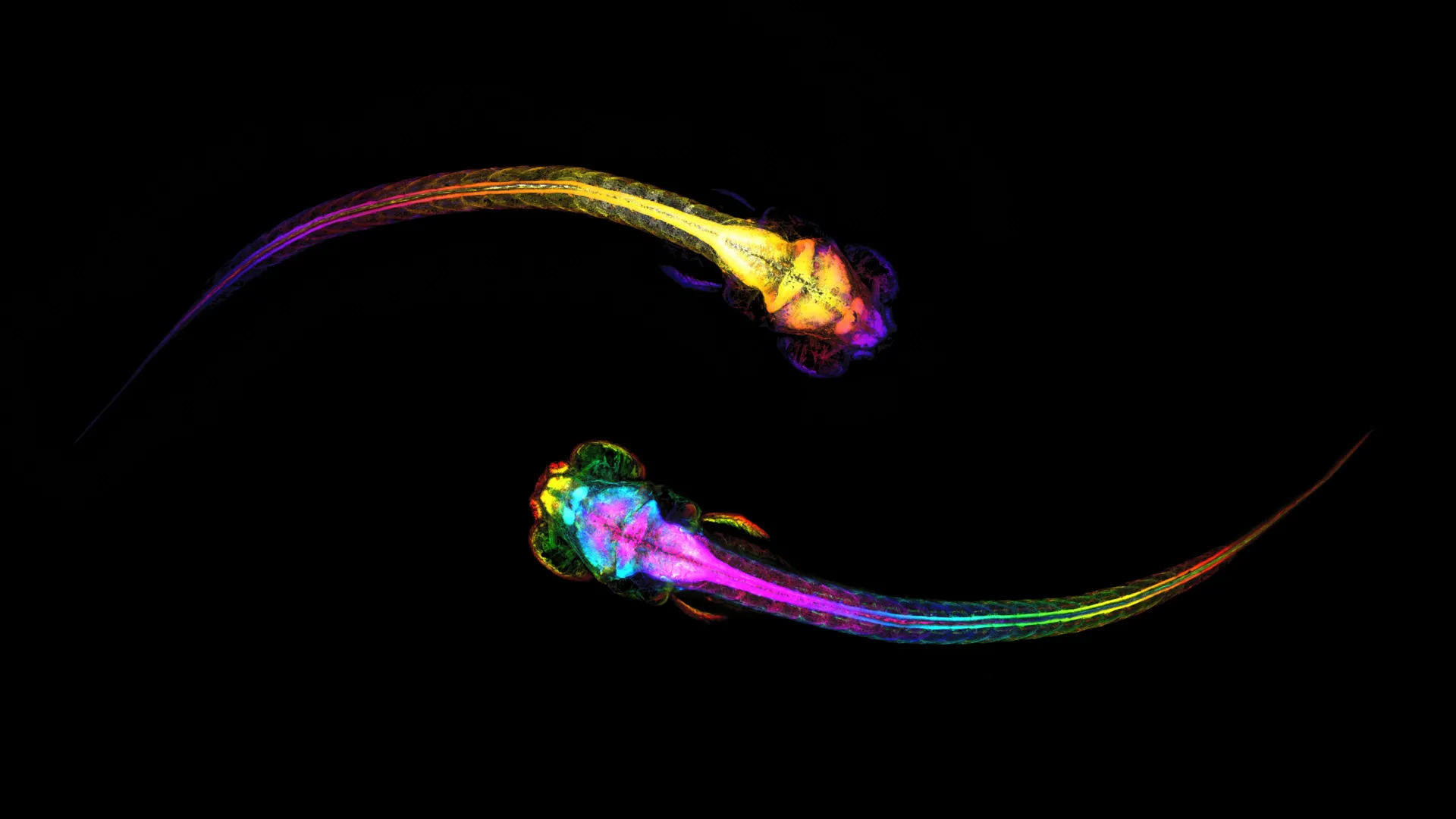
The decision to walk across a room and strike up a conversation may begin unfolding in the brain long before any muscle twitches, according to a new study that caught the neural prelude to social behavior in the act. Working with zebrafish, researchers at the Hebrew University of Jerusalem recorded a coordinated wave of activity spreading across the animal's entire brain several seconds before it moved to approach another fish.
Zebrafish are a favorite of neuroscientists for a simple reason: when young, they are nearly transparent, and their brains are small enough that scientists can monitor the firing of individual cells across the whole organ in real time. The team built an experimental setup in which one "observer" fish could watch and respond to another fish while researchers captured a brain-wide map of its neural activity, cell by cell.
What they saw was not a sudden, localized command to swim, but a distributed pattern of signaling that built up in advance of the approach. The activity foreshadowed the social choice, suggesting the brain quietly assembles a state of readiness — a kind of internal lean toward connection — before that intention ever surfaces as visible movement.
A higher-order brain region called the pallium, the evolutionary forerunner of the cortex in mammals, played a central role in orchestrating the pattern. And the strength of the signal tracked the personality of the fish: individuals with more robust neural buildup were generally more social, more inclined to seek out their tankmates, while weaker signals corresponded to more reserved animals.
The implication, the researchers say, is that social drive is encoded in the brain as a measurable, preparatory dynamic rather than a simple reflex to a stimulus. The brain is not merely reacting to the sight of another animal; it is predisposing the body to engage, and the magnitude of that predisposition reflects how strongly the individual is wired to connect.
Because the pallium is conserved across vertebrates — and because the molecular and circuit logic of zebrafish brains echoes our own in surprising ways — the findings, published in Nature Communications, may offer clues to how social motivation works in people. Researchers note that conditions ranging from autism to social anxiety involve differences in social approach, and understanding the neural signature that precedes the decision to engage could eventually help illuminate what changes when that drive is dialed up or down.