Astronomers Find a Cosmic 'Rosetta Stone' That Could Decode Deep-Space Radio Mysteries
Using Australia's ASKAP telescope, a team traced a baffling repeating signal to a white dwarf devouring its companion star — emitting bursts every 1.4 hours that are 100 times more powerful than any seen before.
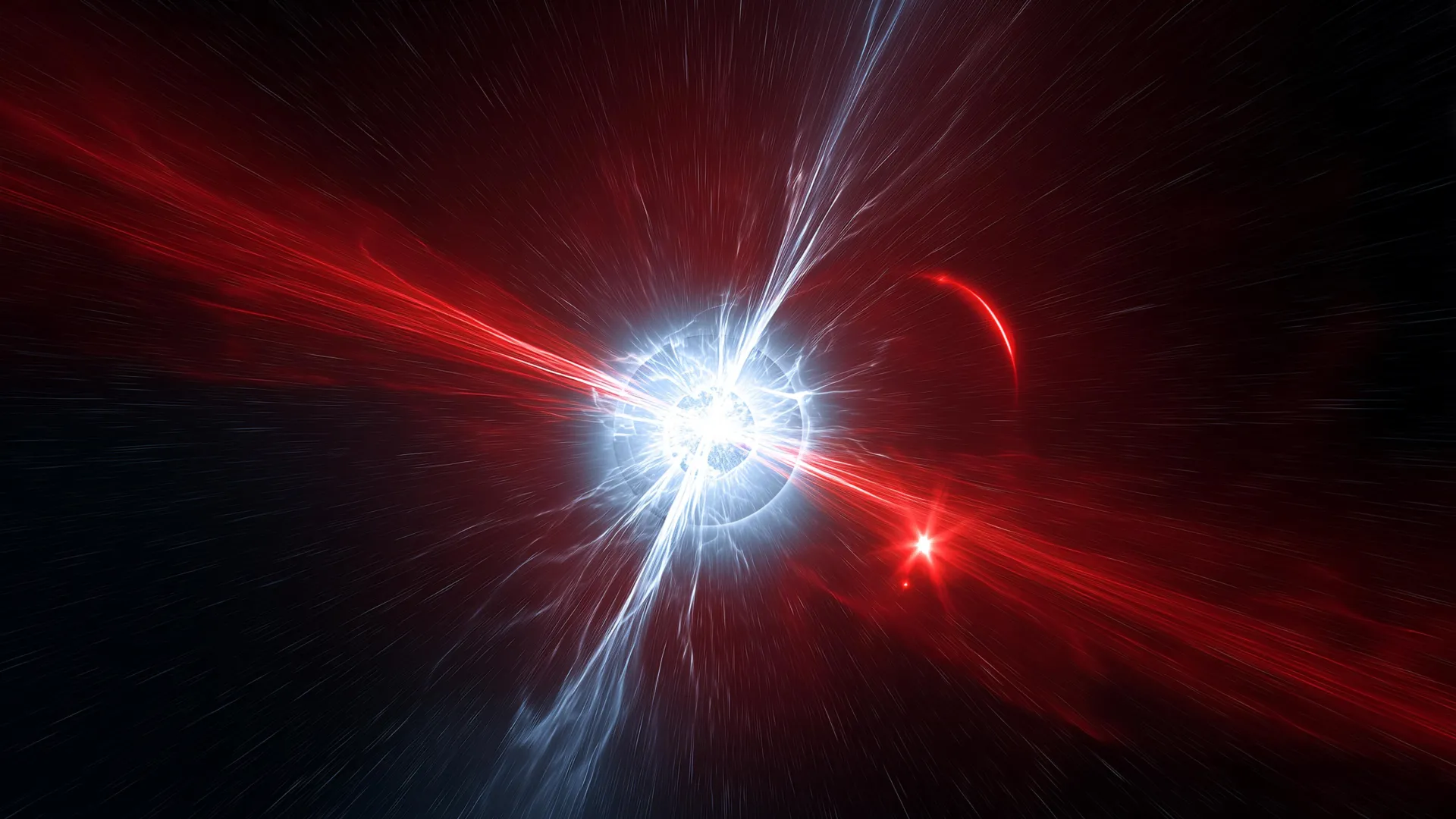
Astronomers say they have cracked one of the more stubborn puzzles in modern radio astronomy: the origin of a class of mysterious repeating signals that have flickered out of deep space for years without explanation. The answer, they report, is a violent stellar partnership that may serve as a "Rosetta Stone" for decoding similar transmissions across the galaxy.
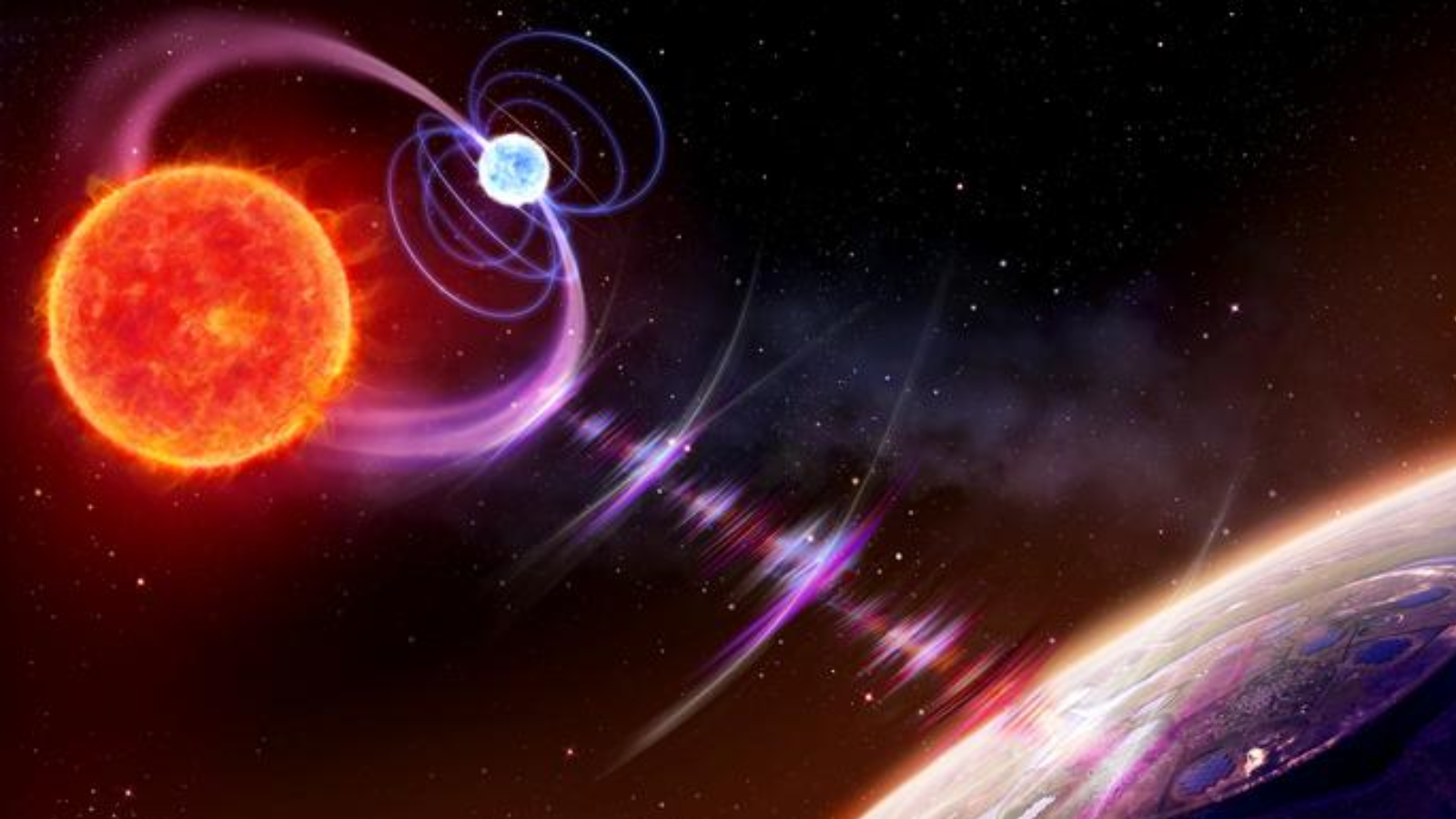
An international team led by scientists at the University of Sydney, using CSIRO's ASKAP radio telescope in Western Australia, traced the bursts to a rare stellar duo. In the system, a dense, burned-out star called a white dwarf is relentlessly siphoning material from a nearby red dwarf companion. As the stolen gas spirals inward, the system unleashes powerful pulses of radio waves and X-rays roughly every 1.4 hours.
The object, designated ASKAP J1745, belongs to a category astronomers call long-period transients — sources that pulse on timescales of minutes to hours, far slower than the rapid-fire flashes of typical pulsars. What sets this one apart is its sheer ferocity: the radio bursts are more than 100 times more powerful than those of any previously known feeding white dwarf binary.
Even more intriguing, the signal carries a pattern that had been seen in only one place before — the electromagnetic interaction between Jupiter and its volcanic moon Io, where the planet's magnetic field channels charged particles into bursts of radio emission. Detecting that same signature in a distant binary star suggests a shared underlying physics linking objects of wildly different scales.
The discovery is being hailed as a breakthrough because ASKAP J1745 is the first long-period transient observed to show signs of accretion — matter falling onto a star — across the full spectrum of light, from radio waves through visible light to X-rays. That multi-wavelength view gives astronomers a complete physical picture they have never had for such an object.
Long-period transients have been one of the hottest puzzles in astronomy since the first examples were reported only a few years ago. Some researchers had speculated they might be exotic neutron stars with extraordinarily strong magnetic fields; others suspected unusual white dwarfs. The trouble was that the radio bursts alone offered too few clues to settle the question, leaving the field with a growing catalog of signals and no firm explanation for any of them.
Researchers are calling ASKAP J1745 a cosmic Rosetta Stone because understanding one well-characterized example could unlock the meaning of the many other long-period transients that remain unexplained. Just as the original Rosetta Stone let scholars finally read Egyptian hieroglyphs, this single, richly detailed system may give astronomers the key to translate a whole family of cryptic cosmic signals. As more sensitive radio surveys come online, the team expects the roster of these objects to keep growing — and now, for the first time, scientists have a template against which to test what each new discovery might be.