Astronomers Capture the First 'Live' View of a Planetary Nursery Spinning Around a Distant Star
Using the European VLT's SPHERE instrument over four years, a French-led team directly tracked the rotation of the planet-forming disk around the young star AB Aurigae — and spotted anomalies that hint at giant planets being born.

Astronomers have, for the first time, directly observed the rotation of a "planetary nursery" — the swirling disk of gas and dust around a young star where new worlds are born — capturing the slow turning of the cosmic cradle in something close to real time.
The breakthrough centers on AB Aurigae, a young star surrounded by a protoplanetary disk that has long fascinated researchers. A team led by scientists at France's CNRS and the University of Bordeaux mapped emissions from the dust grains within the disk, tracking its structures and watching them move across multiple observing campaigns. The results were published in the journal Astronomy & Astrophysics.
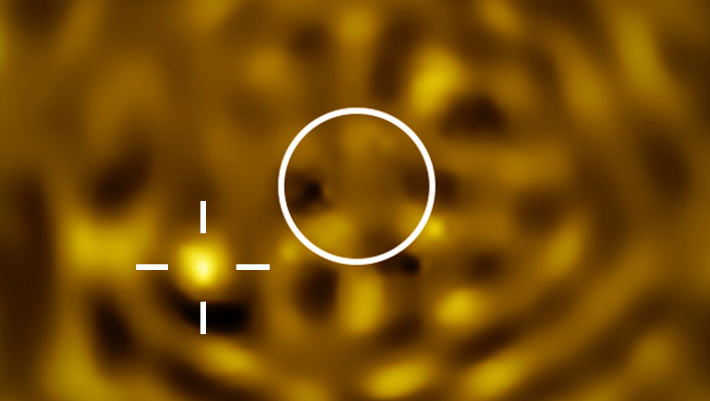
The team relied on the unique near-infrared capabilities of the SPHERE instrument mounted on the European Southern Observatory's Very Large Telescope in Chile, whose exceptional spatial resolution allowed researchers to follow fine details within the disk. By comparing three sets of observations collected over a four-year period, the scientists were able to detect how the disk's features evolved — effectively turning a still image into a slow-motion movie of planetary formation.
While the disk as a whole appears to rotate in accordance with the expected laws of physics, certain regions close to the star showed an unexpected departure from that orderly motion. Researchers say the most compelling explanation for these anomalies is the presence of giant planets still in the process of forming, whose gravity disturbs the surrounding material and leaves telltale fingerprints in the disk's dynamics.
That interpretation is significant because catching planets in the act of forming is extraordinarily difficult. Newborn worlds are typically hidden within the dense gas and dust of their birth disks, and astronomers usually infer their presence indirectly — from gaps, rings or spirals carved into the disk. Watching the disk actually rotate, and pinpointing where its motion goes awry, offers a more direct window into how and where planets coalesce.
The study sheds fresh light on the mechanisms of planet formation and the complex dynamics of protoplanetary disks, processes that ultimately shaped our own solar system some 4.6 billion years ago. As instruments grow more sensitive, astronomers hope to extend this "live" approach to other young stellar systems, building a clearer picture of the chaotic, dynamic environments in which planets — and perhaps the conditions for life — first take shape.
AB Aurigae, located roughly 500 light-years from Earth in the constellation Auriga, has become a favorite laboratory for planet-formation studies precisely because its disk is bright, nearby and richly structured, with spiral arms that earlier observations had already revealed. By repeatedly imaging the same system and measuring how its features shift, the researchers were able to convert those static snapshots into a measurement of motion — a technique that, applied over longer baselines, could eventually let astronomers watch a young planetary system evolve across years and decades.