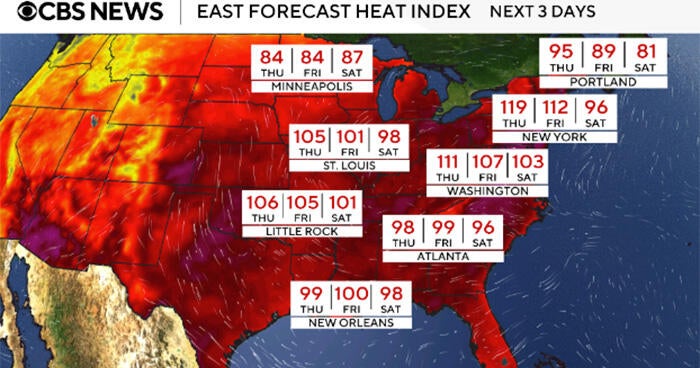
New Study Finds U.S. States Are Warming Unevenly — Reality More Alarming Than Averages Suggest
Only 27 states show rising average temperatures, but 41 states are warming in specific parts of their temperature distributions.
A major new climate study has found that while average temperatures are rising in just over half of all U.S. states, the true picture of American climate change is far more nuanced — and in some ways more alarming — than headline warming statistics suggest. The research, published in the journal PLOS and analyzed by ScienceDaily, found that 41 of the 48 contiguous states are experiencing statistically significant warming in specific parts of their temperature distributions, even when average temperatures show no significant trend.
The study was led by María Dolores Gadea Rivas of the University of Zaragoza, Spain, and Jesús Gonzalo of the University Carlos III in Madrid. Their dataset spanned more than 26,000 daily temperature readings per state from 1950 to 2021 — a comprehensive 70-year archive that allowed the researchers to analyze not just averages but the full shape of each state's temperature distribution across seasons and decades. Their key finding upended a common assumption: that warming is either present or absent in a given location. In reality, warming can be absent on average while still pushing up temperature extremes or raising overnight lows — changes with profound consequences for public health, agriculture, and infrastructure.
The geographic patterns that emerged from the data are striking. Western states are experiencing elevated annual temperature extremes — hotter peak temperatures than historical baselines would predict — even in cases where mean warming is not statistically detectable. Northern states are seeing their minimum temperatures rise most sharply, meaning fewer cold nights and compressed winters. This translates into real-world consequences: pest and disease ranges expanding northward, disrupted seasonal agriculture, reduced winter snowpack, and heat stress events in areas that historically relied on cool nights to provide relief. "Most U.S. states are warming in specific parts of the temperature distribution, even when average warming is not statistically significant," Gadea Rivas said.
The policy implications of the research are significant. Federal climate adaptation programs have often been designed around average temperature projections — tools like mean warming maps that show uniform or smooth gradients of change across the country. The new findings suggest that approach misses crucial regional variation. A state that shows no average warming trend may still need to prepare for dramatically hotter extreme events or for the loss of reliably cold winters that agricultural planning has historically assumed. "Location-specific approaches" to climate adaptation are essential, the researchers argued, not uniform national policies calibrated to a single warming number.
The study arrives as the U.S. government has dramatically reduced its federal climate monitoring and adaptation infrastructure under the current administration, which has moved to scale back the Environmental Protection Agency's climate programs, withdraw from international climate commitments, and reduce funding for NOAA's weather and climate research. Scientists outside the government have warned that this retreat from federal climate science will make it harder to implement exactly the kind of granular, state-level adaptation strategies that the new PLOS research recommends. The academic community, meanwhile, continues to publish findings that underscore the complexity and urgency of the challenge — even as the policy environment for acting on that science has become more restrictive.