UCLA Starved Brain Stem Cells of Glucose and They Started Building the Wrong Neurons Too Early
Two studies find that radial glia — the cells that construct most of the human cortex — take their instructions from how they burn sugar and from thalamic fibers physically touching them.
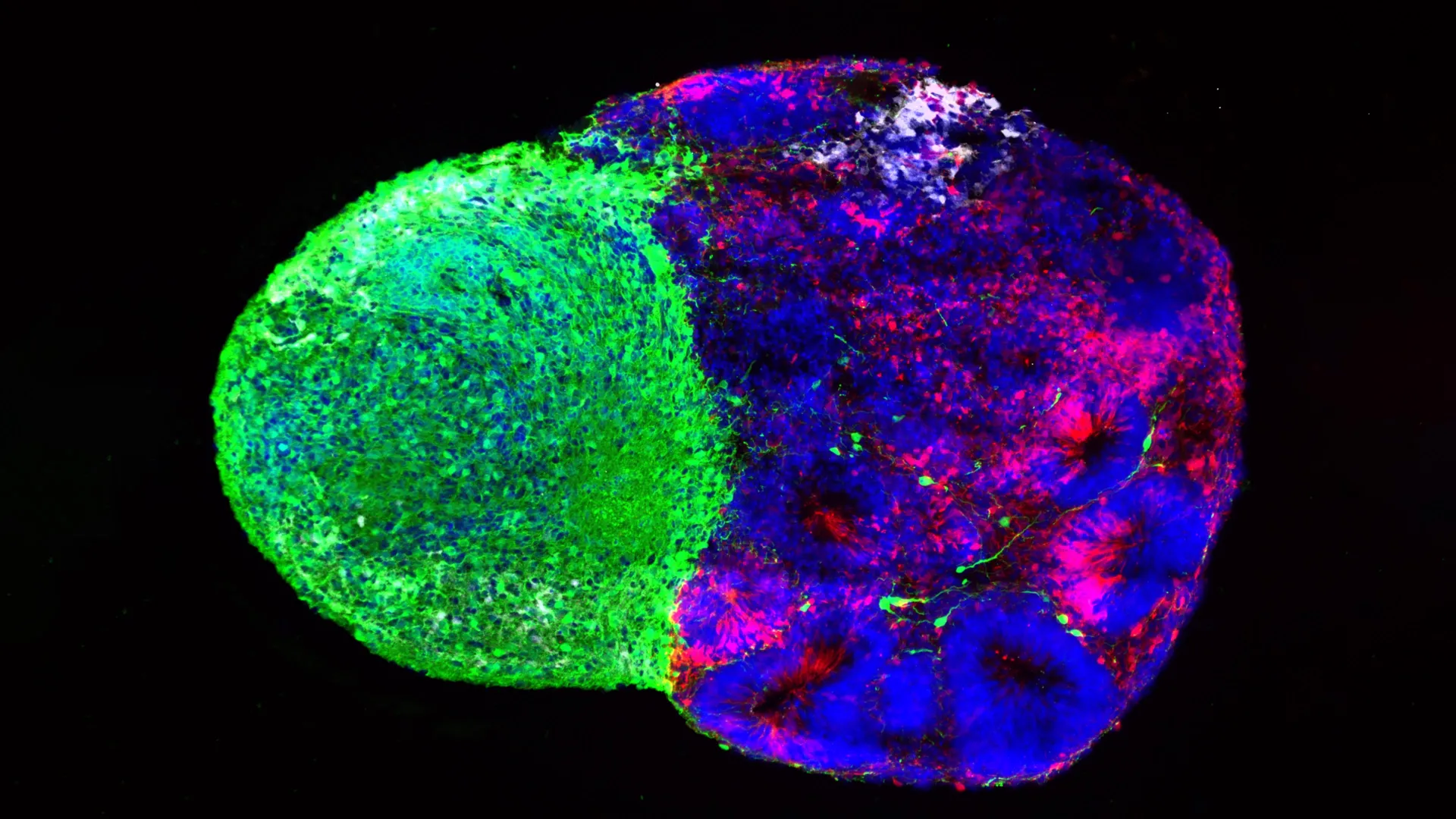
The human cerebral cortex is built almost entirely by one class of cell. Radial glia sit in the developing brain and divide, producing neuron after neuron in a strict sequence — deep layers first, upper layers later — while their long fibers act as scaffolding the new cells climb. The order has been documented for decades. What has never been clear is what tells a radial glial cell which neuron to make, and when. Two UCLA studies published this week point at two answers, and neither is a gene.
The first is metabolic. The researchers found that radial glia lean heavily on the pentose phosphate pathway, a branch of glucose metabolism that supplies the building blocks rapidly dividing cells need. When the team lowered available glucose, or interfered with the pathway directly, the stem cells did not simply slow down or die. They changed their output. They began producing more inhibitory neurons and other cell types that normally appear later in development — the schedule ran ahead of itself.
The second is mechanical. Fibers projecting from the thalamus, the brain's central relay, reach the cortex while it is still under construction, and the team found they physically contact radial glia during that window. That contact altered what the stem cells produced, including upper-layer neurons — the ones that are disproportionately expanded in humans compared with other primates, and that carry much of the cortex's long-range wiring.
Both results move something that had been treated as background into the foreground. Nutrient supply and incoming axons were understood as conditions the developing brain happens to sit in. These studies recast them as instructions. The cortex is not only executing a genetic program; it is reading its own environment — the sugar reaching it, the fibers touching it — and adjusting production accordingly.
The clinical implications follow directly, and they are uncomfortable. Fetal glucose availability is not a fixed quantity. It varies with maternal diabetes, with placental insufficiency, with malnutrition. If the pentose phosphate pathway is part of how radial glia keep time, then metabolic disturbances during specific developmental windows could shift the composition of the cortex — the balance of excitatory and inhibitory neurons — in ways that no single gene variant would explain. That balance is implicated across a range of neurodevelopmental disorders.
The same machinery has a second life. Radial glia divide fast and are metabolically demanding, which is also a fair description of tumor cells, and the pentose phosphate pathway is already a subject of interest in cancer biology. Work of this kind depends on human tissue models — the organoids that let researchers watch cortical and thalamic tissue develop and interact — because the timing that matters here, particularly the expansion of upper-layer neurons, is precisely where the mouse brain stops being a good stand-in for ours.