Supercomputer Simulation Overturns 45-Year Prediction: Sun-Like Stars Never Stop Rotating Differentially
Japan's Fugaku computer resolved stellar magnetic fields at 5.4 billion grid points, revealing that the fields prevent sun-like stars from ever switching to solid-body rotation — rewriting solar physics textbooks.

A supercomputer simulation using Japan's Fugaku — the world's most powerful publicly available computing system — has overturned a 45-year-old theoretical prediction about how stars like our sun rotate, finding that magnetic fields prevent solar-type stars from ever undergoing a fundamental change in their rotation pattern previously thought to be inevitable as they age. The result, published in Nature Astronomy, has implications for understanding the long-term stability of our own sun and the habitability of planets orbiting similar stars.
For nearly five decades, models of stellar physics predicted that sun-like stars begin their lives rotating differentially — meaning their equators spin faster than their poles, just as the sun does today — but gradually transition to solid-body rotation as they age, in which all latitudes rotate at the same speed. This transition was expected to occur over billions of years as the star shed angular momentum through its stellar wind. The prediction had never been directly confirmed because stellar rotation profiles cannot be observed directly in distant stars, but it had become a widely accepted component of standard solar models.
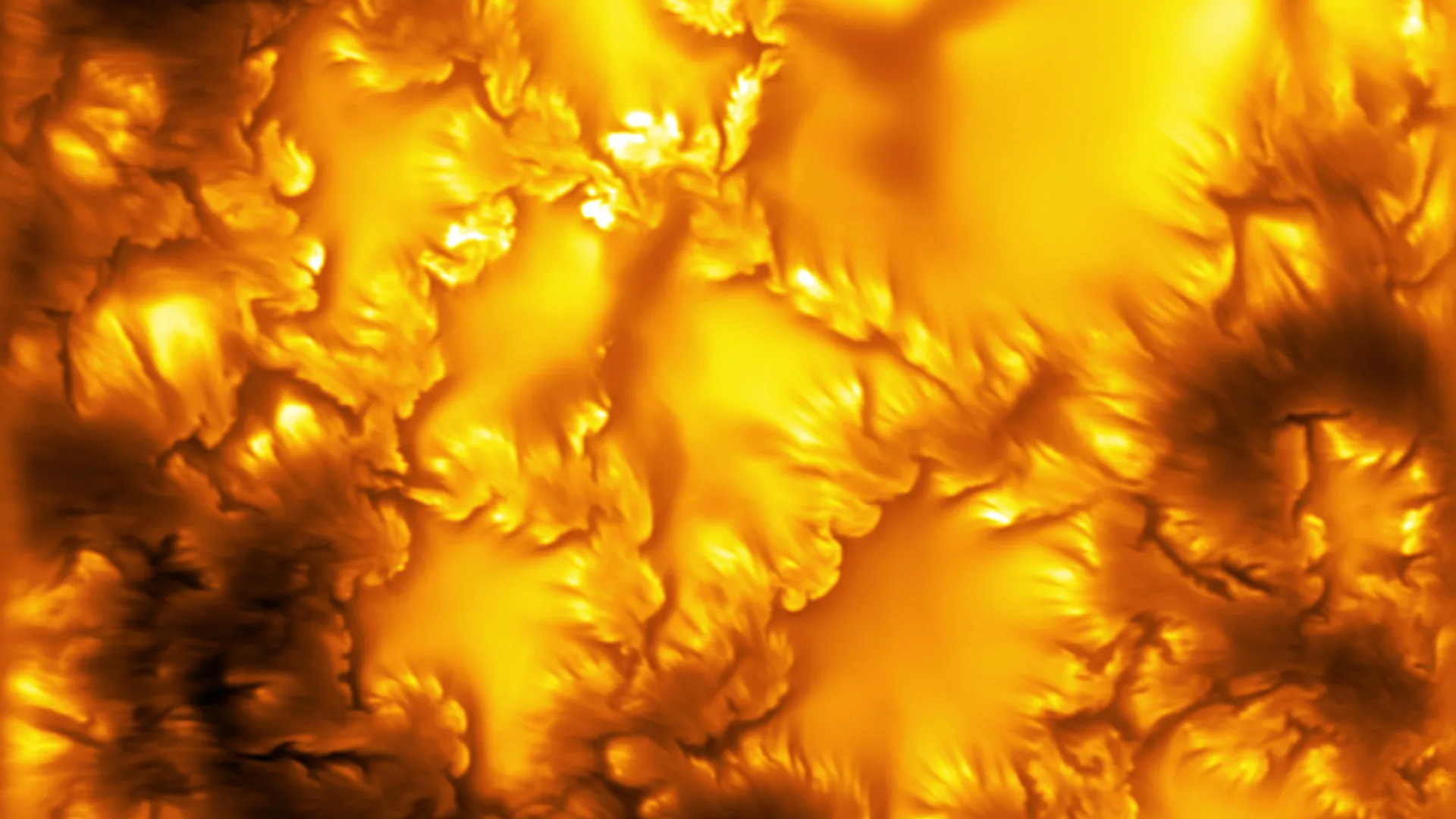
The Nagoya University team, led by professor Hideyuki Hotta, ran simulations on Fugaku representing the interior of a sun-like star at a resolution of 5.4 billion grid points — far beyond what had previously been computationally feasible. At that resolution, the simulation captured the behavior of the star's magnetic field in sufficient detail to reveal that differential rotation generates a self-reinforcing magnetic feedback loop that continuously counteracts any tendency toward solid-body rotation, effectively locking the differential pattern in place throughout the star's main-sequence lifetime.
"Previous simulations simply did not have the resolution to capture this effect," Hotta said. "When you include the magnetic field at the right scale, the transition never happens. The equatorial acceleration is stable for the entire life of the star." The finding helps explain several puzzles in solar physics, including why helioseismology observations — which measure acoustic waves propagating through the sun's interior — consistently find differential rotation at the current epoch even though the sun is already 4.6 billion years old and should, by the old theory, be approaching solid-body rotation.
The result also has important implications for astrobiology and the search for habitable planets. The rate at which a star rotates differentially determines the strength and variability of its magnetic activity, which in turn drives the production of solar flares and energetic particle events that can damage planetary atmospheres and surface chemistry. If solar-type stars maintain consistent differential rotation throughout their lives rather than gradually calming down as previously thought, it suggests that planets around middle-aged sun-like stars face a more predictable — though not necessarily more benign — radiation environment than earlier models had projected. Researchers said the next step would be testing the model's predictions against asteroseismology data from the Kepler and PLATO space missions, which have measured interior rotation profiles for thousands of sun-like stars.