Scientists Capture Trees Glowing with Electricity During Thunderstorms
Researchers driving storm-chasing equipment finally observed 'corona discharges' in nature—faint UV flashes from treetops that had been theorized for over 70 years but never confirmed outside a laboratory.
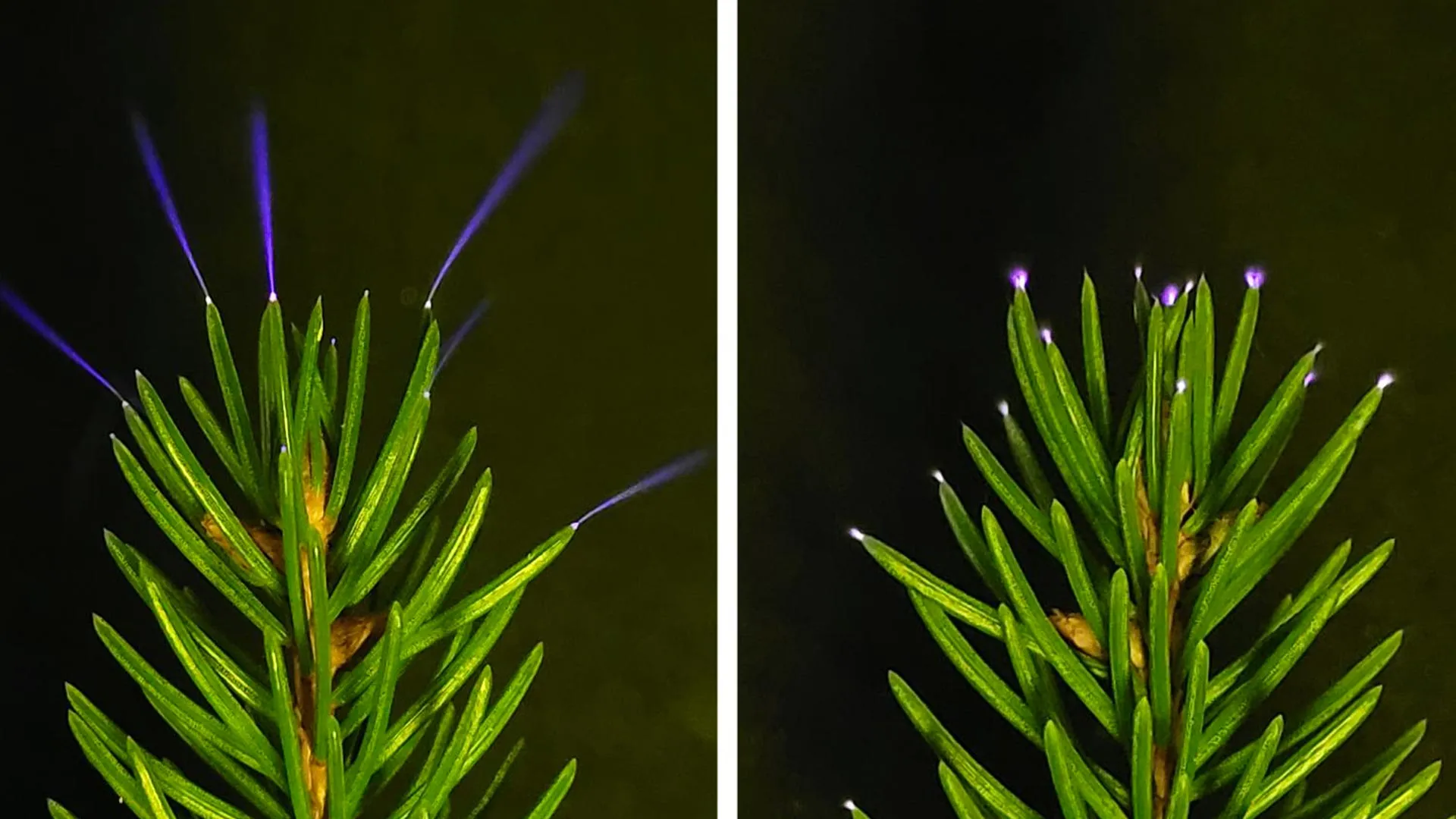
Penn State researchers have achieved a breakthrough that has eluded scientists for more than seven decades: capturing direct evidence of trees producing electrical corona discharges during natural thunderstorms. The phenomenon, which causes treetops to emit faint ultraviolet light during storms, had been theorized since the 1950s but never confirmed in real-world conditions. Using a modified 2013 Toyota Sienna equipped with specialized telescopic weather instruments, the research team spent weeks chasing Florida thunderstorms before finally documenting the elusive electrical displays at the University of North Carolina at Pembroke.
The corona discharges occur when strong electrical imbalances develop during thunderstorms, with negatively charged clouds attracting positive charges from the ground. This positive electrical charge travels upward through trees and concentrates at the highest points, particularly at leaf tips. When the electrical field becomes sufficiently intense, tiny bursts of electricity form at these sharp points, creating brief flashes of ultraviolet light that are invisible to the naked eye but detectable with specialized equipment.
The research team, led by distinguished professor William Brune and doctoral student Patrick McFarland, initially struggled to find suitable conditions for their observations. After three weeks of following short-lived storms in Florida that dissipated too quickly for useful data collection, the breakthrough came during their return journey to Pennsylvania. Large, persistent storms developed west of Interstate 95, providing the extended observation period needed to document the phenomenon. During a nearly two-hour thunderstorm, the team successfully recorded corona discharges on both a sweetgum tree and a loblolly pine.
The discovery has significant implications beyond basic atmospheric science. Corona discharges may play an important role in atmospheric chemistry by breaking down pollutants in the air around forests. The electrical activity could help explain certain atmospheric processes that have puzzled scientists and might contribute to air quality in ways that were previously unknown. The finding also validates decades of theoretical work by atmospheric scientists who suspected that forests might produce these electrical effects during storms.
McFarland, the study's lead author, emphasized the significance of the confirmation, stating that 'this just goes to show that there's still discovery science being done. For more than half a century, scientists have theorized that corona exists, but this proves it.' The research, published in Geophysical Research Letters, opens new avenues for studying how forests interact with atmospheric electrical phenomena and could lead to better understanding of the complex relationships between vegetation, weather, and air chemistry during thunderstorms.