Physicists Stretch a Magnetic 'Ripple' 100-Fold, Clearing a Path to Penny-Sized Quantum Computers
University of Vienna researchers kept magnons alive for 18 microseconds — long enough to carry quantum information — by chilling ultrapure crystals to a whisker above absolute zero.
Physicists have extended the fleeting lifespan of magnons — tiny collective ripples of magnetism — by roughly 100 times, transforming a phenomenon long dismissed as too short-lived to be useful into a promising carrier of quantum information.
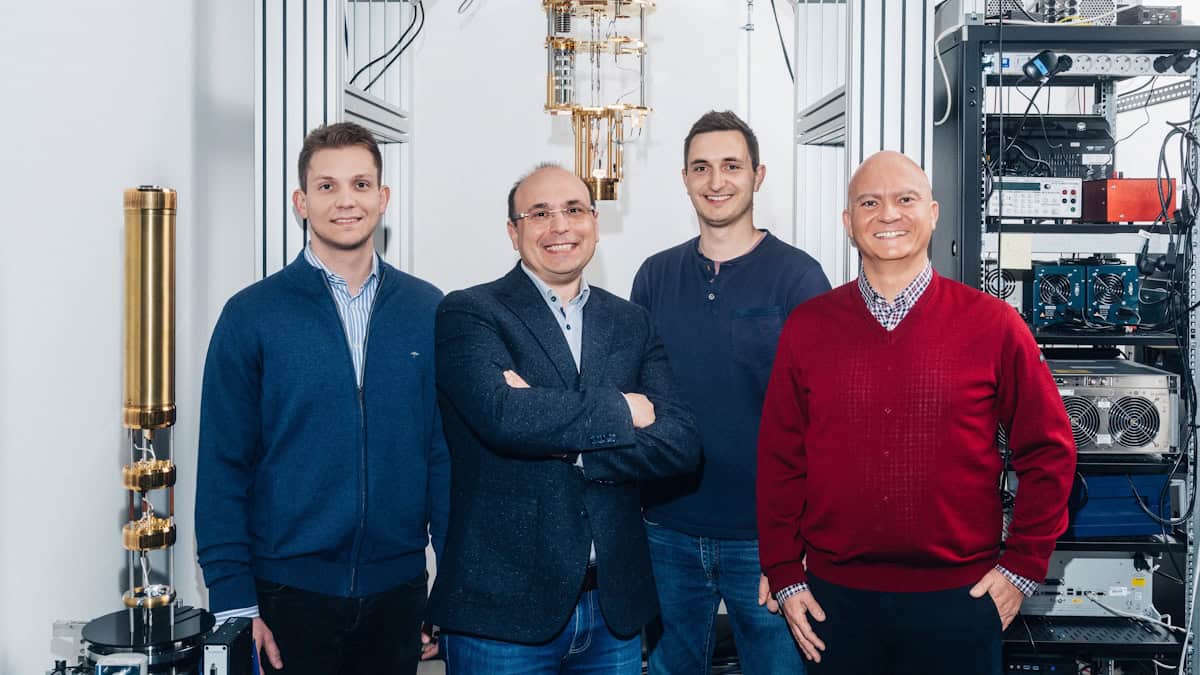
A magnon is a wave of coordinated wobbling among the magnetic spins inside a material, a little like a ripple spreading across a pond of compass needles. Until now, magnons flickered out after just a few hundred nanoseconds, far too quickly to store or shuttle delicate quantum states. In research published in the journal Science Advances, a team led by Andrii Chumak at the University of Vienna kept them alive for up to 18 microseconds.
The group achieved the leap with two complementary tricks. First, they generated short-wavelength magnons, which are less easily scattered by imperfections at a material's surface. Second, they cooled ultrapure spheres of yttrium iron garnet — a synthetic crystal prized for its magnetic properties — to just 30 millikelvin, a temperature only thousandths of a degree above absolute zero, where thermal disturbances all but vanish.
Perhaps the most consequential finding was not the number itself but what it revealed about the limits. The team concluded that the lifespan of a magnon is not fixed by the fundamental laws of physics, but by the quality of the material it travels through. That distinction matters: it means future gains hinge on better materials and cleaner crystals rather than on some undiscovered physics, a far more tractable engineering path.
The payoff could be dramatically smaller quantum hardware. Because magnons pack magnetic information into extraordinarily compact waves, devices built around them could, in principle, shrink components that today fill laboratory benches down toward the size of a coin — an appealing prospect for a field where scaling up quantum machines remains a central obstacle.
Why does lifetime matter so much? In quantum technology, information is stored in fragile states that decay the moment they interact with their noisy surroundings. The longer a carrier survives, the more operations can be performed before the information is lost — so stretching a magnon's life from nanoseconds to microseconds is the difference between a curiosity and a usable building block. Magnons also couple naturally to microwaves and to the spins used in other quantum platforms, making them attractive as go-betweens that could link different parts of a future quantum machine.
The work drew on collaborators at the University of Colorado, Colorado Springs, and institutions across Germany, the United States and Ukraine. Practical magnon-based quantum computers remain years away, and 30-millikelvin refrigeration is no small requirement. But by showing that these magnetic ripples can be coaxed into lasting long enough to matter, the researchers have nudged a once-overlooked idea onto the roadmap of serious quantum technologies.