NASA Captures Stunning X-Ray Portrait of RCW 86, the Oldest Documented Supernova in Human History
The Imaging X-ray Polarimetry Explorer spacecraft revealed new detail in the remains of a stellar explosion first recorded by Chinese astronomers in 185 AD, using polarized X-rays to map its magnetic fields.
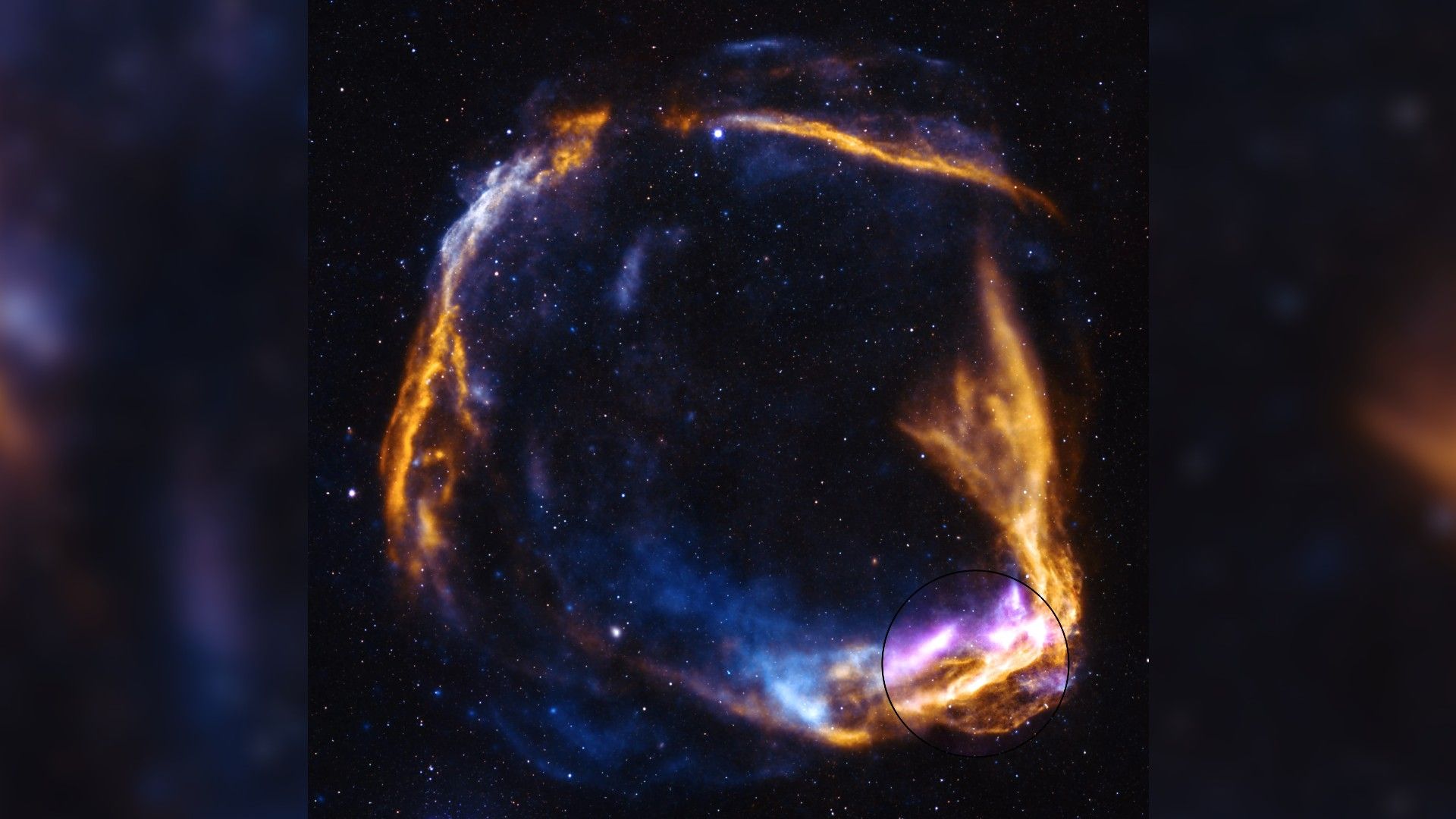
A new X-ray image of RCW 86, the oldest documented supernova in human history, has been captured by NASA's Imaging X-ray Polarimetry Explorer (IXPE) spacecraft, offering the most detailed view yet of what remains from a cosmic explosion first witnessed by Chinese court astronomers nearly 1,840 years ago. Released Thursday as NASA's Space Photo of the Day, the photograph reveals an ethereal, multicolored ring of expanding plasma and magnetic field filaments against a field of background stars — a ghostly relic of the violent stellar death that lit up the skies over ancient Earth in 185 AD and puzzled observers for eight months before finally fading.
RCW 86 sits approximately 8,000 light-years from Earth in the direction of the southern constellation Circinus. The explosion that created it was recorded by Han dynasty astronomers in the Book of Later Han, which described a "guest star" appearing near the southern horizon — the earliest surviving documented observation of a supernova in all of human astronomical literature. For nearly two millennia, the remnant expanded invisibly through the interstellar medium at thousands of kilometers per second. Only in the 20th century did radio and X-ray observatories begin to reveal the vast, irregular shell of superheated plasma that the explosion left behind, still racing outward long after the ancient observers who recorded it turned to dust.
IXPE, launched in December 2021 as a joint mission between NASA and the Italian Space Agency, uses a novel instrument to measure not just the brightness of X-ray emissions from cosmic objects but the direction and degree of polarization of the X-rays themselves — a technique that reveals the geometry of magnetic fields and the efficiency with which the supernova's expanding shock wave accelerates charged particles to near-light speeds. Polarimetry had never before been applied to RCW 86 at this resolution, making the new image a scientific first rather than merely an aesthetic achievement. NASA scientists say the data will be submitted to peer-reviewed journals in the coming weeks.
The image shows a striking asymmetry in RCW 86's structure. The northeastern rim of the remnant is far brighter in X-ray emission and far more highly polarized than the rest of the shell, suggesting the original explosion expanded into a particularly dense region of the interstellar medium on that side, generating a stronger shock wave and more intense particle acceleration. This asymmetry helps researchers reconstruct the three-dimensional structure of the environment the star exploded into roughly 18 centuries ago. Current evidence points to a Type Ia supernova — an explosion triggered by a white dwarf star stealing material from a companion star until the dwarf becomes unstable and detonates — rather than the gravitational collapse of a single massive star.
The new RCW 86 portrait joins a growing portfolio of IXPE observations that are reshaping how astronomers understand the physics of stellar explosions. The telescope has so far observed more than 100 cosmic objects, and its data are being combined with imagery from the Chandra X-ray Observatory and the James Webb Space Telescope to construct multi-wavelength, three-dimensional portraits of ancient cosmic explosions. For scientists, the photograph is a reminder that some of the most spectacular laboratories in the universe are the ruins of catastrophes recorded long ago by patient human observers who watched with the naked eye and wrote down what they saw.