New MXene Synthesis Method Boosts Electrical Conductivity 160-Fold, Unlocking Next-Gen Electronics
A German research team replaced acid etching with molten salts and iodine vapor to produce perfectly ordered 2D materials — making them viable for radar coatings, flexible electronics, and advanced wireless systems.

Researchers at the Helmholtz-Zentrum Dresden-Rossendorf and TU Dresden have achieved a 160-fold increase in the electrical conductivity of MXenes — a family of ultrathin two-dimensional materials — by developing a fundamentally new synthesis method that eliminates the surface disorder that has long limited their performance. The breakthrough, published in Nature Synthesis, could accelerate the development of next-generation flexible electronics, radar-absorbing stealth coatings, electromagnetic shielding, and advanced wireless communication systems.
MXenes are among the most intensively studied materials in modern physics and engineering. Discovered in 2011, they are produced by etching layers from a class of materials called MAX phases, leaving behind sheets just a few atoms thick with extraordinary electrical, mechanical, and optical properties. But the traditional production process — using corrosive acids — leaves the surface atoms in a disordered, partially contaminated state that severely limits how efficiently electrons can flow through the material. The new research directly solves this problem.
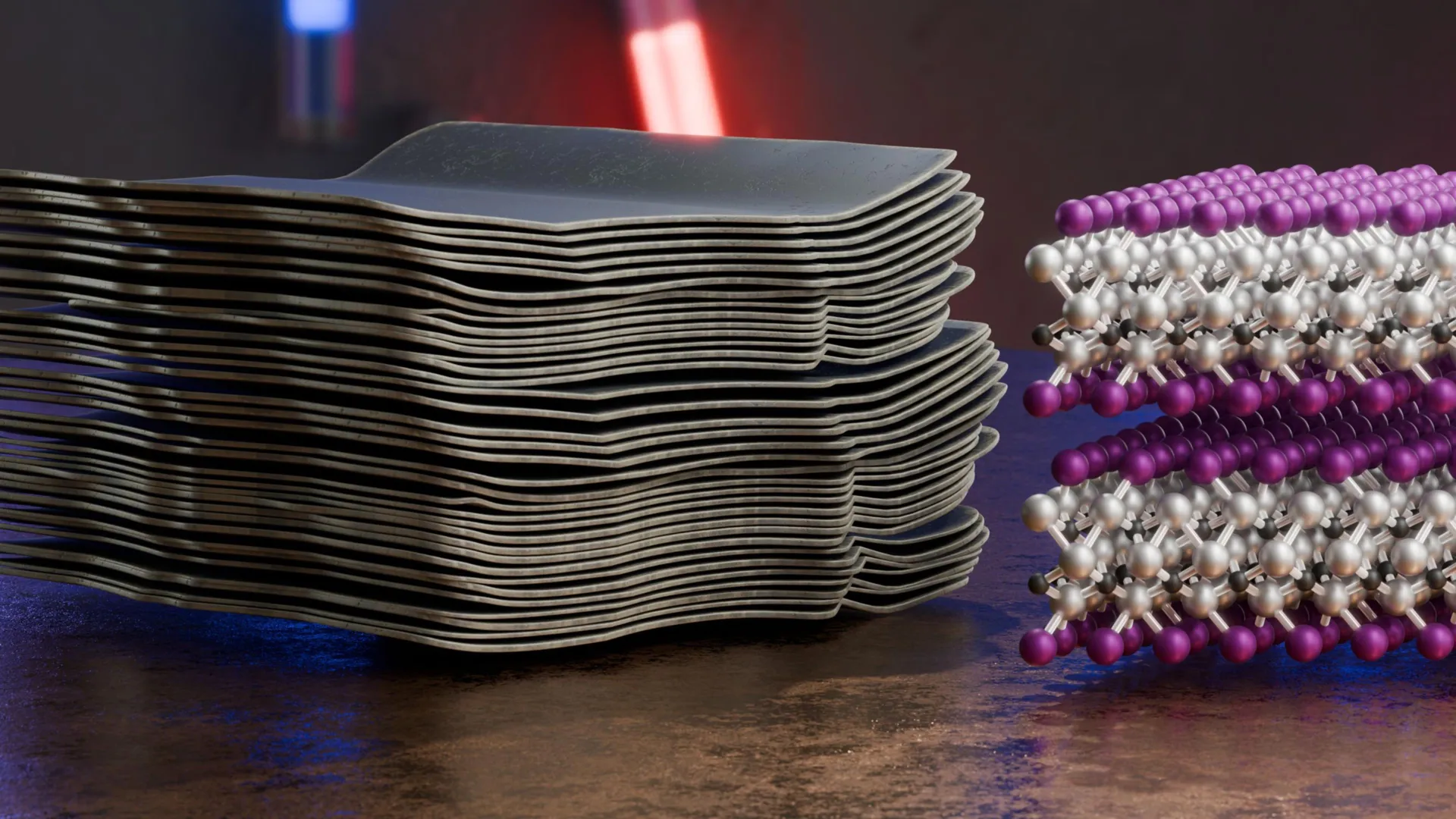
Lead researcher Dr. Dongqi Li of TU Dresden and his collaborator Dr. Mahdi Ghorbani-Asl of HZDR's Institute of Ion Beam Physics developed a gas-liquid-solid process, or GLS method, that replaces acid etching with a combination of molten salts and iodine vapor. Instead of randomly stripping atoms away and leaving messy surfaces, the GLS method allows researchers to control which halogen atoms — chlorine, bromine, or iodine — attach to the MXene surface, producing a perfectly ordered, uniform atomic layer with dramatically reduced impurities. "Atomic disorder limits performance because it traps and scatters electrons, much like potholes slowing traffic," Li explained. "Surface atoms strongly influence how electrons move, how the material interacts with light, heat, and chemical environments," added Ghorbani-Asl.
The performance numbers in the study are striking. The chlorine-terminated MXene produced via the GLS method showed a 160-fold increase in macroscopic electrical conductivity, a 13-fold enhancement in terahertz conductivity, and a nearly fourfold increase in charge carrier mobility compared with the same material made by traditional methods. The team verified these results using density functional theory calculations and quantum transport simulations, showing that the improvements stem directly from the elimination of surface disorder rather than any compositional change in the material. The method was successfully applied to eight different MAX phase precursors, suggesting it is broadly applicable rather than limited to one specific material.
The electromagnetic properties of the new MXenes are particularly promising for defense and wireless applications. The chlorine-terminated variants showed strong electromagnetic wave absorption in the 14–18 GHz frequency range, which is used in radar systems. The ability to tune which halogen covers the surface means engineers could, in principle, design MXenes that absorb at specific frequencies — useful for stealth coatings — or reflect them, useful for shielding sensitive electronics from interference. Researchers at the Max Planck Institute of Microstructure Physics and several European partner institutions contributed to the theoretical modeling underpinning the results.
The implications extend beyond defense. MXenes with dramatically improved conductivity could replace components in flexible electronics — thin, bendable screens and wearable sensors — where conventional rigid conductors are impractical. The terahertz conductivity enhancement could enable new generations of high-speed wireless data transfer, as terahertz frequencies are being explored for beyond-5G communication systems. Dr. Ghorbani-Asl noted that the new synthesis approach "introduces a gentler and widely applicable way to produce materials with highly ordered surfaces and precisely controlled chemistry" — a characterization that suggests this method may become the new standard for MXene production across the research community.