New Manufacturing Method Boosts MXene Electrical Conductivity 160-Fold, Unlocking Next-Gen Materials
German scientists replaced conventional acid etching with a molten salt and iodine process to produce atomically perfect MXene sheets with tunable electromagnetic properties for radar, shielding, and electronics.
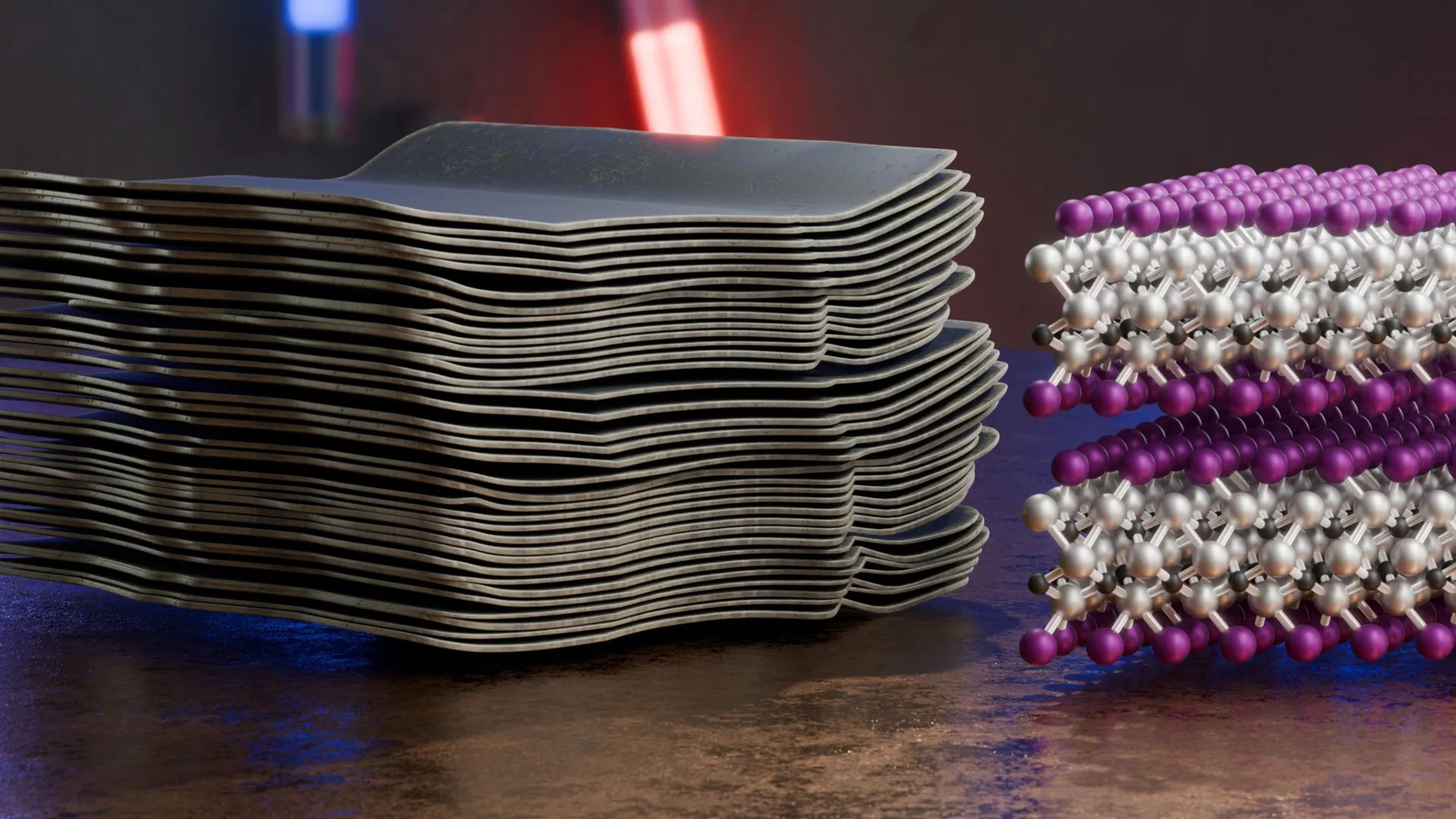
Scientists at Germany's Helmholtz-Zentrum Dresden-Rossendorf have developed a new manufacturing technique for MXenes — a family of ultra-thin, two-dimensional materials at the leading edge of next-generation electronics — that boosts electrical conductivity by 160-fold compared to conventional production methods, a breakthrough published in Nature Synthesis that could accelerate applications in electromagnetic shielding, flexible electronics, radar-absorbing coatings, and advanced wireless communications.
MXenes were first synthesized in 2011 and have since attracted intense scientific interest because of their unique combination of metallic conductivity, chemical versatility, and the ability to be produced as atom-thin sheets that can be layered, coated, or incorporated into composite materials. The challenge has been manufacturing quality. The conventional method of making MXenes involves removing aluminum atoms from a layered precursor structure called a MAX phase using hydrofluoric acid and similar corrosive chemicals. The process works, but it leaves behind a disordered jumble of surface-termination groups — oxygen, fluorine, and hydroxide clusters — scattered unevenly across the MXene surface. These imperfections trap and scatter electrons the way potholes slow traffic on a highway, according to Dr. Dongqi Li of TU Dresden, a co-author of the new study. The result is material that performs well below its theoretical potential, limiting real-world applications.
The new GLS method developed at HZDR replaces acid etching with a process using molten salts and iodine vapor. By starting with solid MAX phase precursors and processing them through a temperature-controlled molten salt bath, the researchers found they could determine exactly which halogen atoms — chlorine, bromine, or iodine — attach to the MXene surface, and in what arrangement, with remarkable atomic precision. The outcome is perfectly ordered surface coverage with minimal impurities or defects. Dr. Mahdi Ghorbani-Asl of HZDR's Institute of Ion Beam Physics and Materials Research, who co-led the study, confirmed the mechanism using density functional theory calculations and quantum transport simulations: the dramatic reduction in electron scattering from the ordered surfaces was directly responsible for the conductivity jump, and the simulations matched experimental measurements with high fidelity.
The headline result is extraordinary: titanium carbide MXene (Ti3C2Cl2) produced using the chlorine-terminated GLS process showed a 160-fold increase in macroscopic electrical conductivity compared to a conventionally produced sample from the same MAX phase precursor. Terahertz conductivity — a key performance metric for high-frequency signal and sensing applications — improved 13-fold. Charge carrier mobility, a fundamental measure of how freely electrons move through a material, increased by four times. The technique was successfully demonstrated across eight different MAX phase precursor materials, suggesting it generalizes well beyond the flagship titanium carbide composition to a broad range of MXene families with different elemental compositions and electronic properties.
The study also revealed an unexpected secondary benefit: changing the type of halogen attached to the MXene surface changes how the material interacts with electromagnetic waves across specific frequency ranges. Chlorine-terminated versions absorb strongly between 14 and 18 gigahertz — a range used by military and civilian radar systems. Bromine- and iodine-terminated variants respond to different frequency bands. This tunability means engineers could, in principle, design materials specifically tailored for particular shielding, radar-defeating, or wireless communication applications by simply choosing the appropriate halogen in the manufacturing process. For defense contractors, consumer electronics manufacturers, and clean energy researchers working on everything from 5G infrastructure to battery technologies, the ability to program MXene electromagnetic properties at the atomic level represents a qualitative leap in materials design capability that had previously been inaccessible using conventional production routes.


