LONGi Sets World Record Solar Cell Efficiency at 34.85%, Surpassing Silicon's Physical Limit With Perovskite Tandem Design
The Chinese manufacturer's NREL-certified result breaks through the Shockley-Queisser ceiling that no silicon-only cell can ever surpass — delivering 45% more power per unit of sunlight than today's commercial panels.
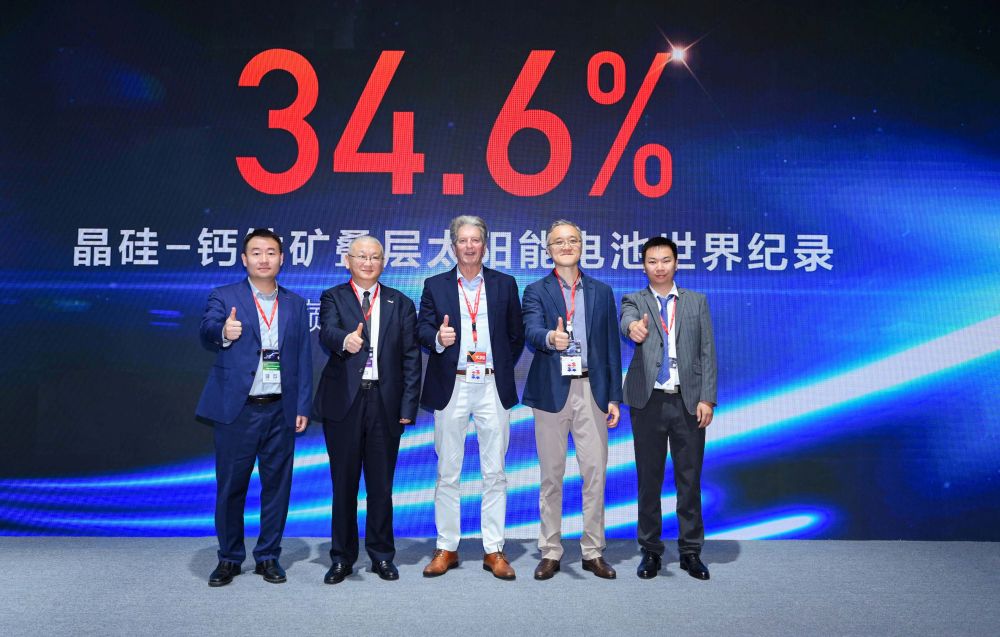
Chinese solar manufacturer LONGi has set a certified world record for solar cell efficiency, achieving 34.85 percent power conversion in a perovskite-silicon tandem cell independently verified by the National Renewable Energy Laboratory. The result surpasses the fundamental physical ceiling for single-junction silicon solar cells — the Shockley-Queisser limit of approximately 29 percent — a milestone that seemed improbable as recently as a decade ago. Commercial silicon panels sold today typically convert between 20 and 22 percent of sunlight into electricity. LONGi's record cell produces roughly 45 percent more electricity from the same amount of light.
Perovskite is not a single compound but a crystal structure — the same atomic arrangement found in calcium titanate — that can be engineered with precisely tunable properties by adjusting its chemical composition. In solar applications, the active layer is typically a lead halide perovskite, most commonly methylammonium lead iodide or its derivatives, which can be deposited from liquid solution at low temperatures using processes far cheaper than the high-temperature Czochralski method used to grow silicon crystals. Most critically for efficiency, perovskite's bandgap — the energy threshold at which it absorbs photons — can be tuned across a wide range by swapping chemical ingredients, making it the ideal partner for silicon in a tandem architecture.
LONGi's record-setting cell exploits this tunability through a stacked design: a semi-transparent perovskite layer tuned to capture high-energy blue and green photons sits atop a conventional silicon cell that captures the lower-energy red and near-infrared photons that pass through. Each layer operates near its own theoretical efficiency limit, and together they break through what any single-material cell can achieve. Critical technical advances enabling the record include textured silicon surfaces with anti-reflective coatings that increase photocurrent by approximately 23 percent, optimized light management structures that minimize reflection losses at each material interface, and surface passivation techniques using 2D perovskite interlayers to suppress the electron recombination that wastes energy at grain boundaries.
A separate research group simultaneously published a result in Nature demonstrating a 33.6 percent efficient flexible perovskite-silicon tandem cell — the highest efficiency ever demonstrated in a solar cell that can be bent and shaped rather than mounted on rigid glass. The flexible cell achieved a record open-circuit voltage of 2.015 volts, demonstrating that high-efficiency tandem solar technology need not be constrained to conventional rigid panels. Oxford PV in the United Kingdom has already begun shipping commercial perovskite-silicon tandem panels at efficiencies between 24.5 and 29 percent, confirming the technology is reaching commercial markets.
The path from laboratory records to widely deployed solar panels still faces real obstacles. LONGi's 34.85 percent result was achieved on a one-square-centimeter device; efficiency typically drops five to eight percentage points when scaled to full panel size. The single biggest challenge remains durability. Commercial silicon panels carry 25- to 30-year warranties; current perovskite cells degrade significantly under real-world UV exposure, humidity, and temperature cycling within one to two years. Researchers are pursuing several approaches to address this, including modified perovskite chemistry, improved encapsulation, and replacement of lead with less toxic tin-based variants that carry fewer regulatory obstacles.
The global energy implications of solving the durability problem are substantial. Japan has projected 20 gigawatts of perovskite-based solar generation capacity by 2040. Researchers and manufacturers widely describe tandem perovskite-silicon technology as "the most significant leap in photovoltaics since the 1950s." The efficiency records keep falling — LONGi has surpassed its own previous marks repeatedly — but the commercial prize awaits the team that can make these cells last as long as the silicon panels they are destined to replace.