IonQ Achieves World-First Quantum Networking Breakthrough, Wins DARPA Contract — Stock Surges 21%
On World Quantum Day, IonQ announced it had successfully photonically interconnected two separate trapped-ion quantum computers, solving a core bottleneck on the path to large-scale fault-tolerant quantum computing and landing a DARPA contract in the same announcement.

On World Quantum Day, April 14, 2026, quantum computing company IonQ announced it had achieved what researchers are calling one of the most significant milestones in the history of the field: the successful photonic interconnection of two independent trapped-ion quantum computers, enabling them to work together as a single unified system. The announcement sent IonQ's stock soaring more than 20 percent in a single trading session, closing at $43.25 — even as the broader market was digesting the economic turbulence of the ongoing US-Iran conflict.
The breakthrough was accomplished in partnership with the U.S. Air Force Research Laboratory. The two physically separate IonQ quantum processing units were connected using photonic links — essentially using individual particles of light to transmit quantum information between machines. By doing so, the team demonstrated that quantum entanglement could be reliably established and maintained across the gap between two distinct systems, creating a quantum network in miniature.
This is not merely a laboratory curiosity. One of the central problems in building practical quantum computers powerful enough to outperform classical machines on real-world tasks is that individual quantum processors have fundamental physical limits on how many quantum bits, or qubits, they can support. Networking multiple processors together — if it can be done reliably — would allow the industry to scale up computational power without having to solve the extreme engineering challenges of building ever-larger single-chip quantum systems.
"This is the quantum equivalent of connecting two computers on a local area network," said Dr. Niccolo de Masi, IonQ's chief executive, in a statement. "What we've shown is that you can make multiple QPUs behave as a single cohesive computational fabric. That is the path to the kind of quantum advantage that actually matters in the real world."
Also on April 14, DARPA announced that IonQ had been selected for its Heterogeneous Architectures for Quantum (HARQ) program, which aims to develop high-speed quantum interconnects capable of linking different types of quantum computing hardware. The contract adds institutional credibility and significant government funding to IonQ's research program at a time when competition in the quantum sector is intensifying rapidly.
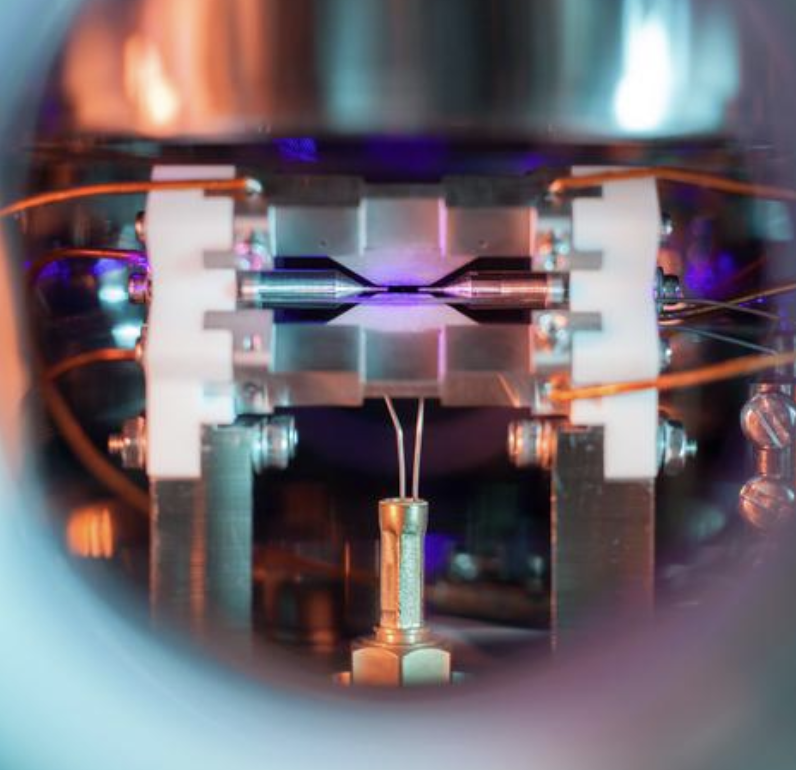
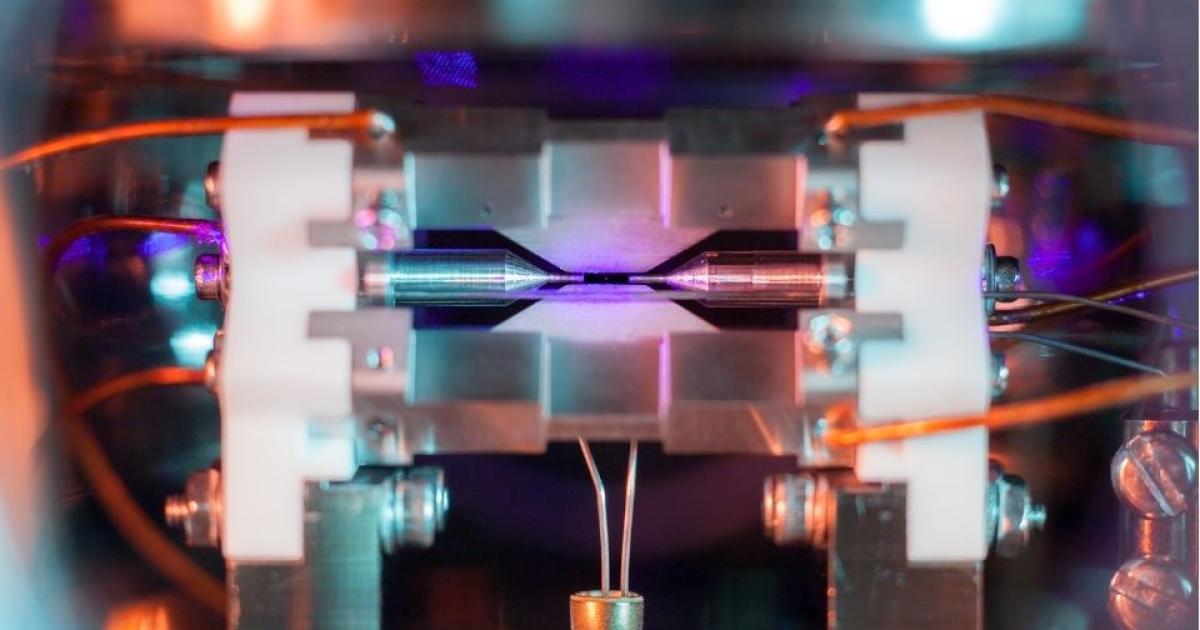
IonQ's approach relies on trapped-ion qubits — individual charged atoms suspended in electromagnetic fields — which are known for their high fidelity and long coherence times compared to some competing qubit technologies. The photonic interconnect demonstrated on Monday used a process in which photons are generated by each quantum system, transmitted through optical channels, and detected in a way that causes the two machines to become quantum entangled without any direct physical connection.
The demonstration resolves what researchers had long considered one of the most stubborn bottlenecks on the path to large-scale fault-tolerant quantum computing. Previous experiments had shown photonic interconnection was theoretically possible, but achieving it with commercially viable hardware, at reliable fidelity, between real quantum computing systems had remained elusive.
Investors reacted swiftly. IonQ's April 15 trading volume was nearly six times its 30-day average, with shares closing up 20.95 percent in a day that also saw the S&P 500 hit a new all-time high of 7,022.95 on optimism about Iran peace talks. The dual announcements — the networking breakthrough and the DARPA contract — represent a rare moment when scientific and commercial momentum aligned for the company.
The achievement is also expected to accelerate interest from defense, pharmaceutical, and financial services sectors, all of which have identified fault-tolerant quantum computing as a strategic priority. Modeling complex molecular interactions for drug discovery, breaking public-key encryption, and optimizing large-scale logistics networks are among the most cited applications awaiting sufficient quantum computing power.