NTSB Data on China Eastern MU5735 Points to Intentional Act and Cockpit Struggle
Both fuel-cutoff levers were moved to 'cutoff' within a second of each other and the control wheels jerked back and forth in the seconds before the Boeing 737 nosedived into a Guangxi mountainside, killing 132.
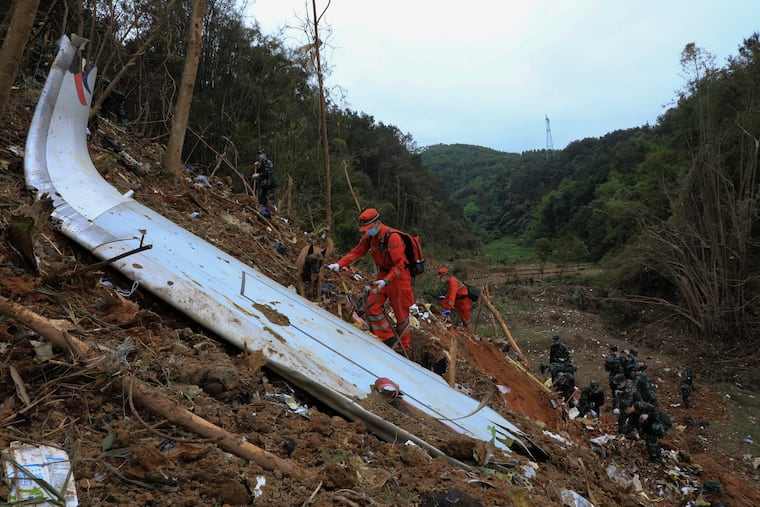
Newly released flight-data-recorder readings from China Eastern Airlines Flight MU5735 show that both engines were intentionally cut off and the cockpit's control wheels jerked back and forth as if amid a physical struggle in the seconds before the Boeing 737-800 nosedived into a Guangxi mountainside on March 21, 2022 — strongly suggesting an intentional act caused the crash that killed all 132 people on board. The data, obtained through a Freedom of Information Act request and disclosed Wednesday, deepens four years of unanswered questions about one of the deadliest aviation disasters of the past decade.
The National Transportation Safety Board had assisted Chinese authorities under international protocols and retained a copy of the recorder data. Jeff Guzzetti, a former Federal Aviation Administration and NTSB accident investigator now consulting independently, told reporters Wednesday that "aggressive movements to pitch the airplane down and to roll it dramatically tell me this was an intentional act," pointing to the irregular back-and-forth oscillation of the captain's and first officer's control columns. "Those movements indicate to me that there was a struggle."
John Cox, a retired airline pilot and aviation-safety consultant, walked through how the dual-engine shutdown could have happened. "A pilot can shut off fuel to both engines at the same time, by moving the levers from run to cutoff," Cox said, but each fuel-cutoff lever has to be physically pulled outward before it can be moved — a deliberate, two-step action specifically engineered to prevent accidental shutdowns. The data showed both levers moved to the cutoff position within roughly one second of each other, after which engine RPM and fuel flow plummeted simultaneously.
Flight 5735 was cruising at 29,100 feet when, with no distress call and no apparent mechanical fault, it pitched into a 40-degree dive. The aircraft then executed a 360-degree roll, briefly leveled at 7,400 feet, and resumed its descent until the data recorder lost power at 26,000 feet — a sequence consistent with a hands-on, sustained input rather than any known failure mode. Investigators with Boeing and the engine maker, CFM International, found no defects in the wreckage that would explain the trajectory.
China's Civil Aviation Administration of China has not released a final report or made the cockpit voice recordings public, more than four years after the crash. Chinese authorities have been criticized by Western aviation experts for what International Civil Aviation Organization observers have described as an opaque investigation. The Wednesday disclosures have reignited demands from victims' families, several of whom have pursued litigation in U.S. courts, for full release of the cockpit voice recorder transcripts. "For the families, the question of intent isn't academic," said Jim Hall, a former NTSB chair. "It is the only question that matters."