Chinese Robot Runs Beijing Half Marathon in 50 Minutes — Beating Human World Record by 7 Minutes
Honor's humanoid robot "Lightning" finished ahead of all 12,000 human competitors, shattering the human half-marathon world record in a race that signals a stunning leap in real-world robotic endurance.
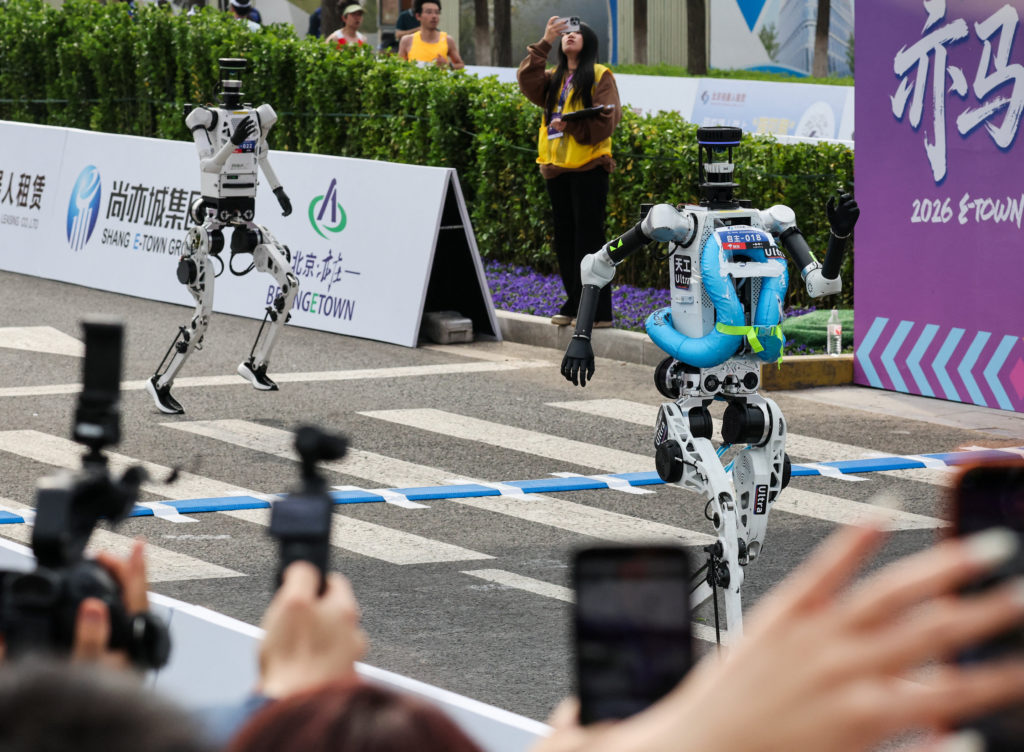
A bright-red humanoid robot named Lightning, built by Chinese technology company Honor, crossed the finish line of the Beijing Half Marathon on April 19, 2026, in a time of 50 minutes and 26 seconds — beating all 12,000 human competitors in the race and surpassing the human world record for the half-marathon distance by nearly seven minutes, in a demonstration of robotics advancement that astonished observers and prompted immediate comparisons to the dawn of a new era in athletic performance.
The race, run on a course through central Beijing, marked the second annual Beijing Half Marathon open to humanoid robots alongside human runners. The contrast with the inaugural event in 2025 was striking: that year's winning robot finished the 13.1-mile course in 2 hours and 40 minutes. Lightning's time of 50:26 obliterates that mark, and also falls below the human world record of 57 minutes and 31 seconds set by Ugandan runner Jacob Kiplimo in Lisbon in November 2021 — a record previously considered one of the most demanding athletic benchmarks in endurance sports.
Nearly all of the more than 300 competing robots in the race were Chinese-built, with teams from over 100 companies and research institutions participating. International teams also entered, marking the race's growing profile as a global proving ground for bipedal locomotion and endurance robotics. Lightning briefly collided with a railing near the finish line but recovered quickly and crossed without further incident — a moment that humanized, in some ways, a machine that had otherwise performed with uncanny efficiency.
The result drew immediate attention not just for its speed but for what it implies about the pace of development in humanoid robotics. Just twelve months ago, robots completing a half marathon in under three hours was considered a significant achievement. The ability of a robot system to sustain sub-four-minute-per-mile pace across the full distance, managing balance, gait control, energy management, and real-time adaptation to road surfaces and crowds, represents a qualitative leap in capabilities that robotics engineers said had come faster than many expected.
Honor's engineering team has not disclosed the specific hardware and software architecture behind Lightning's performance, citing competitive concerns. But the robot's motion profile — smooth, efficient, with relatively long stride cadence and minimal lateral sway — suggests significant advances in dynamic balance control and energy-efficient actuator design, likely leveraging machine learning models trained on human gait data. The company positioned the achievement as a demonstration of real-world reliability, noting that a robot capable of sustaining precise locomotion for 50 consecutive minutes in a crowded public race environment has cleared a bar that many laboratory demonstrations never approach.
The broader field of humanoid robotics has accelerated sharply over the past three years, driven by the convergence of more capable AI systems, improved battery and actuator technology, and significant investment from Chinese and American companies. Competitors including Boston Dynamics, Agility Robotics, Figure AI, and Chinese firm Unitree have all released walking and running robots capable of increasingly complex physical tasks. The Beijing Half Marathon has become a visible benchmark event in this space, drawing direct competition in a setting that cannot be managed or staged.
Several athletics commentators and ethicists noted that the result raises questions the sporting world is not prepared to answer: at what point does robotic performance in athletic events cease to be a novelty demonstration and begin to challenge the assumptions underlying competitive sport? The robot cannot be tired, cannot feel pain, cannot be motivated by crowd noise — but it can clearly run faster than a human, over a distance that separates elite athletes from ordinary ones by more than an hour.