Astronomers Confirm Two Protoplanets Forming at the Same Time in Rare 'Twin Birth' Discovery
The star system WISPIT 2, just 5 million years old, becomes only the second known system where multiple planets have been directly observed forming simultaneously — offering an unprecedented planetary science laboratory.

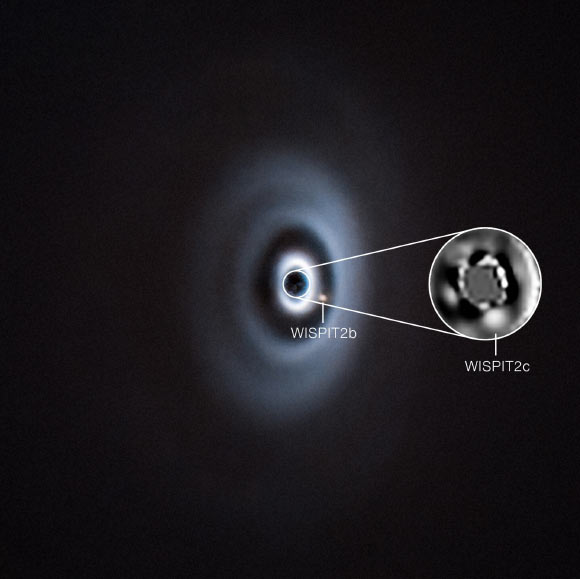
Astronomers have confirmed the existence of a second forming planet in a young star system called WISPIT 2, making it only the second known system in the universe where multiple planets have been directly observed in the act of formation simultaneously. The discovery was enabled by the upgraded GRAVITY+ instrument on the European Southern Observatory's Very Large Telescope Interferometer in Chile, which allowed researchers to peer close enough to the host star to detect a planet far inside the glare of the stellar disk. The finding was published in a new paper by researchers from the University of Galway, Leiden Observatory, the University of Arizona, and the Max Planck Institute for Extraterrestrial Physics.
The WISPIT 2 system, located in the Taurus star-forming region, is approximately 5 million years old — an infant by cosmic standards. At that age, the system's planets are not yet fully formed; they are still actively accreting material from the surrounding disk of gas and dust, growing larger with each passing million years. The first planet, designated WISPIT 2b, was discovered in August 2025. It has a mass of approximately 5 Jupiter masses and orbits the star at a distance of 57 astronomical units — roughly comparable to the distance from the Sun to the outer edge of the Kuiper Belt. The newly confirmed planet, WISPIT 2c, is significantly larger at approximately 10 Jupiter masses and orbits much closer in, at just 14 astronomical units, roughly corresponding to Saturn's distance from the Sun.
Detecting WISPIT 2c presented a formidable technical challenge. The host star is approximately 1,000 times brighter than the planet being observed, making direct imaging at close angular separations extraordinarily difficult. Achieving the necessary contrast required the GRAVITY+ instrument, which uses interferometric techniques to combine light from multiple telescope apertures and achieve the angular resolution equivalent to a telescope with a mirror more than 100 meters across. The team validated the detection over multiple independent observations to ensure the signal was genuinely from an orbiting planet rather than an artifact of the optical system.
The significance of finding two planets forming simultaneously in the same system extends beyond the novelty of the achievement. Because both planets share the same stellar environment — the same disk composition, the same radiation field, the same age — they provide a controlled comparison that is impossible to obtain by studying planets in different systems at different evolutionary stages. Researchers can ask: why did one planet end up at 57 AU while the other formed at 14 AU? Why is the inner planet more massive despite forming in a region where the disk is typically less dense? The answers to these questions could illuminate how planetary architectures are shaped during the early accretion phase.
"Finding two planets forming at the same time is almost like witnessing a rare twin birth," said one member of the discovery team, describing the system as an unprecedented laboratory for comparing parallel planet formation histories. Until now, the only confirmed example of a system with multiple directly imaged protoplanets was PDS-70, discovered to harbor two forming planets in 2019. WISPIT 2 now provides a second case, confirming that such systems exist at a rate that future surveys with the James Webb Space Telescope and the upcoming Extremely Large Telescope may be able to study systematically. The finding also raises the possibility that the solar system's own architectural features — the positions of Jupiter and Saturn, the orbital gap between the inner rocky planets and the outer gas giants — were shaped by competitive accretion dynamics during a similarly brief and violent formation period billions of years ago.