USGS Study Finds Hidden Secondary Faults Beneath Seattle Are Far More Active Than Long-Watched Cascadia Zone, Rupturing Roughly Every 350 Years
Newly mapped Lytle Beach and Vasa Park faults last cracked open around 1833, putting four million people in the Puget Sound region at greater near-term shaking risk than the much larger Cascadia subduction megathrust offshore.
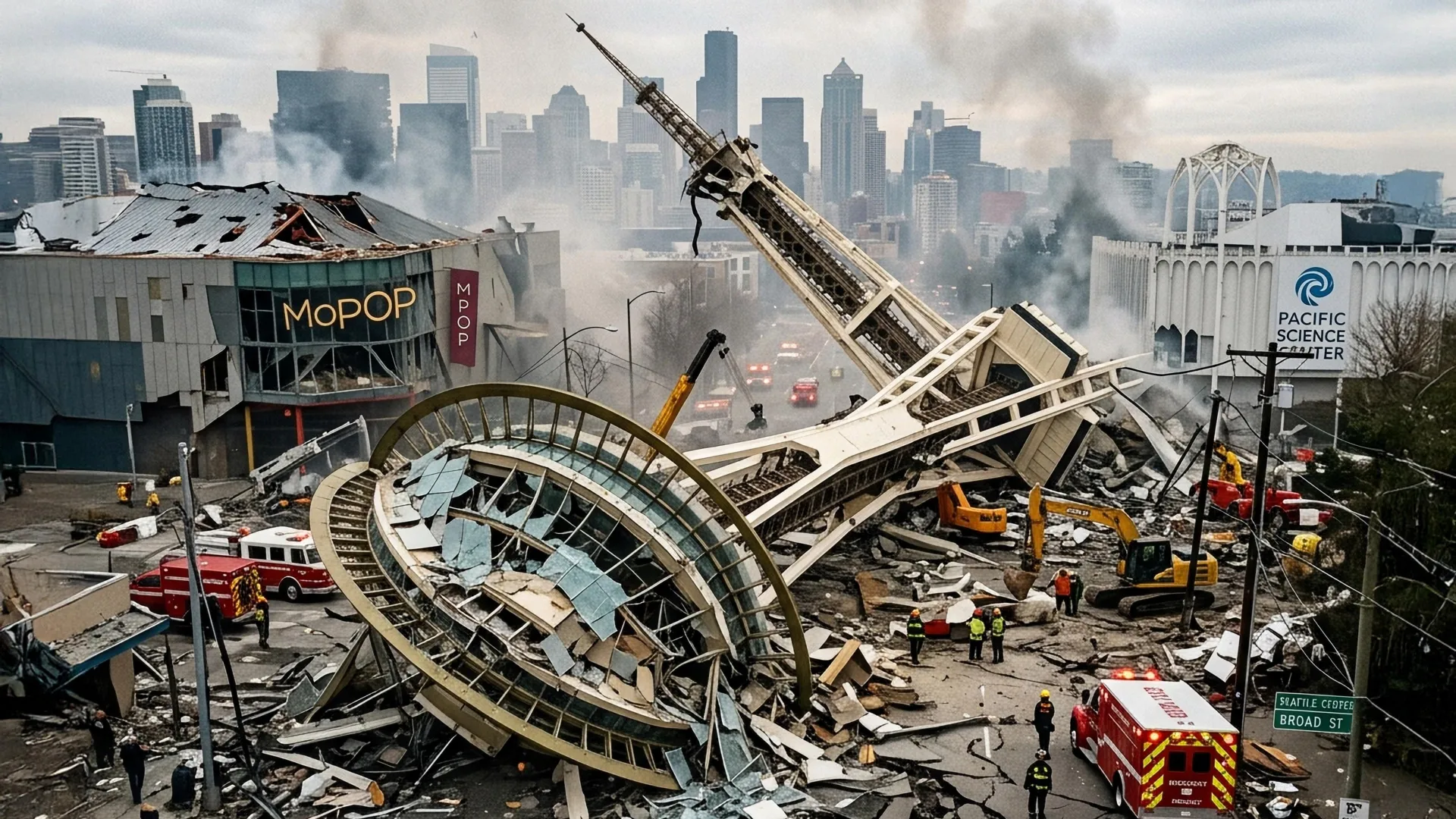
For decades, residents of the Puget Sound region have been taught to fear the same earthquake: a magnitude-9 megathrust rupture on the Cascadia subduction zone, the 600-mile boundary between the Juan de Fuca and North American plates that runs offshore from Cape Mendocino to Vancouver Island. A new peer-reviewed study by the U.S. Geological Survey now suggests that the more imminent threat to the city of Seattle itself may be much closer to home — and much more frequent — than the giant offshore fault that has captured the public imagination.
Writing in the May issue of the Geological Society of America Bulletin, USGS geologist Alex Hatem and a team from the agency's Earthquake Science Center in Moffett Field, California, present detailed paleoseismic, geomorphic and lidar evidence for two previously unmapped secondary faults within the broader Seattle Fault Zone: the Lytle Beach Fault, which cuts northeast across the southern tip of Bainbridge Island and beneath Eagle Harbor, and the Vasa Park Fault, which runs through the Eastside community of the same name. Both faults, the team concludes, have ruptured at least four times since the end of the last ice age, with average return intervals of approximately 350 years.
Most consequentially, both faults appear to have ruptured most recently around 1833, based on radiocarbon dating of soils displaced along a series of trench excavations dug between 2021 and 2024. That date sits within the historical record but predates systematic written documentation of earthquakes in the Pacific Northwest, meaning the events likely went unrecorded by European settlers. "We now think the Seattle fault system has had more action in the last several centuries than the seismic-hazard maps reflect," Hatem said in a USGS statement. "The Lytle Beach and Vasa Park structures have ruptured repeatedly, they did so as recently as roughly 190 years ago, and they sit right under where four million people live, work and have built tall buildings."
The implications for building codes are significant. The 2018 Washington State Hazard Mitigation Plan and the most recent USGS National Seismic Hazard Model both treat the Seattle Fault Zone primarily as a single main thrust capable of magnitude-7.0 to 7.5 ruptures roughly every 1,000 years, with the last known rupture dated to about A.D. 900-930. The new study argues that those models substantially underestimate the rate of moderate-to-large shaking events in the immediate Seattle metro area because they do not account for the secondary structures. Even a magnitude-6.5 rupture on Lytle Beach, the team's preliminary ground-motion modeling suggests, would shake downtown Seattle with peak accelerations comparable to the 2001 Nisqually earthquake — but with significantly higher frequency content damaging to mid-rise concrete buildings.
State officials moved quickly Tuesday to incorporate the findings. Maximilian Dixon, hazard mitigation supervisor at the Washington Emergency Management Division, said the agency would convene a technical working group within 60 days to assess whether the state's 2030 hazard plan should explicitly model the secondary faults. Seattle Mayor Bruce Harrell's office said the city is "reviewing the study with our structural engineering team" and "will work with state and federal partners on appropriate next steps." The USGS team plans to extend trenching this summer to a third suspected secondary fault on the western Eastside, near Issaquah, that lidar surveys flagged in 2023 but that has not yet been confirmed paleoseismically.