Physicists Find Crystal With Two Kinds of Magnetic Frustration at Once — Potentially Unlocking New Quantum States
UC Santa Barbara's Stephen Wilson led the discovery of a triangular lattice antiferromagnet exhibiting 'double frustration,' where magnetic and bond frustration coexist and interact, providing a new handle for accessing and controlling the exotic entangled quantum states needed for quantum computing.

Physicists at UC Santa Barbara have discovered a crystal with a deeply unusual property: it is frustrated in two completely different ways at the same time, and those two frustrations interact in ways that could give scientists unprecedented control over exotic quantum states. The research, published in Nature Materials and led by materials scientist Stephen Wilson, describes a rare phenomenon called "double frustration" that has never previously been observed in a real material and that opens new possibilities for quantum information science.
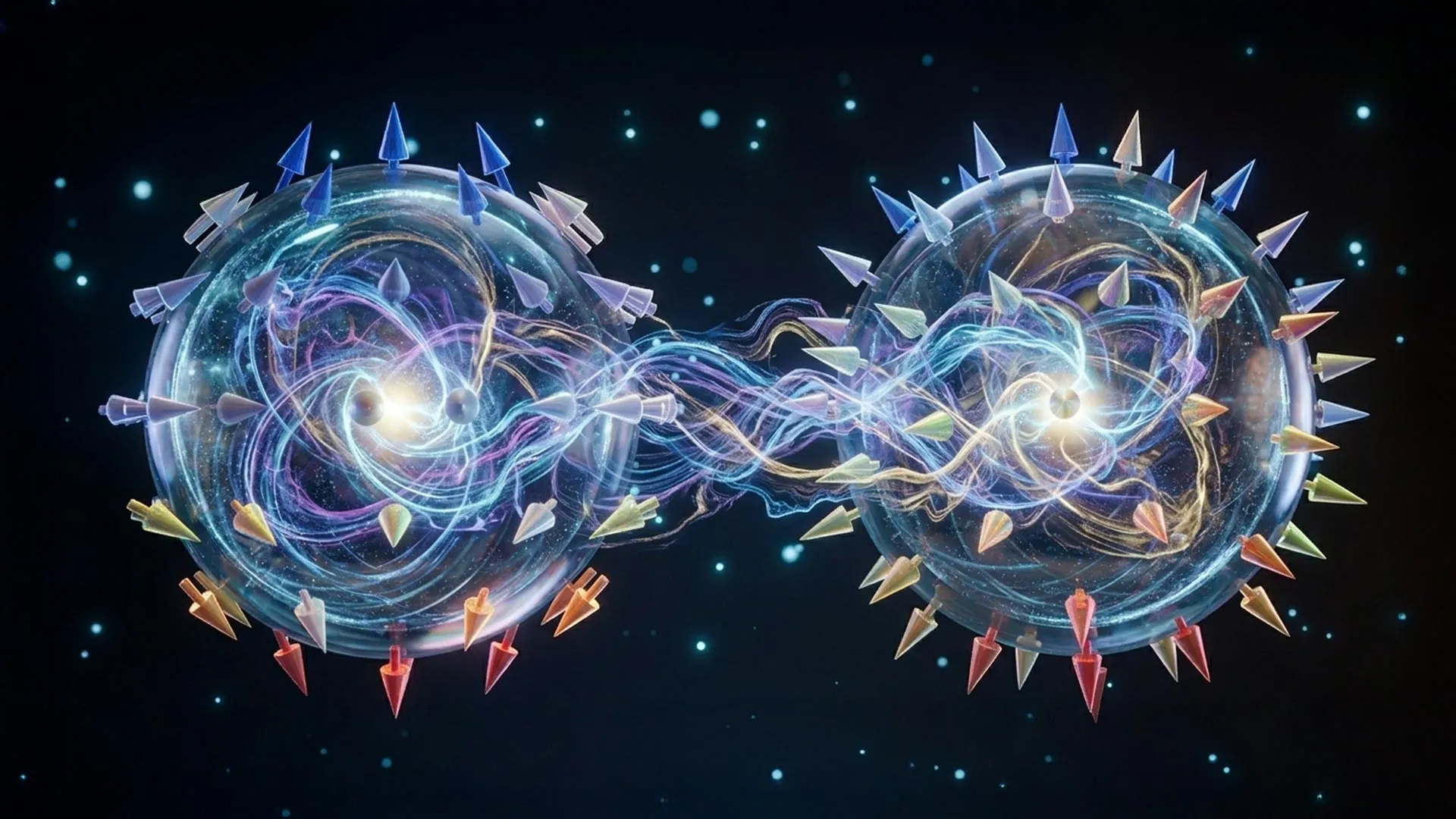
In everyday physics, frustration refers to a system whose competing interactions prevent it from settling into a single stable state. Think of three bar magnets arranged in a triangle, each trying to point opposite to its neighbors: no configuration can satisfy all three constraints simultaneously, so the system remains in a perpetual state of magnetic tension. In quantum materials, geometric frustration produces exotic fluctuating magnetic states where spins — the quantum equivalent of the north-south orientation of a bar magnet — remain perpetually disordered rather than locking into a stable crystal-like pattern.
Wilson's team discovered a crystal in which two entirely distinct types of frustration coexist in the same material. The first is the familiar magnetic frustration arising from the triangular arrangement of atoms: neighboring spins cannot simultaneously minimize their mutual energy, leaving the system in constant quantum flux. The second is a rarer form called bond frustration, which arises when the electronic bonds between atoms themselves cannot settle into a stable configuration — the material's chemical "handshake" between neighboring atoms is geometrically prohibited from choosing sides.
"We found a rare system where both kinds of frustration coexist and interact," Wilson explained. "What makes this special is that the two frustrated systems are coupled to each other. That means we may be able to use a strain or a magnetic field applied to one of them to influence the other — and that's a completely new handle on exotic quantum states."
The coupling between the two frustrated systems could prove transformative for quantum technology. Exotic quantum states arising from frustrated magnets — including quantum spin liquids, in which spins remain disordered and entangled all the way down to absolute zero — are among the most promising candidate systems for fault-tolerant quantum computing. These materials protect quantum information through a kind of topological immunity: the entanglement is encoded in the global pattern of the material rather than in any individual atom, making it resistant to local disturbances that would destroy information in conventional qubits.
The challenge has always been accessing and manipulating those entangled states. In a single-frustration system, the only handles available are temperature and magnetic field. In a doubly frustrated system, Wilson's work suggests, it may be possible to use mechanical strain applied to one frustrated network to change the quantum state of the other — effectively allowing scientists to dial in the degree of entanglement or choose between different exotic phases of matter.
The material itself belongs to a family of compounds built from triangular networks of rare-earth elements called lanthanides, a class that has been a hotbed of frustrated magnetism research for the past decade. The specific compound Wilson's team studied has a layered crystal structure that places the two types of frustrated networks in close proximity — close enough for quantum fluctuations in one to resonate with the other.
Practical quantum computing applications are still likely years away, as the material needs to be synthesized in forms suitable for device fabrication and tested extensively under the conditions required for qubit operation. But the fundamental discovery is significant: it shows that the universe of quantum materials contains geometric configurations that researchers had not previously encountered, and that these configurations could offer new routes to controlling quantum entanglement in ways that single-frustration materials cannot. "This is fundamental science," Wilson said. "We're asking what quantum physics can do. And the answer keeps getting more interesting."