Deep Underground in Canada, the World's Most Sensitive Dark Matter Detector Reaches Operating Temperature
The SuperCDMS experiment at SNOLAB has cooled to 0.02 kelvin — 100 times colder than deep space — and is now entering final commissioning before beginning its hunt for light dark matter particles in mid-2026.
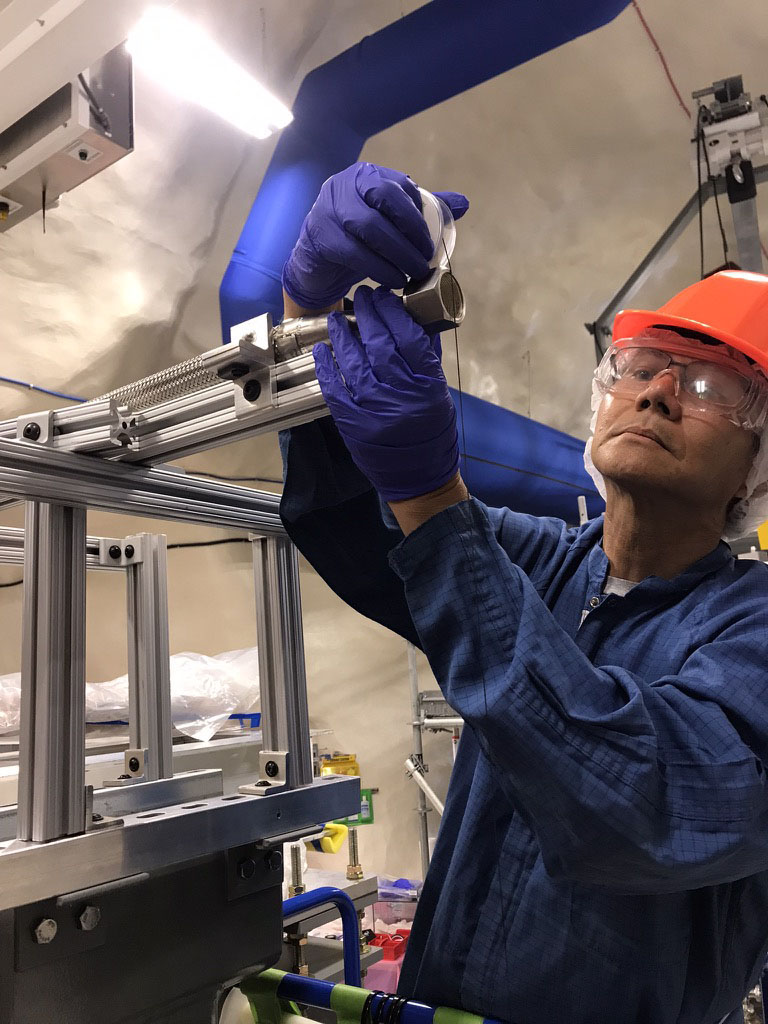
A half-ton experiment buried two kilometers underground in a Canadian nickel mine has achieved a critical milestone in humanity's long quest to directly detect dark matter: the Super Cryogenic Dark Matter Search, known as SuperCDMS, located at SNOLAB near Sudbury, Ontario, has cooled to its operating temperature of 0.02 kelvin — roughly 100 times colder than the temperature of deep space, and just thousandths of a degree above absolute zero. Researchers announced the achievement in mid-March 2026, marking the beginning of the experiment's final commissioning phase before scientific data collection begins in mid-2026.
Dark matter is the invisible substance that comprises approximately 85 percent of all matter in the universe, detected only by its gravitational effects on visible matter, light, and the large-scale structure of galaxies. Despite decades of observational evidence for its existence — from the anomalous rotation curves of spiral galaxies first documented by Vera Rubin in the 1970s to the precise temperature fluctuations in the cosmic microwave background — no experiment has ever directly detected a single dark matter particle. SuperCDMS represents the next generation of effort to change that, focusing specifically on so-called "light dark matter" — particles with masses roughly comparable to a proton, lighter than the candidates targeted by earlier experiments like LUX and PandaX.
The SuperCDMS detectors consist of precisely machined silicon and germanium crystals. When a particle of dark matter passes through and scatters off an atomic nucleus in those crystals, it should produce minute vibrations called phonons — quantum mechanical sound waves propagating through the crystalline lattice. The detectors are designed to sense these phonon signals. The extreme cold is essential: at room temperature, thermal noise from constantly vibrating atoms would overwhelm any dark matter signal. At 0.02 kelvin, that thermal noise drops to nearly nothing, in principle allowing the detectors to identify interactions so faint they might occur just a handful of times per year across the entire experiment — and potentially just once or twice if dark matter is particularly elusive.
SNOLAB's location 2 kilometers underground was chosen deliberately. The rock above acts as a natural shield against cosmic rays from space, which would otherwise trigger false signals indistinguishable from a dark matter interaction. The mine's depth reduces the cosmic ray flux by a factor of roughly 50 million compared to the surface. Even so, the detector is surrounded by additional shielding made of ultra-pure lead and polyethylene to block radiation from the surrounding rock, and the entire apparatus must be built from materials with negligible natural radioactivity — a requirement so stringent that the detector's copper components were manufactured in a special underground workshop to prevent surface-level radioactive contamination before installation.
The collaboration — involving more than 100 scientists from 25 institutions across North America, Europe, and Asia — expects to begin collecting science-quality data in mid-2026. If dark matter of the predicted mass interacts with ordinary matter at any detectable rate, SuperCDMS could see just a few events per year, each requiring careful statistical analysis to distinguish from background. The result would rank among the most significant in the history of physics. If SuperCDMS observes nothing, that null result would be equally important, ruling out entire classes of light dark matter candidates and forcing theorists to revise their models of what dark matter is and how it interacts with the ordinary universe.