Stanford's New Light-Trap Arrays Chart a Realistic Path to Million-Qubit Quantum Computers
By giving every atom its own miniature mirror resonator to capture escaping photons, Stanford physicists demonstrated a 40-qubit array and a 500-cavity prototype — the clearest route yet to quantum systems far beyond today's best machines.
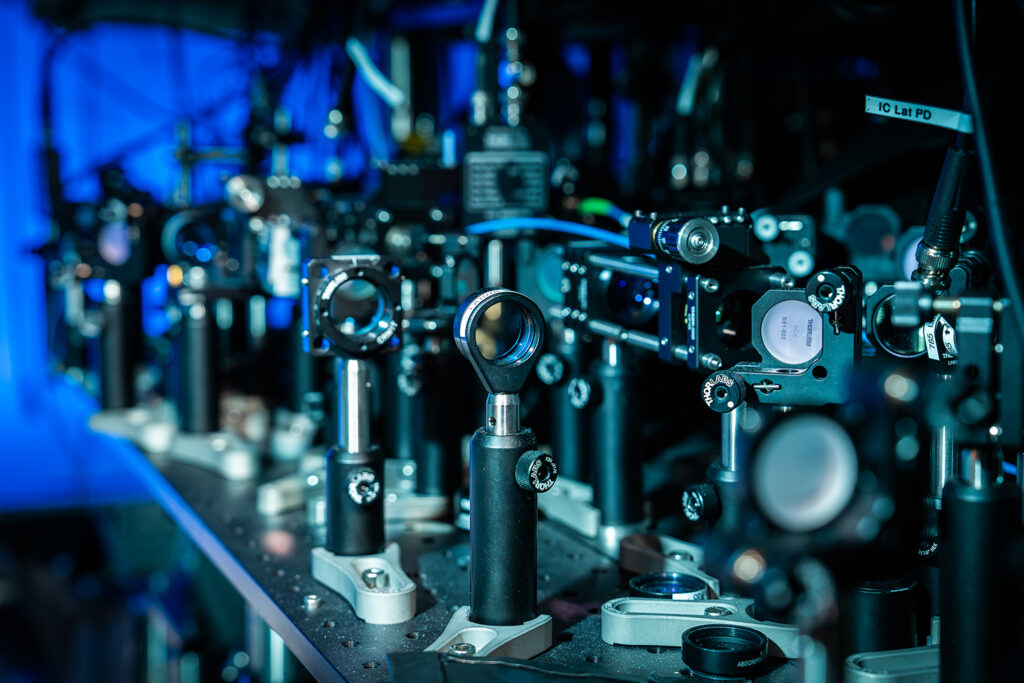
Stanford University physicists have demonstrated a new type of optical cavity array that efficiently captures photons emitted by individual atoms, pointing toward a viable path for building quantum computers with millions of qubits — a scale researchers believe is necessary to solve the classes of problems that would make quantum computing commercially transformative. The work, published in Nature and carried out in collaboration with scientists from Stony Brook University, Harvard, the University of Chicago, and Montana State University, describes a 40-cavity prototype in which each cavity holds a single atom qubit, along with a larger proof-of-concept system containing more than 500 cavities — a leap that demonstrates the approach can scale beyond laboratory demonstrations.
The fundamental challenge the Stanford team addressed is what the field calls the "photon collection problem." Atoms are natural quantum systems whose internal energy states make excellent qubits — they can be prepared in precise quantum states, entangled with other atoms, and read out with high fidelity. But atoms interact with light inefficiently, emitting photons in random directions rather than into a controlled channel. This means that in most atomic quantum computer architectures, much of the quantum information carried by emitted photons is simply lost before it can be detected or transmitted to another qubit, severely limiting how efficiently the system can be scaled. "Atoms just don't emit light fast enough, and on top of that, they spew it out in all directions," said Professor Jon Simon, the paper's senior author. "We needed to give each atom its own dedicated light trap."
The optical cavity approach solves this by surrounding each atom with a miniature mirror resonator that bounces light back and forth, amplifying the probability that an emitted photon will be captured and directed into a fiber optic channel rather than lost. Previous cavity designs worked in principle but were impractical to build at scale because they required hand-crafting individual mirrors to nanometer precision. The Stanford team's innovation was to fabricate cavities using a microlens-based design that can be mass-produced with standard semiconductor manufacturing processes — the same techniques used to make microchips — while achieving the photon collection efficiencies needed for quantum information processing.
The 40-cavity array demonstrated that all qubits could be addressed simultaneously and that quantum information could be extracted from them in parallel rather than sequentially, a requirement for the error correction protocols that large-scale quantum computers will need to function reliably. The 500-cavity proof-of-concept showed that the manufacturing approach produces consistent results across large numbers of devices, addressing the reproducibility concerns that have dogged earlier cavity-based quantum hardware platforms. The research team's next target is tens of thousands of cavities, with the longer-term vision being quantum data centers in which individual quantum computers are linked through cavity-based network interfaces to form full-scale quantum supercomputers.
Beyond computing, the Stanford team described potential applications in biosensing, quantum-enhanced microscopy, and long-baseline astronomy. Optical cavities that can efficiently interface single atoms with optical fibers could form the backbone of a quantum internet in which quantum states are distributed across long distances for secure communication and distributed quantum computation. Simon's lab is among several competing to demonstrate what quantum network researchers call a "quantum repeater" — a device that can extend the range of quantum communication beyond the distances achievable with direct fiber transmission, which is limited by photon loss. Monday's Nature paper represents significant progress toward that goal, demonstrating that the hardware platform for efficiently interfacing individual atoms with photonic networks can be built at scale using manufacturable processes rather than artisanal laboratory techniques.