Physicists Propose Spacetime Itself May Have a Quasicrystal Structure — Ordered But Never Repeating
Researchers at the Perimeter Institute constructed a mathematical framework for spacetime that respects Lorentz symmetry but is organized like a quasicrystal — patterned without being periodic.
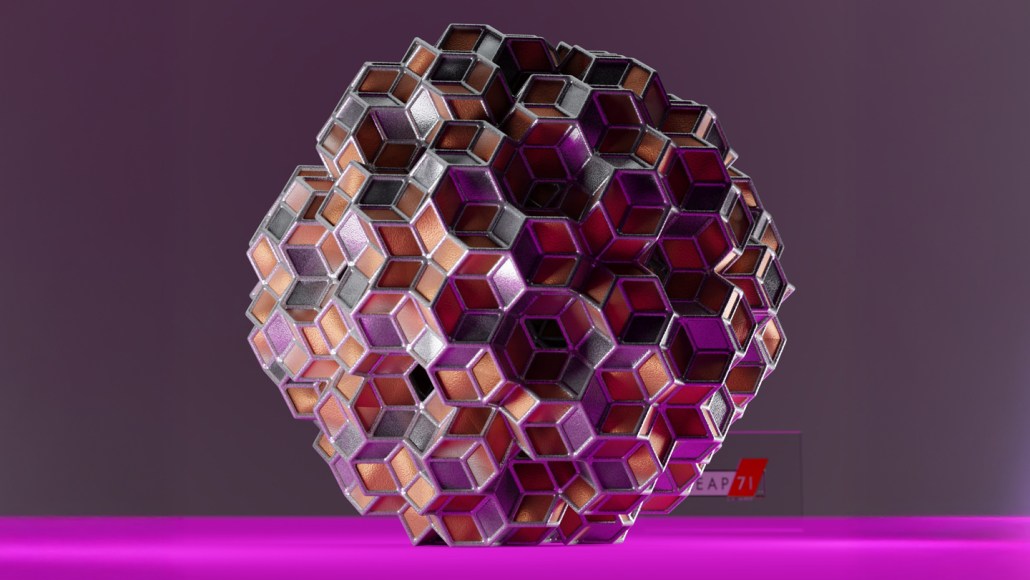
Two physicists at the Perimeter Institute for Theoretical Physics in Waterloo, Canada, have proposed that the fabric of spacetime itself might have the structure of a quasicrystal — a form of order that is intricate and patterned but never periodically repeating — in a new theoretical framework that could offer a fresh mathematical path toward reconciling quantum mechanics with general relativity.
Latham Boyle and Sotiris Mygdalas, working at the Perimeter Institute, published the proposal as a preprint in January 2026, and it has since circulated widely through the theoretical physics community, drawing both admiring and skeptical responses. The central idea involves constructing spacetime not from a regular lattice — the way a crystal's atoms are arranged in repeating rows and columns — but from a quasicrystal-like tiling: a structure that exhibits long-range order and can fill space without gaps but lacks the periodic repetition of an ordinary crystal. Quasicrystals were discovered in physical materials in 1984, an achievement for which Dan Shechtman received the 2011 Nobel Prize in Chemistry, but their possible appearance at the level of spacetime geometry is a radical new idea.
The key mathematical innovation is that Boyle and Mygdalas construct their spacetime quasicrystal by slicing through a higher-dimensional periodic grid at an irrational angle — the same mathematical technique used to generate quasicrystals in three-dimensional materials from higher-dimensional periodic structures. In materials science, this technique produces patterns that have five-fold or ten-fold rotational symmetry, which cannot exist in ordinary repeating crystals. In Boyle and Mygdalas's framework, the analogous construction produces a spacetime structure that respects Lorentz symmetry — the principle, central to special relativity, that the laws of physics appear identical to all observers regardless of their constant velocity. This is a highly non-trivial requirement: most discrete spacetime models break Lorentz symmetry, which immediately makes them inconsistent with known physics. The quasicrystal structure threads this needle.
The proposal has attracted attention from physicists working on quantum gravity precisely because the problem of discretizing spacetime — representing it as a finite structure at the Planck scale, roughly 10⁻³⁵ meters — without violating Lorentz symmetry has resisted solution for decades. Felix Flicker of the University of Bristol, a specialist in quasicrystals, called the construction "the most elegant things you can have in spacetime." Gregory Moore of Rutgers University offered more cautious praise: "It's beautiful mathematics. The physics is very highly speculative." Boyle and Mygdalas note that their 10-dimensional construction naturally aligns with the dimensions required by superstring theory, a correspondence they describe as suggestive but not yet explanatory.
Whether spacetime quasicrystals correspond to anything physically real remains entirely open. The framework is currently a mathematical proposal, not a physical model with experimentally testable predictions. Developing such predictions — and connecting the quasicrystal structure to observable effects at accessible energy scales — will be the central challenge for future work. But the proposal fits within a growing tradition of using insights from condensed matter physics, where quasicrystals are studied as physical objects, to inspire new structures in theoretical high-energy physics. If spacetime does have a quasicrystal architecture, the implications would extend far beyond particle physics: such a structure would impose fundamental constraints on the Planck-scale physics that underlies everything else, and could explain why the universe looks so smooth and symmetric at large scales even if it has complex, aperiodic structure at the smallest ones.