Scientists Uncover Secret Behind Nature's 'Proton Highway' Through Molecular Analysis
Researchers reveal how phosphoric acid efficiently moves electrical charges in biology and technology by freezing key molecular structures to near absolute zero.

Scientists have achieved a major breakthrough in understanding how electrical charges move through living systems by uncovering the molecular secrets behind nature's most efficient "proton highway." The research, conducted by teams from the Fritz Haber Institute along with collaborators from Leipzig and the United States, focused on phosphoric acid and related compounds that play crucial roles in everything from DNA structure to cellular energy production.
Phosphoric acid compounds are ubiquitous in biological systems, serving as key components of DNA and RNA, forming essential parts of cell membranes, and enabling ATP to store and transfer energy throughout living organisms. These molecules excel at conducting protons through a process called "proton-shuttling," where positive charges hop from one molecule to another along hydrogen bond pathways. While scientists have long understood that this process occurs, the precise molecular details have remained elusive until now.
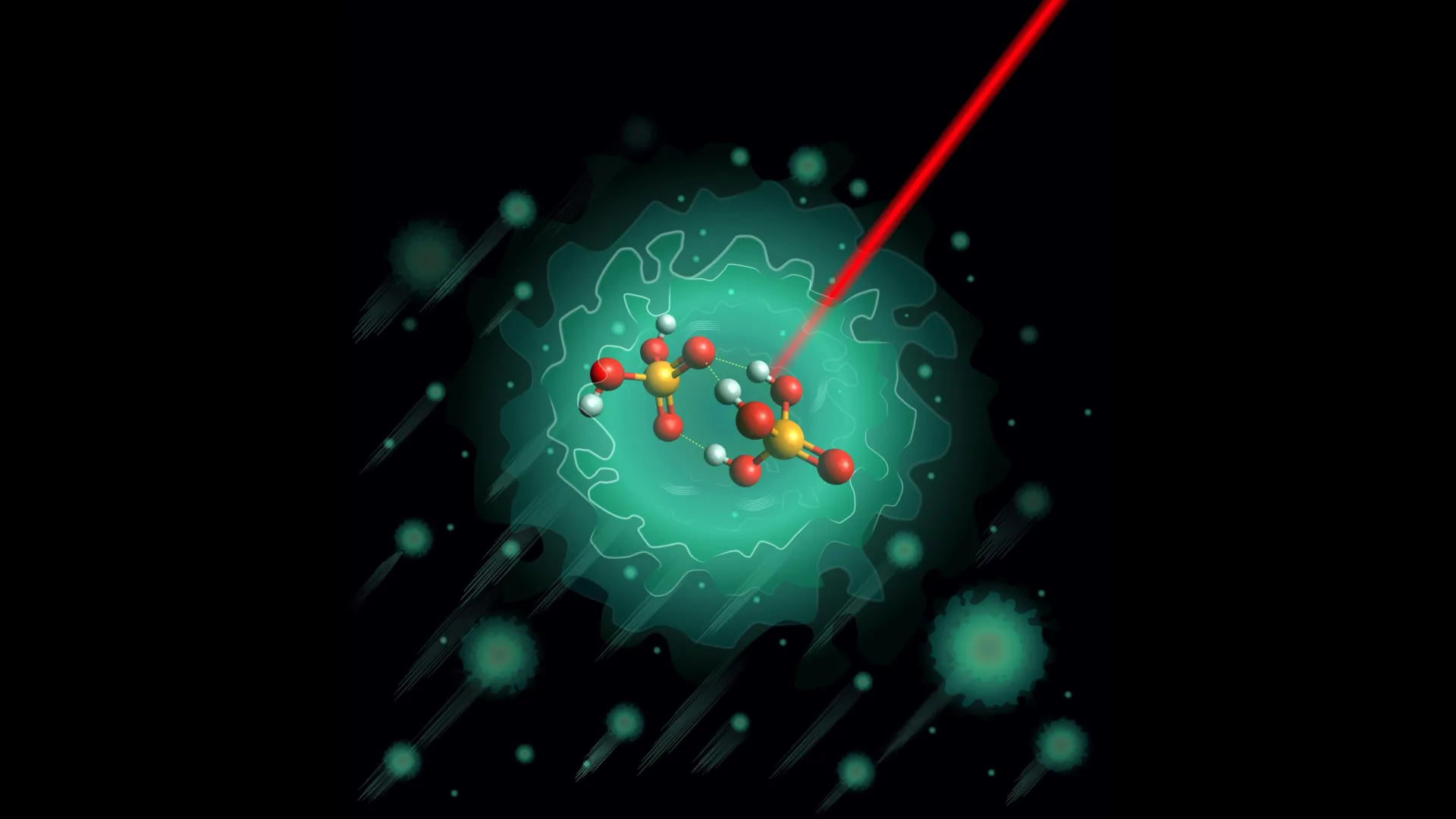
To investigate these microscopic mechanisms, researchers employed an innovative approach that involved freezing a key molecular structure to extraordinarily low temperatures. By placing the deprotonated dimer H3PO4·H2PO4- inside helium nanodroplets, they reduced its temperature to just 0.37 degrees above absolute zero. This extreme cooling eliminated unwanted molecular vibrations and allowed the team to analyze the structure with unprecedented precision using infrared spectroscopy combined with quantum chemical calculations.
The experimental results revealed a surprising finding that contradicted theoretical predictions. While computer models had suggested the molecule could exist in two equally stable configurations, the actual measurements showed only one rigid structure featuring three hydrogen bonds connected through a shared oxygen atom. This configuration presents high barriers that limit proton movement within the molecule, yet paradoxically enables the efficient charge transport observed in biological and technological applications.
The discovery has significant implications for both fundamental science and practical applications. Understanding how proton transport works at the molecular level could lead to improved designs for fuel cells, batteries, and other energy storage technologies. The research also provides insights into biological processes that depend on efficient charge movement, potentially opening new avenues for medical treatments and biotechnology applications. The findings suggest that similar hydrogen-bonding patterns may be universal in related molecular systems, offering a framework for understanding proton transport across diverse chemical environments.