Scientists Uncover Nature's 'Proton Highway' Through Revolutionary Molecular Analysis
Breakthrough study reveals how phosphoric acid efficiently moves electrical charges in biology and technology using specific hydrogen-bond networks.

Scientists have achieved a major breakthrough in understanding one of nature's most efficient electrical systems by uncovering the secret behind phosphoric acid's remarkable ability to move charges through biological and technological systems. By freezing a key molecular pair to extremely low temperatures, researchers discovered that it forms just one stable structure, contrary to previous predictions that suggested multiple possible configurations. This finding provides crucial insight into how protons travel so quickly through living systems and could inspire the development of better energy materials for future technologies.
Every second, countless electrical charges move through the human body, driving essential processes from cellular communication to energy production and metabolism. These microscopic signals depend on the careful and controlled movement of charges across cell membranes and within cells, essentially acting as a fundamental control system for all biological functions. Phosphoric acid and related compounds are found throughout living systems as key components of DNA, RNA, cell membranes, and ATP, the molecule that stores and transfers energy in cells.
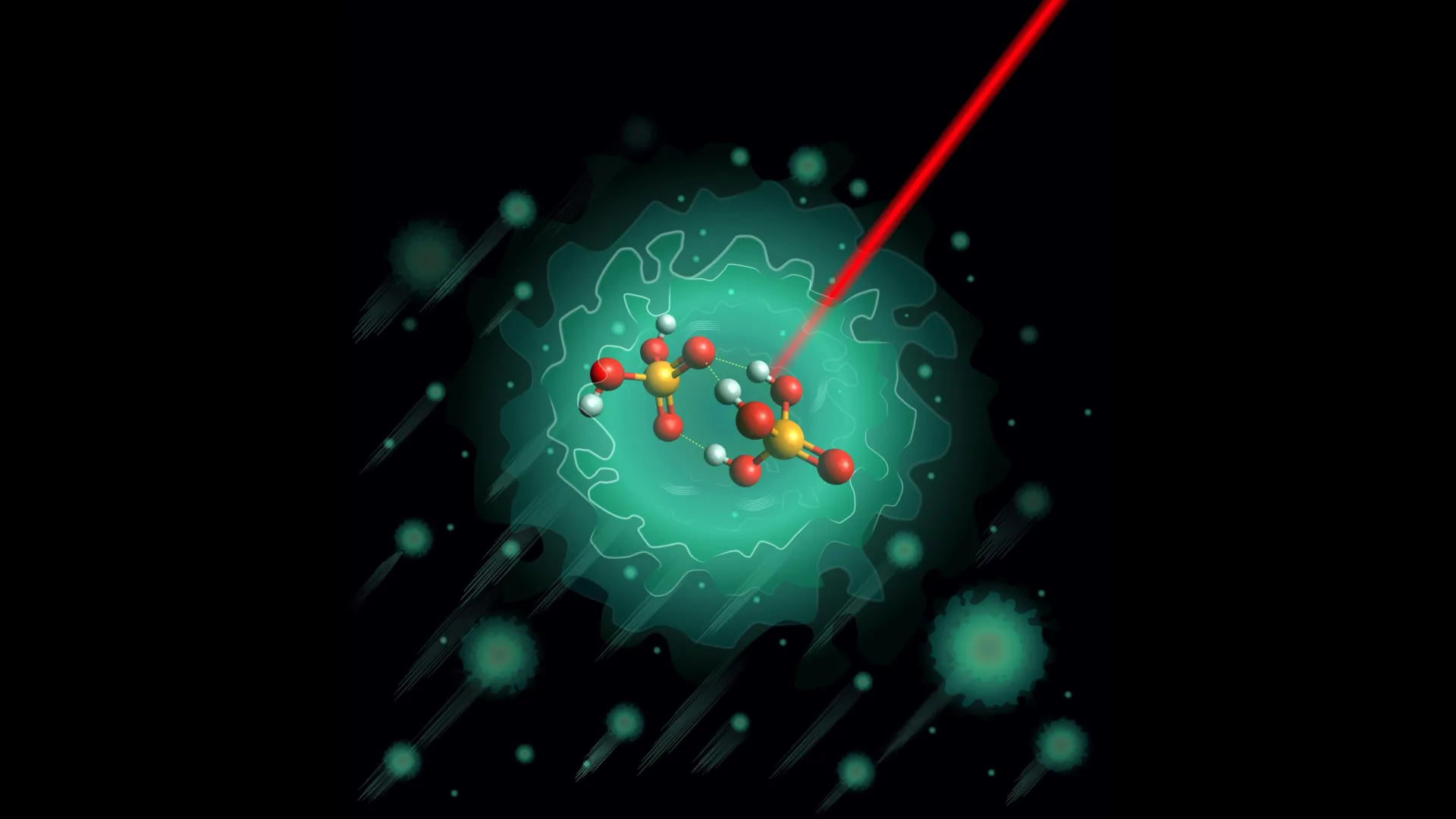
The research team, led by scientists from the Department of Molecular Physics at the Fritz Haber Institute in collaboration with institutions in Leipzig and the United States, focused on understanding how proton-shuttling actually occurs at the molecular level. Rather than traveling freely, protons hop from one molecule to another using hydrogen bonds as pathways, allowing charges to move with remarkable speed and efficiency. Previous research had suggested that the process was initiated by a specific negatively charged molecule known as the deprotonated dimer H3PO4·H2PO4-.
To examine this molecule in unprecedented detail, scientists created it in laboratory conditions and cooled it to just 0.37 degrees above absolute zero using helium nanodroplets. This extreme cooling eliminated unwanted molecular disturbances and allowed researchers to analyze the structure using infrared spectroscopy combined with quantum chemical calculations. The experimental results revealed an unexpected finding that contradicted theoretical models predicting two equally likely molecular structures.
The actual structure discovered by the researchers is relatively rigid and features three hydrogen bonds connected through a shared oxygen atom. This configuration presents high barriers that limit proton movement within the molecule, but the specific arrangement appears to be universal in similar phosphate-containing systems. The discovery helps explain the remarkable efficiency of biological charge transport systems and could lead to the development of new materials for fuel cells, batteries, and other energy storage technologies that rely on controlled proton movement.