Scientists Discover How Universe's Explosive Birth May Emerge From Quantum Gravity
University of Waterloo researchers propose that Big Bang inflation arises naturally from deeper quantum gravity framework, offering testable predictions for future experiments.

Scientists at the University of Waterloo have unveiled a revolutionary approach to understanding how the universe began, proposing that the Big Bang's explosive early expansion may emerge naturally from quantum gravity rather than requiring additional theoretical components. The research, led by Dr. Niayesh Afshordi from the university's Department of Physics and Astronomy and the Perimeter Institute, challenges conventional cosmological models by demonstrating how rapid cosmic inflation could arise directly from a mathematically consistent theory of quantum gravity.
The breakthrough centers on Quadratic Quantum Gravity, a theoretical framework that remains stable even under the extreme energy conditions present during the universe's first moments. Unlike current Big Bang models that rely on Einstein's general relativity supplemented with additional elements to explain observations, this new approach provides a unified picture linking the universe's earliest moments directly to well-tested cosmological models. The framework successfully addresses the mathematical breakdowns that occur when general relativity encounters the quantum-scale physics governing the universe's birth.
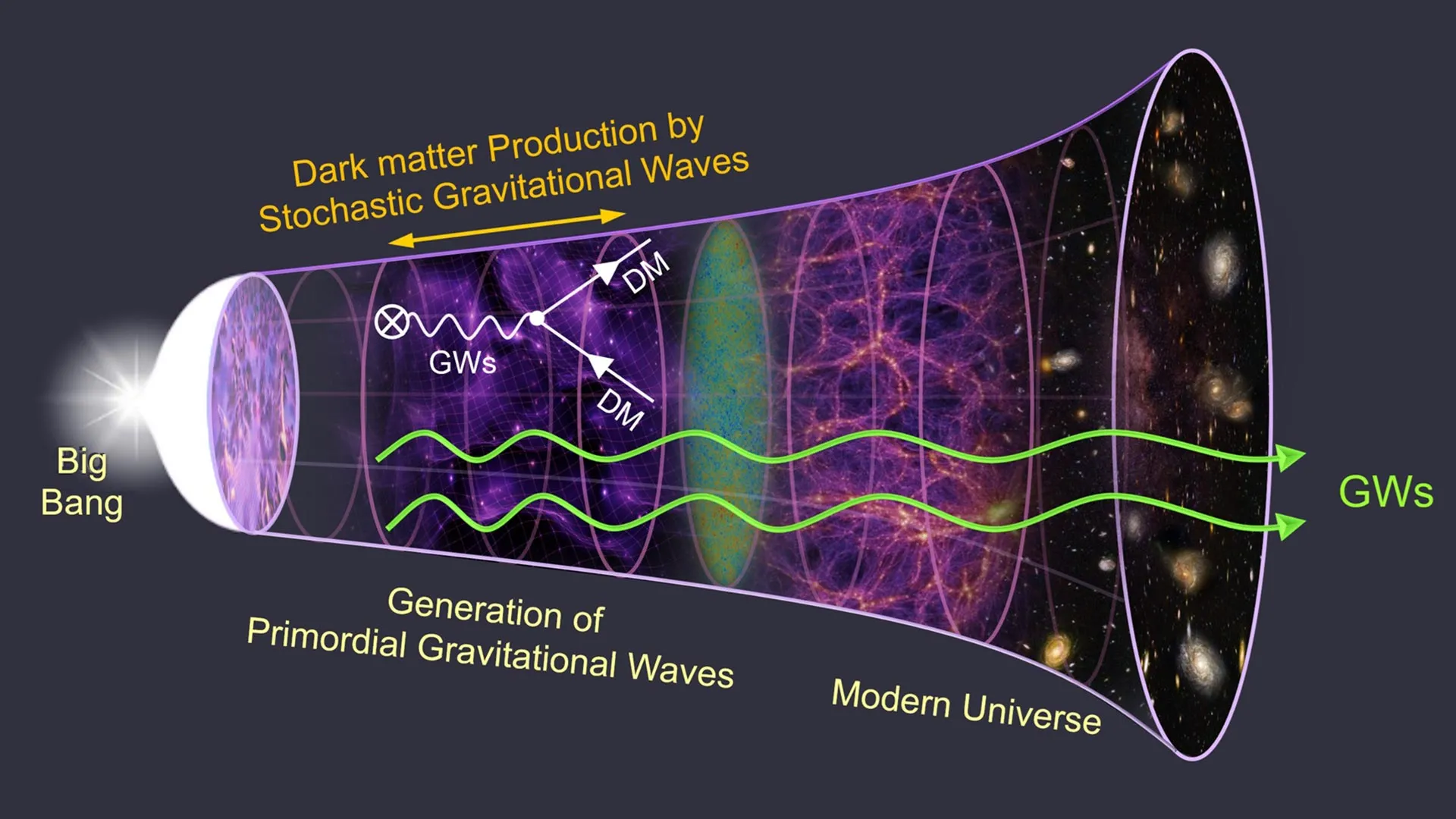
What makes this research particularly significant is its ability to generate testable predictions, a rarity in theoretical cosmology dealing with such extreme conditions. The model predicts a minimum level of primordial gravitational waves—tiny ripples in spacetime created shortly after the Big Bang that future gravitational wave detectors may be able to observe. These signals would provide direct evidence of quantum gravitational effects during the universe's first moments, offering scientists an unprecedented window into the fundamental physics governing cosmic origins.
"This work shows that the universe's explosive early growth can come directly from a deeper theory of gravity itself," Afshordi explained. "Instead of adding new pieces to Einstein's theory, we found that the rapid expansion emerges naturally once gravity is treated in a way that remains consistent at extremely high energies." The approach eliminates the need for exotic forms of matter or energy that previous inflation models required, streamlining our understanding of cosmic evolution.
The timing of this discovery coincides with an era of unprecedented precision in cosmological observations. Advanced instruments including next-generation galaxy surveys, improved cosmic microwave background studies, and increasingly sensitive gravitational wave detectors are reaching the sensitivity levels needed to test theories that were once purely theoretical. The researchers emphasize that their model's direct connection between quantum gravity and observable phenomena represents a crucial step toward empirically validating our understanding of the universe's most fundamental origins.