Scientists Achieve Revolutionary 3D Light Storage With 130% Efficiency Breakthrough
Holographic data storage technique uses light's amplitude, phase, and polarization to dramatically increase storage density while an AI model reconstructs the information.

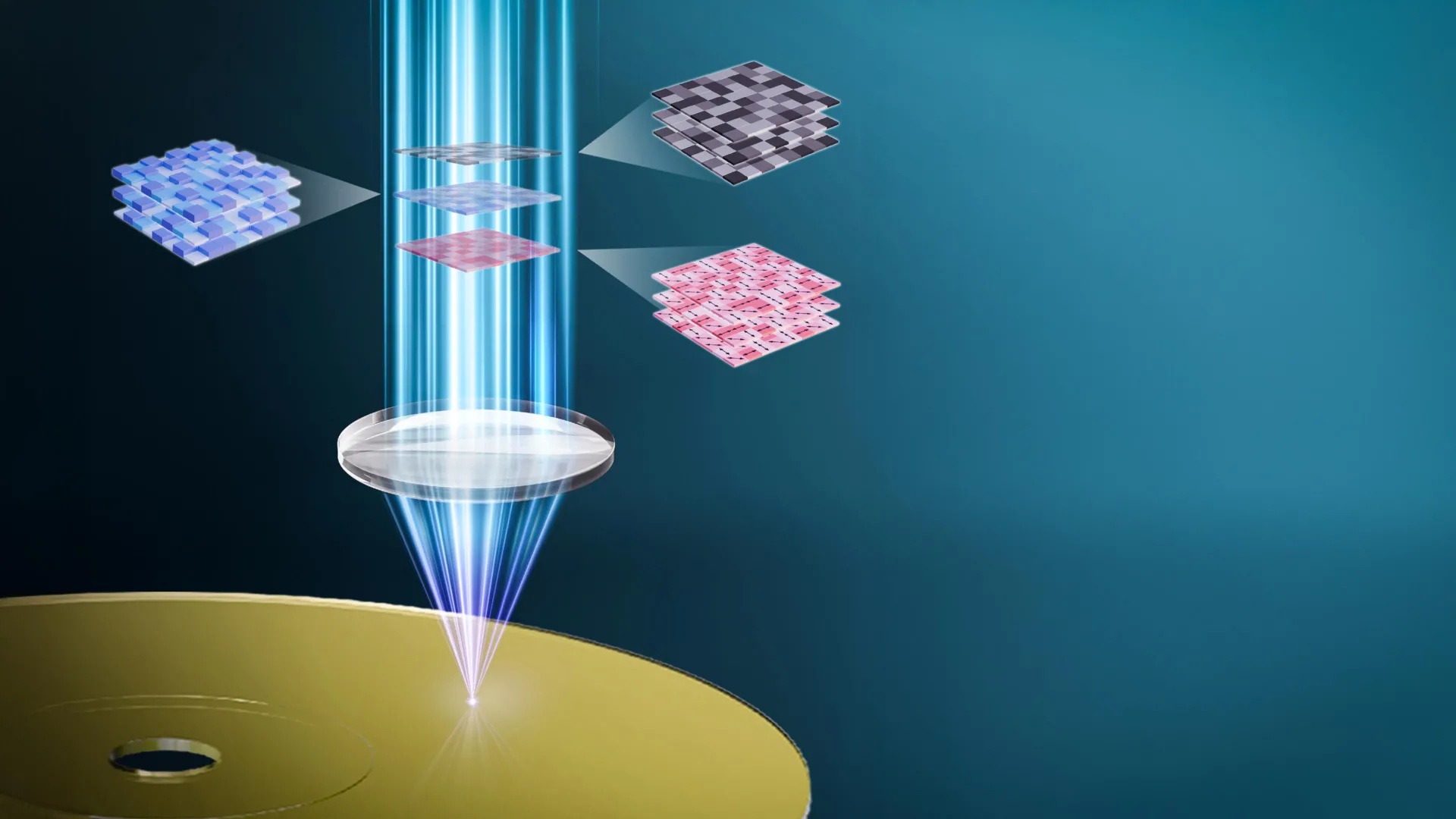
Researchers have developed a groundbreaking holographic data storage method that records and retrieves information in three dimensions by combining three fundamental properties of light: amplitude, phase, and polarization. This innovative approach allows significantly more data to be stored within the same physical space, potentially revolutionizing how the world handles its exponentially growing data storage needs. The technique represents a major advance over traditional storage systems that write data onto flat surfaces like hard drives or optical discs.
The research team, led by Xiaodi Tan from Fujian Normal University in China, published their findings in Optica, demonstrating how their method overcomes longstanding limitations in holographic storage. "In conventional holographic data storage, data encoding typically uses one light dimension such as amplitude or phase alone, or, at most, combines two of these dimensions," Tan explained. "Based on the principle of polarization holography, we used a deep learning architecture known as a convolutional neural network model to enable the use of polarization as an independent information dimension."
The breakthrough relies on a sophisticated technique called tensor-based polarization holography, which preserves the polarization state of light during reconstruction. This makes polarization a dependable channel for storing additional information alongside traditional amplitude and phase encoding. The researchers created a 3D modulation encoding strategy that adjusts the intensity and phase of two perpendicular polarization states while applying a double-phase hologram technique, enabling a single device to encode all three light properties simultaneously in the optical field.
Decoding the multidimensional information presents unique challenges since standard sensors can only measure light intensity and cannot directly detect phase or polarization. To solve this problem, the team developed an artificial intelligence system using convolutional neural networks that can reconstruct the original data from complex light patterns. This AI-driven approach simplifies what would otherwise be an extremely complex decoding process, making the technology potentially viable for commercial applications.
The implications of this research extend far beyond traditional data storage applications. "With further development and commercialization, this type of multidimensional holographic data storage could enable smaller data centers and more efficient large-scale archival storage, while also enhancing data processing and transmission efficiency," Tan noted. The technology could also contribute to safer data transmission, optical encryption, and advanced imaging systems, marking a significant step toward next-generation storage solutions that could handle the world's rapidly expanding digital information needs.